Is your transport information ready to leave the paper pile?
By navichain team



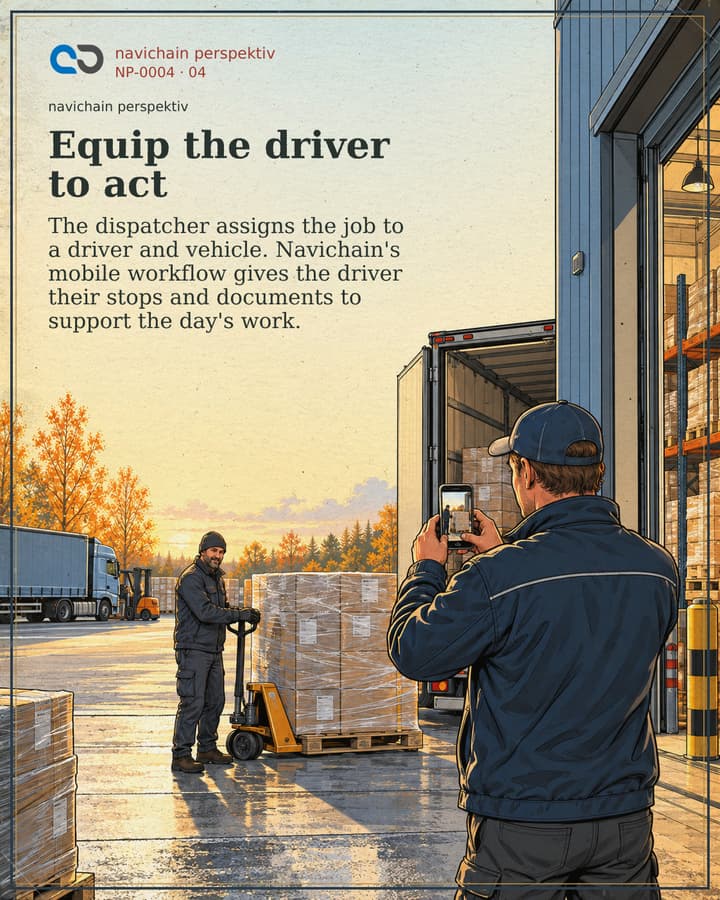
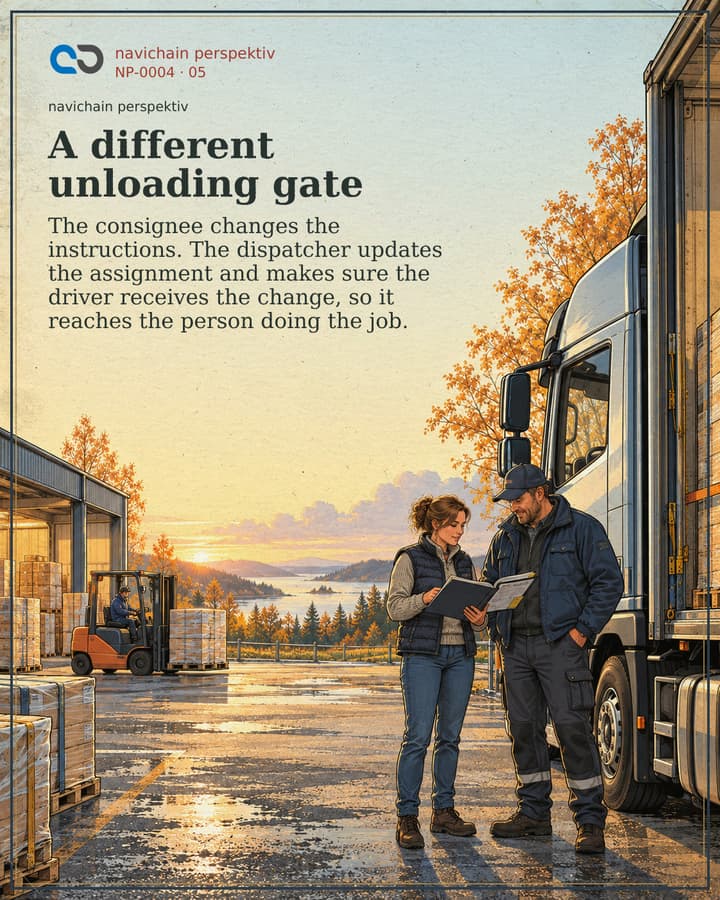
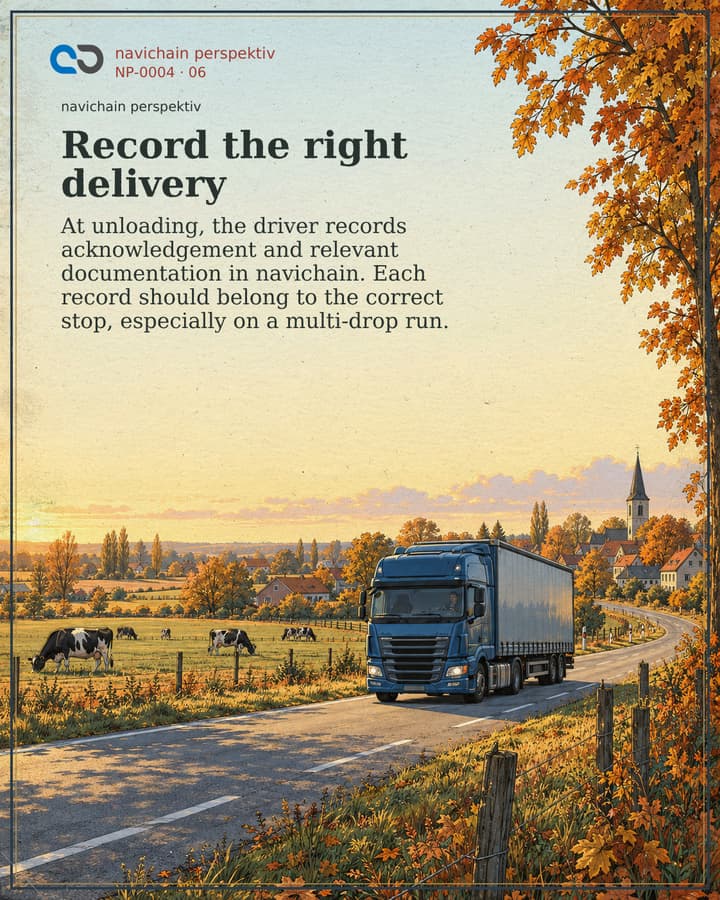
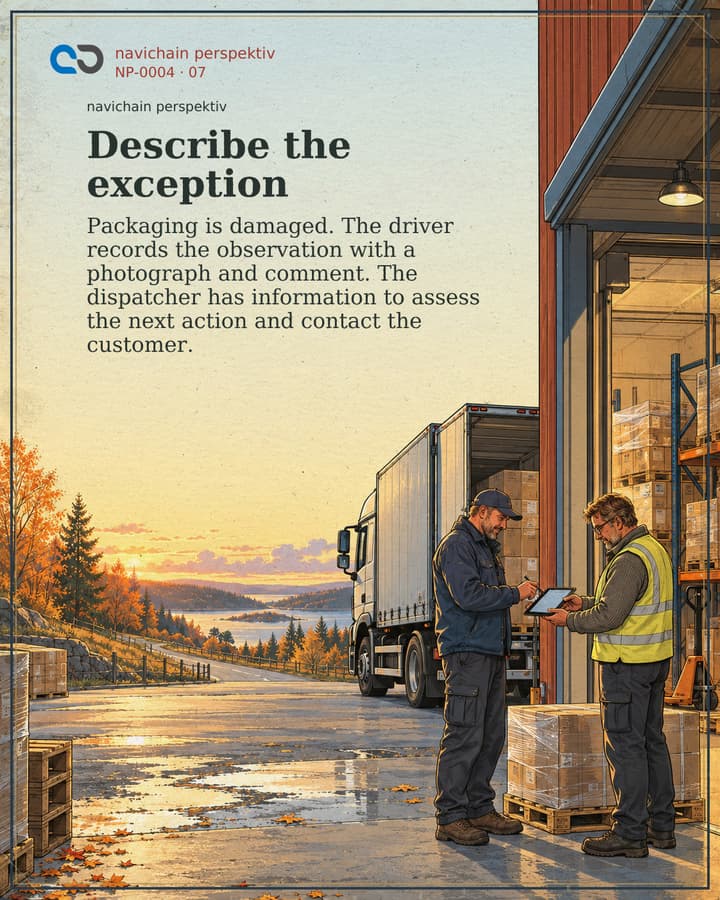



Follow a transport to Rotterdam. See how navichain helps connect bookings, instructions and proof of delivery, so the next person can find the right information.
navichain perspektiv · NP-0004
Summary
Transport information becomes useful when the next person can understand it without calling whoever created it. For a haulier, digitalisation therefore means more than replacing paper with PDFs. A booking needs the right references, a driver needs clear instructions and the office needs to find delivery records when a customer asks. In navichain, dispatchers and drivers can work with bookings, assignments, documents and proof of delivery in a shared workflow. This article follows an illustrative job to Rotterdam and explores how information can stay connected when the consignee changes the unloading instructions. Developments around eFTI also show why structured transport information matters. Start with one recurring operation, assign responsibility for its information and measure how much follow-up work remains.
When the customer asks, the answer should be within reach
It is mid-morning and the truck is unloading outside Rotterdam. The customer wants the receiving reference and proof of delivery. The dispatcher has the booking in one system, a change in an email and a photograph in a message thread. Everything exists, but someone has to put it together. This is an illustrative example, yet the question is practical: how much office time goes into reconstructing something that has already happened?
Start with the connection, not the file format
A scanned consignment note may be easy to send but difficult to use. Without the right reference or connection to the transport, somebody still has to read, interpret and enter the information again. The EU’s DTLF addresses interoperability and data exchange in transport and logistics. 3 For your business, the starting questions are close to daily work: what does the next person need, where will they find it and who corrects it when circumstances change? Establish those answers before building more connections.
Create a booking the team can work from
In our example, a customer books a shipment from Sweden to the Netherlands. The dispatcher checks the sender, consignee, dates, goods and customer reference in navichain. Unclear instructions are resolved before planning. The dispatcher then assigns the work to a driver and vehicle. The dispatcher’s judgement determines how the job should be carried out; the system provides a shared place for its working information. Booking, planning and document support help the team keep the assignment connected across the day’s activities. 1
Make a change useful to the driver
When the consignee changes the unloading gate, the change must travel beyond the inbox of whoever read the email. The dispatcher updates the assignment’s instructions and makes sure the driver has received the change. Include both the new gate and the correct receiving reference. The driver can then connect the instruction to the stop being carried out. Agree a simple rule within the team: whoever receives a change is responsible for keeping the assignment’s information current. A shared system helps when the information is actually brought into it.
Record delivery where the work happens
At unloading, the driver uses the assignment in navichain’s mobile workflow to record delivery with the relevant acknowledgement, photograph and comment. 1 Choose images that answer a question: what was handed over, in what condition and at which event? A photograph of a pallet without context still leaves interpretation for the office. Check that the record belongs to the correct delivery before finishing, especially when the truck has several stops for the same customer.
Keep an exception with the same job
Suppose the consignee points out damaged packaging. The driver describes the observation and records it at delivery. The dispatcher then decides the next action and who will contact the customer. Put the follow-up into a task with an owner, so that the next shift can see what remains. Evidence and action serve different purposes: the photograph records the observation, while the task organises the response. Navichain supports incidents and corrective actions as tasks. 1 A clear description helps the team handle the question without first tracking down the driver.
Give the customer a record they can understand
When the customer comes back, the office can work from the delivery’s collected documentation. Customers can also access their own transport documents and proof of delivery in the customer portal. 1 Agree which references to use and what information is needed for a normal delivery and an exception. Check access with a representative customer organisation. The aim is for the recipient to recognise their transport and understand the event, rather than receive another attachment to sort.
Prepare for eFTI through better underlying information
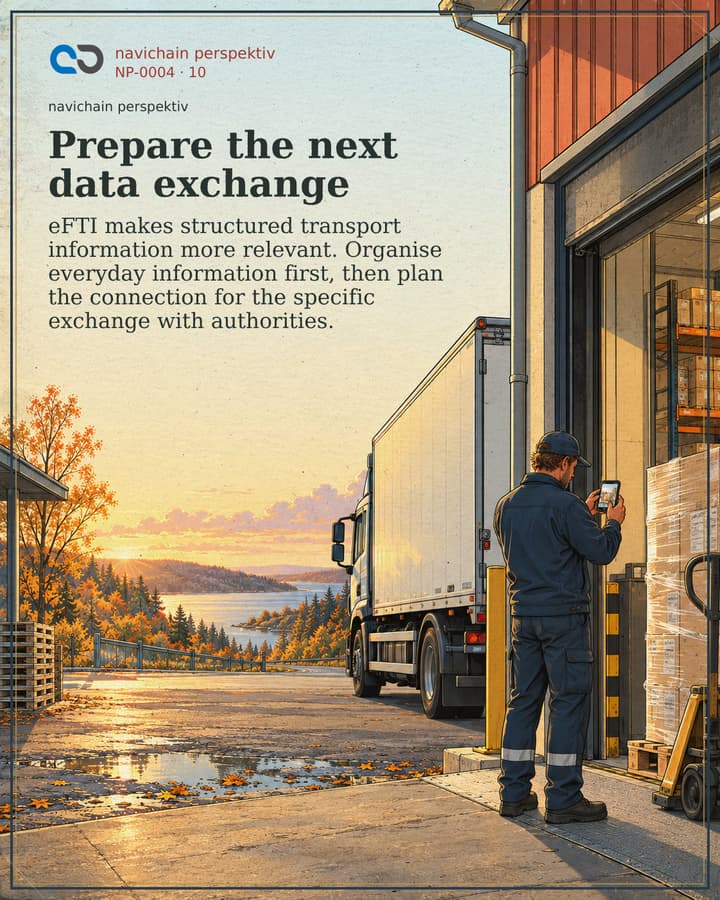
eFTI applies fully from 9 July 2027; electronic acceptance by authorities relies on certified platforms. 2 Prepare two elements: the quality of your transport information and the connection required for regulated information exchange. Map the information already in the booking, what is added during the journey and who supplies missing details. Then choose the arrangements for authority exchange with the parties involved. You can work on the practical benefits of better information today while planning the specific eFTI workflow.
Try one operation and measure follow-up work
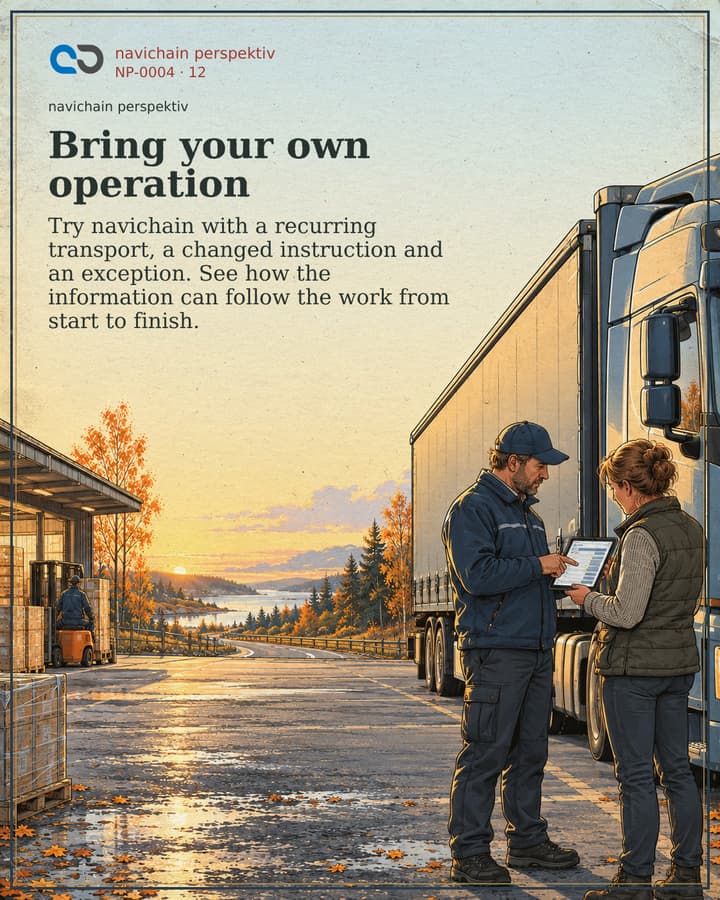
Start with a recurring transport, one dispatcher and one driver. Describe the normal case, a changed instruction and a delivery exception. Agree which information must be ready before the next person takes over. Then track how often the office requests a missing document, the time needed to answer a customer question and the number of deliveries requiring additional information. Compare equivalent jobs before and after the change. Your findings provide a basis for extending the approach to more customers and operations, without assuming a particular saving in advance.
Read also
NP-0006 explores what happens when a delivery deviates. NP-0009 takes the next step: making delivery evidence useful.
- NP-0006 · When delivery deviates
- NP-0009 · Delivery is not complete until the evidence holds
Try it with your next assignment
Create an account and try navichain with a job you know well. Follow its information from booking to acknowledgement and see what the next person needs to carry on.
id.navichain.se · navichain.se
Sources
- navichain: bookings, documents, driver app and customer portal · Accessed: 2026-09-08
- European Commission: the eFTI Regulation · Accessed: 2026-09-08
- European Commission: Digital Transport and Logistics Forum · Accessed: 2026-09-08