Multi-stop tours: what your consignment paperwork must not flatten
By navichain team
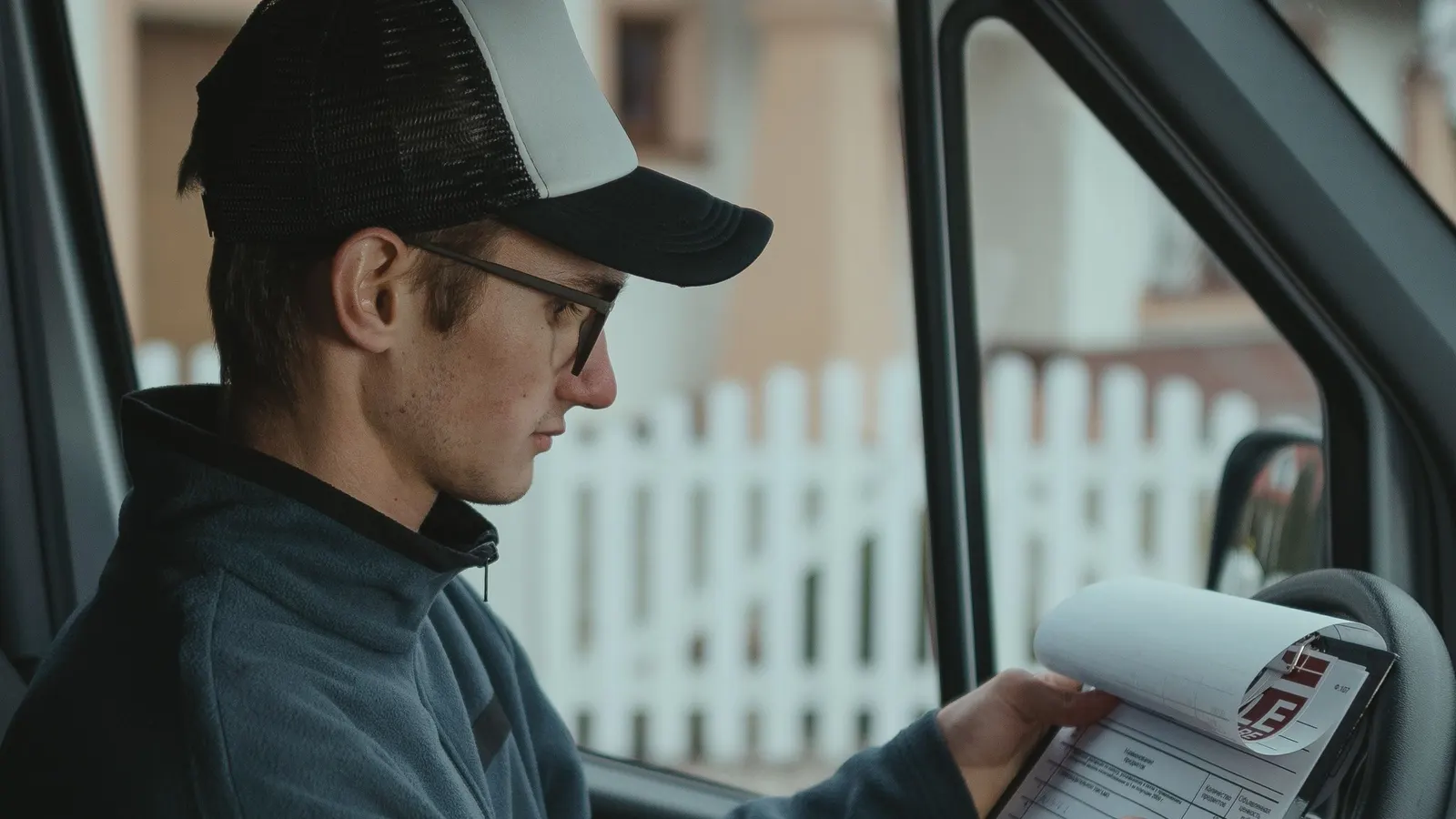
A distribution tour looks like one thing. One vehicle, one driver, one day, one line on the planning board. It is entirely reasonable for a dispatcher to think of it as a single job, because operationally that is exactly what it is.
The paperwork is not one thing, and the gap between those two facts is where a surprising amount of trouble lives. A tour with three deliveries is three consignments that happen to share a vehicle. Each has its own consignee, its own goods, its own moment of handover and its own opportunity to go wrong. Software that models it as one booking with three addresses flattens a distinction the law makes, the driver needs and your claims file depends on.
What the convention keeps separate
The CMR Convention is specific about this, and the wording is worth reading rather than paraphrasing.
Article 6.1(d) requires the consignment note to state “the place and the date of taking over of the goods and the place designated for delivery” — singular. Article 6.1(e) requires “the name and address of the consignee”, also singular. A note listing three consignees and three delivery places is not the document the article describes.
Article 5.1 explains why that matters practically: the note is made out in three original copies — the first handed to the sender, the second accompanies the goods, the third retained by the carrier. Article 13.1 then gives the consignee the right, after arrival, to require the carrier to deliver “against a receipt, the second copy of the consignment note and the goods”.
Follow that through on a three-drop tour with one note. The first consignee exercises a right the convention gives them and takes the copy that is supposed to accompany the goods. Drops two and three now travel with nothing — or the carrier refuses the first consignee the copy they are entitled to. There is no arrangement of a single note that satisfies both, which is the clearest sign that one note was never the right shape.
The convention anticipates division elsewhere too. Article 5.2 gives either the sender or the carrier the right to require a separate consignment note “for each vehicle used, or for each kind or lot of goods” where goods are loaded in different vehicles, are of different kinds, or are divided into different lots. And Article 9 makes the note “prima facie evidence of the making of the contract of carriage, the conditions of the contract and the receipt of the goods by the carrier” — evidence that has to be legible for one contract at a time to be worth anything in a dispute.
Three places flattening bites
The consignment note
The obvious one, per the above: one note per place of delivery, each naming its own consignee, its own goods and its own charges. A system that prints a single document for a multi-drop tour is describing the carriage inaccurately, and it does so at exactly the moment the description becomes evidence.
What the driver is shown at each stop
A driver at drop two needs to know what leaves the vehicle here — and, just as importantly, what does not. Show them the whole booking and two failure modes open up at once. Goods for drop three come off the tail lift because they were on the list, which is a claim. Or the driver, unable to reconcile a list against a pallet, waves it through and signs for the tour rather than the delivery, which is a claim you cannot defend.
A per-stop manifest is not a nicety. It is the difference between a driver confirming something specific and a driver confirming something vague.
Proof of delivery and, more importantly, failure
A signature is evidence that this consignee received these goods at this time. One signature captured at the end of a tour is not evidence of three deliveries; it is evidence of one event whose relationship to the other two you would have to reconstruct from memory.
Failure is the sharper case. A refused or partial delivery at drop two is a normal operational event with its own reason, its own goods still on the vehicle and its own conversation with a customer. In a flattened model there is nowhere to record it — the booking is either delivered or it is not, so either the tour goes red because one drop failed, or the failure is recorded as a note nobody bills against and nobody follows up.
What legitimately does belong to the whole tour
The correction is not “make every drop a separate booking”. Plenty about a tour genuinely is singular, and splitting it destroys real information: the route and its sequence, the vehicle, the driver, driving hours, fuel, tolls, and the simple fact that these consignments share a deck and therefore compete for the same space and the same day. Three unrelated bookings lose all of that, and you will rebuild it badly in a spreadsheet.
What you want is one tour whose stops each carry their own consignment identity — a structure where “which vehicle” and “whose goods” are separate questions with separate answers, rather than one answer forced to serve both.
A ten-minute test on your own system
You do not need a vendor demo to find out where you stand. Take a real three-drop booking and try four things:
- Print the paperwork. Count the consignment notes. One is the finding.
- Open the driver app at stop two. Does it list only what comes off there, or the whole load?
- Fail one delivery. Can you record a reason against that stop alone, leaving the others unaffected — and do the goods stay accounted for on the vehicle?
- Look at the delivered timestamps. Three drops should have three, at three different times, each with its own signature.
Most systems that fail this are not badly built. They started with one pickup and one delivery, which is the honest majority of freight, and grew extra addresses when customers asked for them. The addresses arrived; the documents, the manifests and the status model did not follow. That history is why the symptom is usually silent — nothing errors, the tour completes, and the flattening only surfaces when a consignee disputes a delivery you cannot separately evidence.
Where navichain fits
navichain treats a multi-drop booking as stops that keep their own paperwork: a multi-drop booking produces one note per delivery, each naming its own consignee, issued to the CMR Convention (Geneva 1956). Drivers get today’s stops with per-stop cargo manifests, and signatures, photos and failed-delivery reasons are captured on the spot — sealed, hashed and timestamped. Groupage, multi-drop and hub leg-splitting each carry their own paperwork rather than borrowing one booking’s. If you are also weighing what July 2027 changes for electronic notes, we wrote that up separately in eCMR and eFTI; the platform page shows the rest of what is in the box, and all features are on every plan from 995 kr a month.