The empty kilometre: why backhauls are a planning problem, not a sales problem
By navichain team
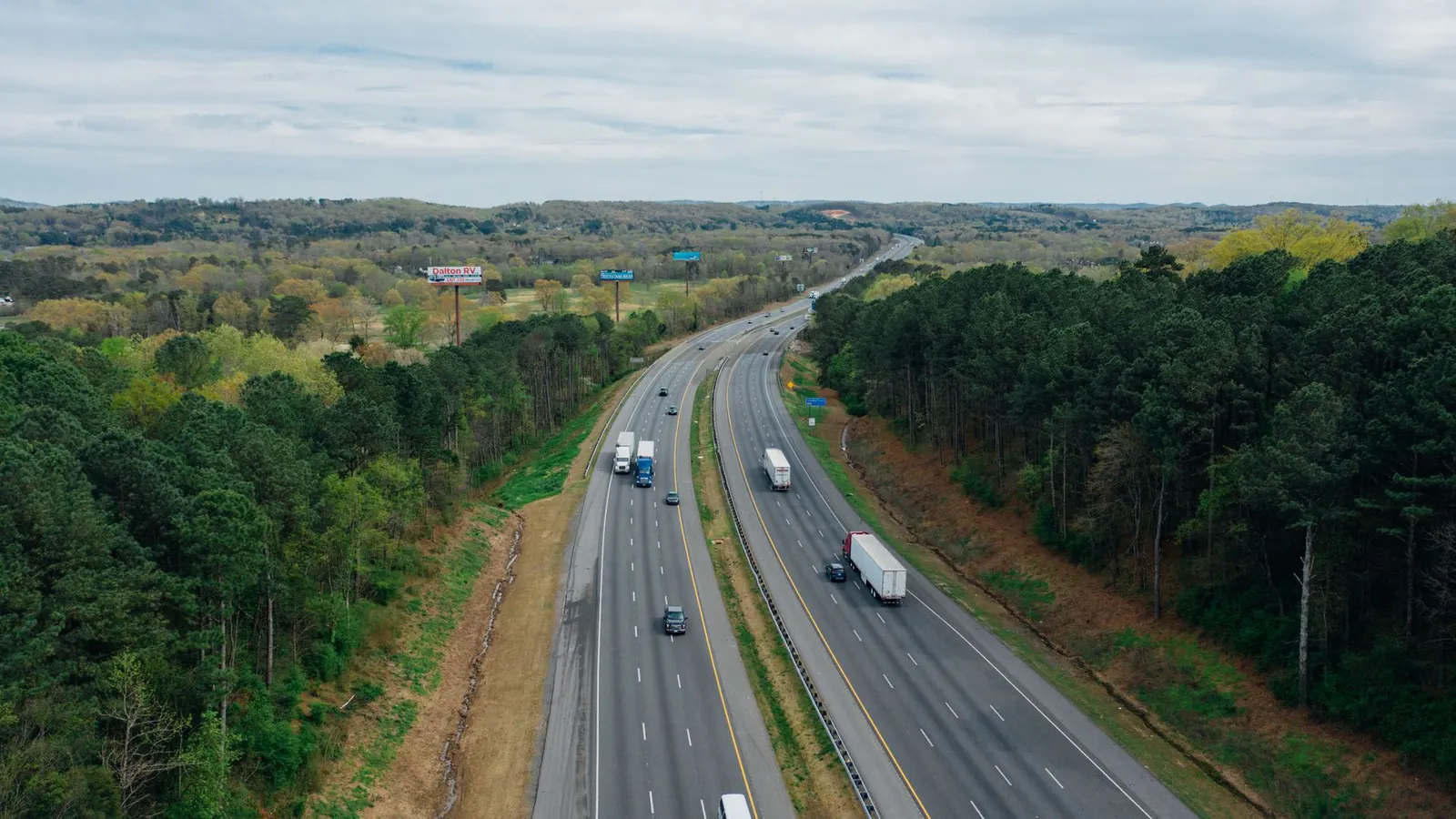
In 2024, 21.6 % of the distance covered by road freight vehicles in the EU was
driven empty. Split by journey type the number breaks in a way worth pausing
over: 25.8 % of national vehicle-kilometres were run empty, against 12.6 % of
international ones
(Eurostat, Road freight transport by journey characteristics, dataset
road_go_ta_tott).
International work is longer, planned further ahead, and worth more effort per journey. Domestic work is short, repetitive, and often planned in the last hour before it happens. That is not proof of anything on its own — domestic geography and cargo mix differ too — but it does suggest the gap is not purely a story about who is offering freight.
The sales framing, and why it sticks
Ask most operations managers what to do about empty running and the answer is commercial: find return freight. Post the lane on a freight exchange, ring the two forwarders you know in that region, accept a rate you would refuse outbound, because a poor rate beats an empty trailer.
None of that is wrong. It is the second half of the job, and it usually starts too late. By the time a vehicle is being advertised for a return load, the outbound run is planned, assigned and fixed in time — so the return load has to fit around a plan nobody can move any more. The search space is at its smallest exactly when the search begins.
The leg you cannot see is the leg you cannot fill
The mechanical problem is simpler than it sounds. A run is planned as a sequence of stops: collect in Jönköping, deliver in Hamburg. What actually happens is three legs — Jönköping to Hamburg loaded, and then Hamburg back towards base empty. That third leg is on the fuel bill and in the driver’s hours, but it is not a row in most systems. It is the blank space after the last stop.
You cannot place a load into a leg your planning surface does not draw. That is most of the problem, and it is a display problem before it is a commercial one.
The timing follows from it. A booking that arrives on Tuesday for a Friday collection to Hamburg is also, at that same moment, an announcement that a vehicle will be empty in northern Germany on Friday evening. A planner who can see the trailing empty leg while the booking is still being entered has three days of inbound enquiries to place into it — and can say yes to a marginal return load on Wednesday instead of hunting one on Friday.
What may actually ride together
The honest part of this argument is that a visible empty leg is not the same as a fillable one. A return load has to survive several constraints, and each of them is a real reason a plausible pairing turns out not to be loadable:
- Cargo compatibility. Foodstuffs, live animals, pharmaceuticals and certain chemicals have contamination and odour-transfer rules that keep them apart regardless of available space.
- ADR segregation. Dangerous goods carry class and division rules governing what may travel with what, and in what quantity. This is not advisory; it is the kind of thing a roadside check ends badly over.
- Equipment and certification. A reefer, a tail lift, a crane, ADR certification for both vehicle and driver, a tanker’s last cleaning certificate — available space says nothing about any of these.
- Weight and volume, in that order. Two loads that fit by cubic metres can still put you over a permitted axle load. Volume is the constraint people check; weight distribution is the one that stops you at a weighbridge.
- Hours and windows. A collection two hours after the last delivery may be physically possible and still fall outside the driver’s remaining hours, or outside the shipper’s receiving window.
A planner establishes most of this by reading two bookings carefully. A system can establish it before the pairing is ever offered.
A backhaul is not a co-load
There is a distinction here that decides whether an automated check is useful or merely noisy. On a genuine backhaul, the two loads never share the vehicle. The outbound cargo is delivered — that delivery is precisely what made the leg empty — and the return load is collected afterwards.
So a system that checks compatibility by comparing every booking on a run against every other booking on that run will refuse the pairing, and be wrong. It will tell a planner that a food consignment cannot travel with a chemical consignment that came off the trailer four hours and two hundred kilometres earlier.
The correct reasoning is over the stop sequence, not the booking list: walk the stops in order, a collection puts goods aboard, a completed delivery takes them off, and only loads whose on-board periods actually overlap can conflict. The same reasoning gives the right answer for the harder case too — a load inserted into a gap in the middle of a tour, where the new cargo genuinely does ride alongside goods collected earlier. A flat list cannot tell those two situations apart; the sequence can.
Two things should stay sequence-blind on purpose. Vehicle equipment is one: a reefer, a tail lift or ADR certification is needed by whatever the truck carries at any point in the tour, so an unequipped vehicle must be refused even for a load it picks up last. A failed delivery is the other — if the goods did not come off, they are still aboard, whatever the plan said. And where the sequence cannot answer a question, the safe move is to widen the comparison, not narrow it. Narrowing is what silently switches a warning off.
What planning does not fix
Some empty running is not a planning failure, and no amount of visibility will change it. A region that exports nothing you are equipped to carry produces empty legs for structural reasons. A return load ninety kilometres off the path may cost more in fuel, tolls and hours than it earns. Repositioning a trailer to where next week’s work starts is empty running that is simply correct. And better visibility improves your odds of saying yes in time; it does not improve the rate you are offered.
So the realistic claim is narrower than the marketing one. Better planning visibility converts the fillable legs you currently miss because nobody saw them early enough to act on them. At roughly a fifth of all vehicle-kilometres, that subset is worth pursuing. It is not a route to zero, and anyone selling it as one has not driven the lanes.
What to measure first
Before changing anything, get three numbers: empty vehicle-kilometres as a share of your total, per vehicle and per lane; how far ahead of departure your return loads are typically confirmed; and how many candidate return loads were rejected for compatibility or equipment reasons rather than commercial ones. The first sizes the prize, the second tells you whether this is a visibility problem for you specifically or a genuine demand problem, and the third tells you whether your constraint rules do useful work or are merely coarse.
Where navichain fits
navichain treats this as planning rather than sales: a dispatch board and a planning sheet for the shapes each planner prefers, every truck and trailer on one live map, and routes judged against real limits — driver hours, vehicle class, delivery windows. When you drag a booking onto a truck the system flags what will not fit before you commit, and a load that must not ride with the one already aboard is refused rather than warned about, with ADR classification, segregation and certification handled as rules instead of reminders. Consolidation and hub routing cover loads that change vehicle mid-journey. What it will not do is sell you freight — no system does — so judge it on whether your planners can see the empty leg in time to act. Every feature is on every plan, from 995 kr a month, with the driver app included and an isolated EU database per customer; the details are on the pricing page and the platform page, and if you are still choosing a system, our TMS buying checklist covers the rest.