Right part. Right van. Job done.
By navichain team







A technician can arrive on time and still have made a wasted journey. A successful service job starts well before the customer visit: with clear instructions, available parts and a material flow that reaches the place where the work will be done.
Summary
For a service business with a workshop and field technicians, planning must cover both people and materials. A part on a workshop shelf is little help to someone already at the customer’s site. Stock in a service van must also be distinguished from material reserved for another job. navichain provides work orders, workshops and spare parts alongside transport planning, purchasing and warehouse management. These are building blocks for coordinating the practical requirements of service work. This article follows a hypothetical job from fault report to completion, explaining why external purchasing, internal material requests, stock transfers and actual consumption need separate treatment. It also explains how a van-stock arrangement should be designed and tried with the business. The aim is clearer customer commitments, less searching and a working day in which more people know what happens next.
This is the background article for navichain perspektiv NP-0086.
The customer orders an outcome
A customer reporting a fault wants equipment working again. For the service company, that means understanding the fault, selecting the right skills, arranging parts, planning travel, doing the work and explaining the result. Service fulfilment means delivering that whole outcome.
The workshop and field team often share limited resources. A valve intended for scheduled workshop work may also solve an urgent customer fault. If both plans depend on the same physical item without an allocation decision, the business has made a promise it cannot keep.
Location and use are different things. Putting a part in a van does not mean it has been consumed. A supplier’s order confirmation is not a goods receipt. A reserved part is not automatically available for the next job.
Keep the identity through every handover
Traceability depends on identifying objects and locations, recording events and sharing the information between those involved. These are also the foundations of GS1’s traceability model. For service operations, the practical lesson is to preserve the identity of the item, its location and its intended job as material moves. 3
Not every internal movement needs a transport booking. Decide which events belong in stock records, which belong to the work order and when a separate transport is needed. Clear responsibilities are more useful than entering the same event twice.
What navichain contributes
navichain work orders include assets, assignees, workshops, priorities, dates, instructions, parts, estimated and actual time and cost. The TMS handles transport bookings, runs and transport planning. Warehouse functions cover articles, purchase orders, balances and stock movements. 1 2
Use each part for its purpose. The work order describes the equipment work; inventory records describe material availability and movement; transport planning describes a journey. A delivered part is not automatically a completed repair.
| Work | Responsible role | Information needed | Useful handover | | Service planning | Service manager | Equipment, fault, priority, instructions, assignee | A defined job to prepare | | Material check | Storekeeper | Item, quantity, location, reservations | What can actually be used | | External purchase | Buyer | Supplier, item, quantity, delivery terms | An order whose receipt can be followed | | Internal request | Technician or supervisor | Need, destination, intended job | A clear material issue request | | Movement | Warehouse staff and, when needed, transport planner | Origin, destination, quantity, time | Material in place and a recorded event | | Completion | Technician and service manager | Work done, actual time, parts, remaining faults | A result and follow-up information |
This is an implementation responsibility model, not a claim that each handover is automated or has a dedicated system function.
One valve, two jobs and a customer promise
This is a hypothetical working example, not a customer case or measured result. A pump service company has a workshop and several vans. A pump is awaiting scheduled work when a customer calls about an on-site breakdown. Technician Sara is assigned, but the manager first needs to establish which valve and seals are required.
1. Make the job possible to prepare
The service manager describes the equipment, fault, priority and instructions. navichain work orders support an assignee, parts, workshop and timing information, giving the preparation a defined focus. 1
Before leaving, Sara needs to know what equipment is involved, what the customer observed, what tools and parts to check, and when to consult her manager. These questions matter more than simply labelling a task urgent. For customer-owned equipment, agree how the customer, asset, location and work order are represented and what completion information the customer receives.
2. Separate stock from what can be promised
The storekeeper checks the valve and quantity. navichain distinguishes on-hand, on-order, reserved and available stock by article and warehouse, with reserve and release actions. 1
Two valves are present, but one is intended for the workshop job. The manager decides whether the other goes to Sara, whether to reprioritise or whether to buy more. The figures support the decision; the person accountable for the commitments makes it. A note saying “for Sara” must not be confused with an actual stock reservation.
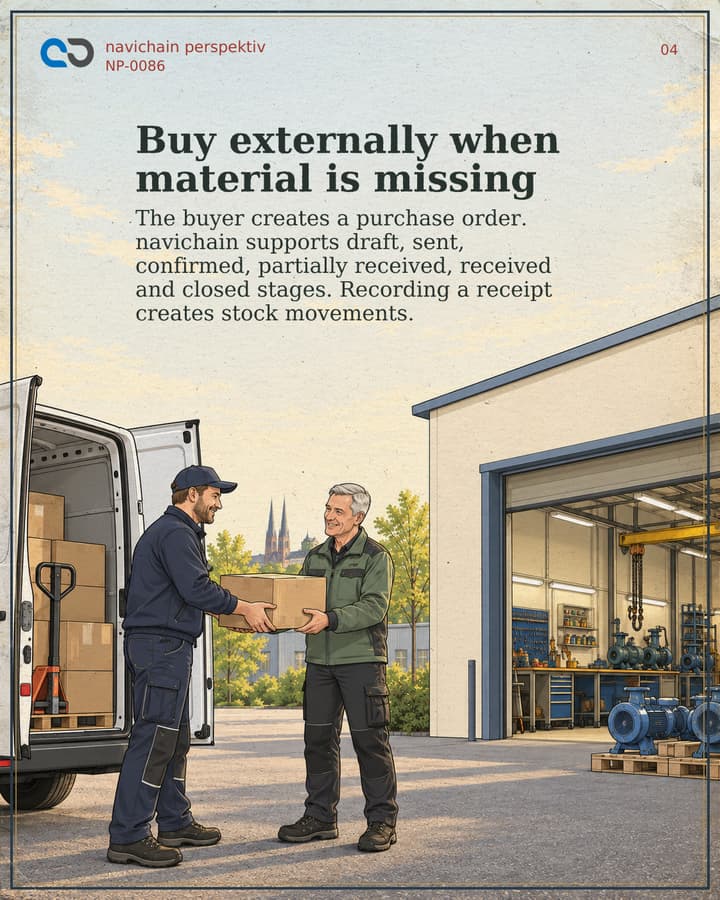
3. Buy externally when material is missing
The buyer creates a purchase order. navichain supports draft, sent, confirmed, partially received, received and closed stages. Recording a receipt creates stock movements. 1
A sent order is different from a checked delivery. The buyer follows supplier commitments, while receiving staff compare the goods with the order and record the actual quantity. In the example, the valve arrives but some seals do not. The manager checks whether the available material permits an initial repair and gives a realistic customer update before Sara leaves.
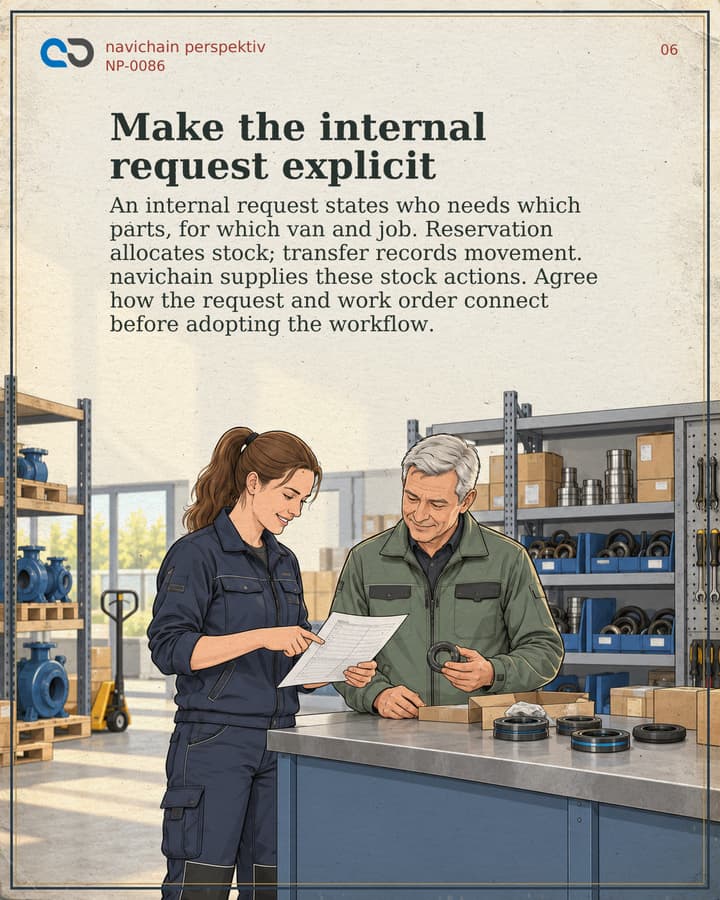
4. Make the internal request explicit
An internal requisition is the business asking itself for material: for example, two seals from workshop stock to Sara’s van for this job. It should state requester, item, quantity, destination, required time and intended job.
The request expresses a need; a reservation allocates stock; a transfer records movement; consumption records what was used. An external purchase additionally involves a supplier as the contracting party. An internal request does not itself create a new supplier transaction.
navichain has stock reservation and transfer actions. During implementation, work through how the internal request links to those actions and the service job. Decide who approves shortages, quantity changes or substitute items. 1
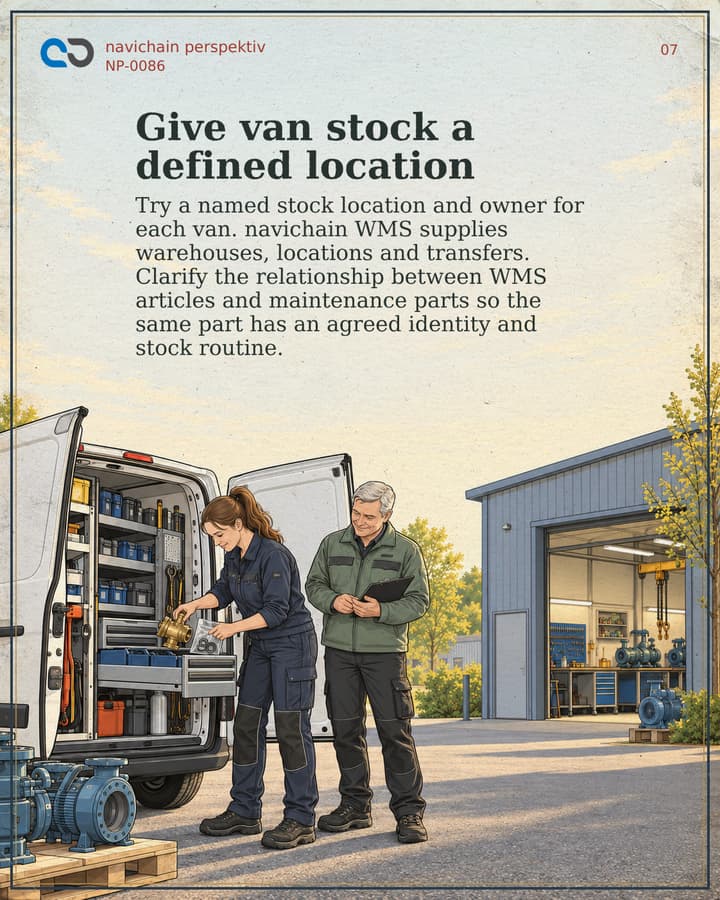
5. Give van stock a defined location
The arrangement should distinguish material in the workshop, in each van and already used. Start with a named warehouse or location for each van, an owner and a consistent receipt and issue routine. Try the concrete model against the business’s needs.
navichain WMS provides warehouses, locations and transfers as building blocks. Also clarify the relationship between WMS articles and maintenance parts, described as separate registers in the documentation. Establish item identity and stock handling before using the same part in both workflows. 1
The storekeeper hands material to Sara. The team must be able to establish what she actually received and what remains for the workshop job. Loading the van must not be treated as installation at the customer’s site.
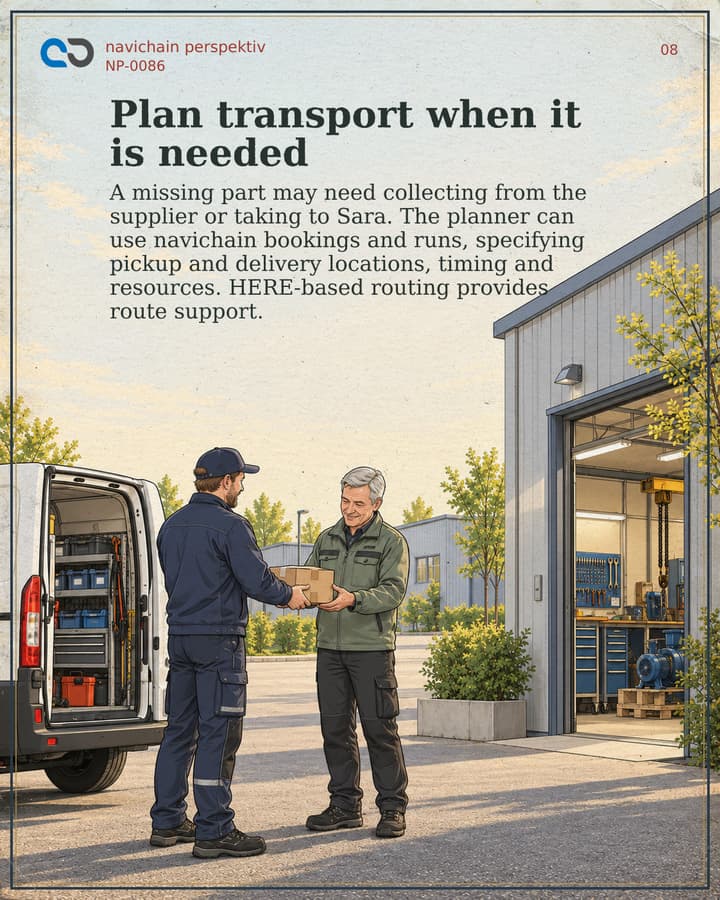
6. Plan transport when it is needed
A missing part may need collecting from the supplier or taking to Sara. The planner can use navichain bookings and runs, specifying pickup and delivery locations, timing and resources. HERE-based routing provides route support. 2
Sara may then continue preparing while someone else collects the part. This is an explicit planning decision, not a claim that a work order selects a carrier, books collection or optimises skills and material availability automatically. TMS is also useful for collecting equipment for the workshop, delivering a replacement unit or coordinating several material deliveries. Delivery status remains distinct from repair status.
7. Record the work and reconcile what remains
Sara records the work and actual work-order information. navichain supports estimated and actual time and cost, together with parts. The manager reviews the result and outstanding work. 1
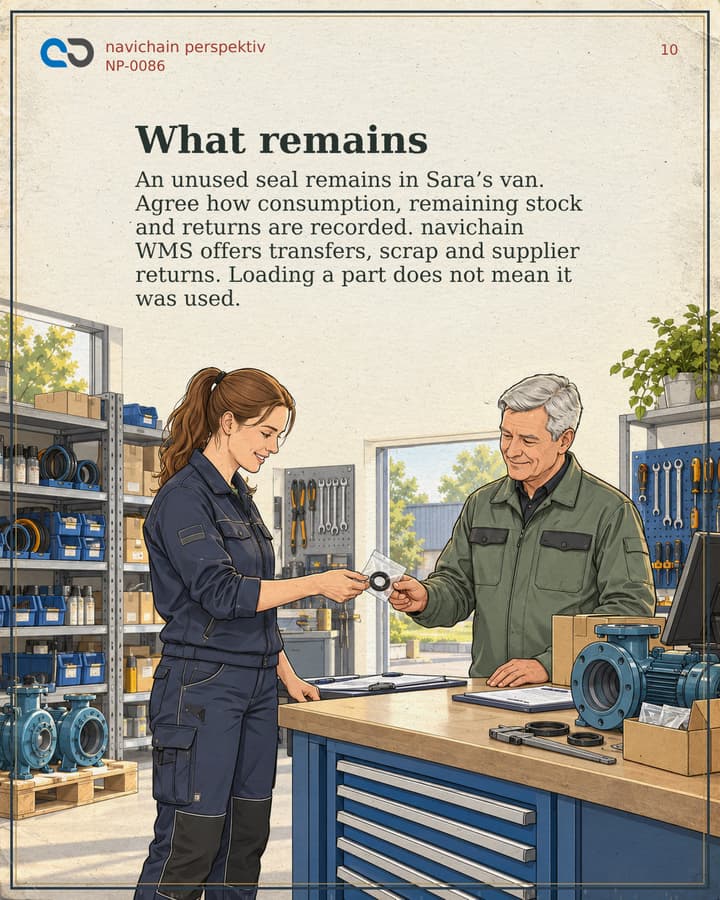
Reconcile material using the agreed procedure. An unused seal may remain in van stock or return to the workshop. A damaged part may need an exception, scrap or supplier return. WMS provides transfer, scrap and supplier-return actions. 1
Reusable tools need different treatment from consumed seals. A customer’s pump held for repair is also different from the company’s own parts: navichain distinguishes customer goods in custody from owned inventory. That matters for responsibility and valuation. 1
Make changes actionable
If Sara finds a further fault, the manager decides on scope, customer approval and material needs. The storekeeper checks availability, the buyer arranges any purchase, and the planner organises transport if needed.
A useful exception record answers four questions: what happened, which job is affected, who acts next and what has the customer been told? navichain tasks and documents can support collaboration, while responsibility remains explicitly assigned. 2 Customer satisfaction also depends on a credible revised commitment when the repair is larger than expected.
Measure where the friction occurs
Compare results with a baseline using consistent definitions. Separate material-related repeat visits from other causes.
| Measure | Definition | What it reveals | | First-visit completion | Jobs completed on the first visit / completed field jobs | Preparation quality | | Material-related repeat visits | Repeat visits attributed to missing or wrong parts | Supply weaknesses | | Material ready before departure | Planned jobs with checked material before departure / planned jobs | Whether booked time is deliverable | | Stock accuracy | Counted item-locations without discrepancies / counted item-locations | Whether stock can be trusted | | Completion-record lead time | Time from work performed to complete work record | Administrative delay | | Customer commitments met | Jobs within agreed time / jobs with agreed time | Operational reliability |
These are suggested business measures, not promises of standard reports or particular savings. Start with a few measures the team can record consistently.
Peace of mind means less guessing
For the technician, reassurance means a clear job and checked material. For the storekeeper, it means responsibility for issues, movements and returns. For the buyer, it means distinguishing ordered from received. For the manager, it means following the customer commitment through the work.
The customer sees the difference in the result and the explanation: what will be done, when and what remains? The aim is to handle exceptions with less searching and fewer conflicting accounts, not to promise that exceptions disappear.
Start with a real job
Choose representative equipment, a workshop job and a field job. Review work orders, parts, locations, external purchases, internal requests, transfers and reporting with the people doing the work. Include partial receipt, a shortage and a return. Check identities, available stock, responsibility and manual steps.
If you retain an existing service or accounting system, specify connections and data ownership for your environment. Start with a limited operation, measure the outcome and then expand.
Try it today! Start free. Bring your own service workflow to a discussion of how navichain fits your business.
Create an account · Visit navichain
Related reading
NP-0022 — The haulier that became a warehouse. A related perspective on operations that also need inventory management. The connection is material location and responsibility between working stages. Its local article and published address are not included here.
Sources
1. navichain documentation, 26 August 2026. Application and help review: work orders, parts, suppliers, purchase orders, warehouses, balances, movements and customer goods. Supports the specific functions described; available through navichain during a workflow review.
2. navichain documentation, 29 August 2026. Bookings, runs, transport planning, maintenance, documents, tasks and HERE-based routing. Supports the overall scope of these functions.
3. GS1, Global Traceability Standard. Identification, capture and sharing of traceability information. Accessed 8 September 2026. Read the standard. This is a traceability reference, not a description of navichain implementation.