Hired with confidence. Ready for the next job.
By navichain team






Booked equipment needs to be available, complete and ready when the customer needs it. It must reach the right place, be hired on clear terms and return through a controlled process. A coordinated way of working around navichain connects the customer promise to everyday operations and prepares the next hire.
Summary
Equipment hire brings together warehousing, service and transport. The customer’s order therefore needs to remain connected from equipment availability and an agreed price through delivery, use, collection and inspection. navichain supports transport bookings, runs, planning and maintenance with work orders, equipment and parts. For the rental transaction, the hire order is a booking assigned to a run, which may represent a trip or a job. The rental item is allocated to that run as an asset. A service with a defined price per time unit provides the charge for the allocated and utilised rental period; the booking can then be invoiced. Suitable connected GPS equipment can complement the operational picture. Clear handovers between customer service, the depot, drivers, purchasing and the workshop help people give reliable answers and manage changes while protecting the next delivery.
This is the background article for navichain perspektiv NP-0088.
The customer hires the ability to get work done
A customer ordering an access platform needs to complete a task at a particular time. The wrong platform, missing accessories or a missed unloading slot can make an otherwise correct booking useless. Fulfilment consequently covers the whole commitment: promise, preparation, delivery, use and return.
Sales needs to know what it can promise. The depot needs to know what to prepare. The planner needs to organise the movements. The workshop needs time and parts to restore equipment. Purchasing needs to distinguish a temporary shortage from a recurring capacity problem.
ERA discusses rental processes, equipment data and customer relationships. 1
ERA highlights repairability and spare parts management. 4
An example: the platform needed on Monday
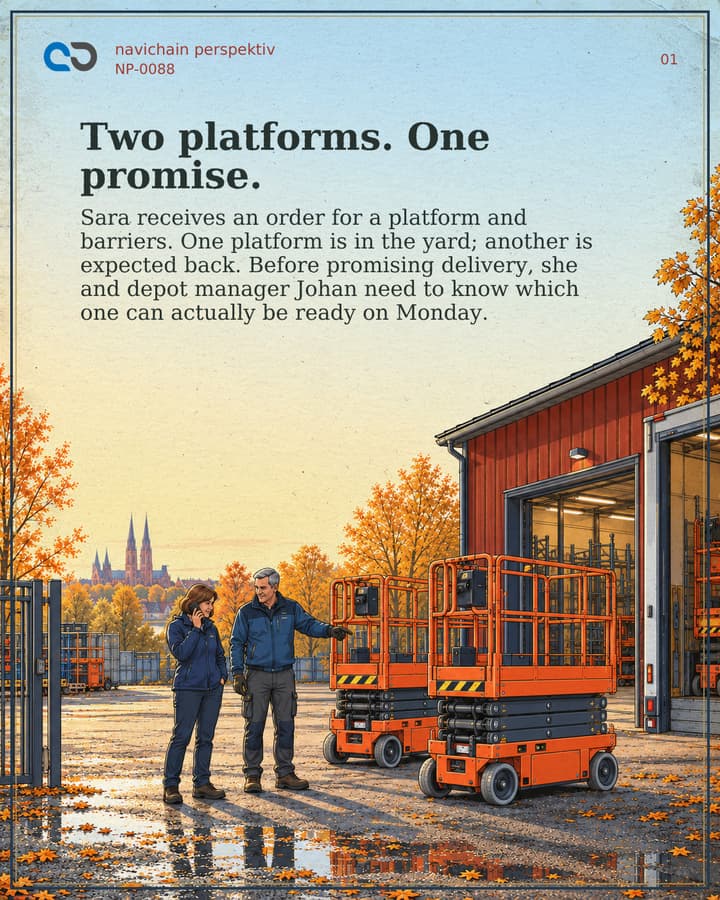
This is a hypothetical example, not a customer case or a measured result. An equipment hire business in Uppsala, Sweden, supplies access platforms, tools and accessories. A customer needs a platform and barriers on Monday morning, expects to finish on Thursday and requests collection on Friday.
Sara manages the customer and agrees equipment, dates, price and delivery. Johan selects and prepares equipment at the depot. Elin plans delivery and collection. Amir needs to know when the equipment returns and what inspection it requires.
One platform is already in the yard; another is due back on Friday. However, the first awaits a spare part and the second might return late. Counting two platforms does not establish what Sara can promise.
Stock information must answer the right question
In the rental setup, the WMS provides the depot’s structured product, quantity and location information. A product category must also be distinguished from an individual item: the customer requests a type of platform, but the depot ultimately needs to identify the particular platform handed over.
Availability depends on time and condition. Equipment may be physically present but under repair, usable but committed elsewhere, or expected back without having been received. Unloading, inspection and preparation take time before another delivery can be promised.
Sara and Johan therefore consider stock information alongside the rental period, existing commitments and maintenance. Establish who confirms that equipment is usable and who confirms the customer promise. Review time reservations, status and asset identity using a representative booking in your own setup. The next person then receives a clear instruction about what to prepare, for whom and by when. An expected return remains distinct from equipment actually received and checked.
From hire order to invoice in navichain
navichain combines services, bookings, runs and assets to handle the rental transaction. A service can have a defined price per time unit. The hire order is an order, also called a booking, assigned to a run. A run may be a trip or a job. The rental item is allocated to it as an asset, such as a vehicle, platform or tool. Charging is per allocated and utilised time unit over the rental period, and the booking can subsequently be invoiced. 3
This gives the transaction a commercial and operational context. The booking represents the customer’s order; the service defines the unit price; the run brings the job together; and the asset allocation identifies the equipment committed to it. The rental period supplies the time basis for charging.
| navichain component | Rental application | Sara’s example | | Service | Rental service priced per time unit | Platform hire on the agreed time basis | | Order/booking | Customer’s hire order | The request for the platform | | Run | Trip or job receiving the booking | The rental job | | Asset | Allocated rental item | The selected platform | | Allocated and utilised time | Chargeable rental period | The period for which the customer hires it | | Invoicing | The booking can be invoiced | The rental transaction is billed |
Service prices make the offer understandable
Sara uses a service with a defined price per time unit. 3 She agrees the rental period, what is included and any additional services with the customer. Delivery and collection also need to be clear in the offer.
For illustration, an agreed rate of SEK 800 per day over four chargeable days produces a rental amount of SEK 3,200 before any additions or taxes. These are hypothetical figures, not navichain prices. The point is the relationship between the service rate, the time unit and the rental period.
Both parties need the same interpretation of time units. Agree how the contract treats part days, weekends and extensions. Clear terms let Sara explain the offer and let the person invoicing understand the booking’s period and services.
Run planning allocates equipment to the job
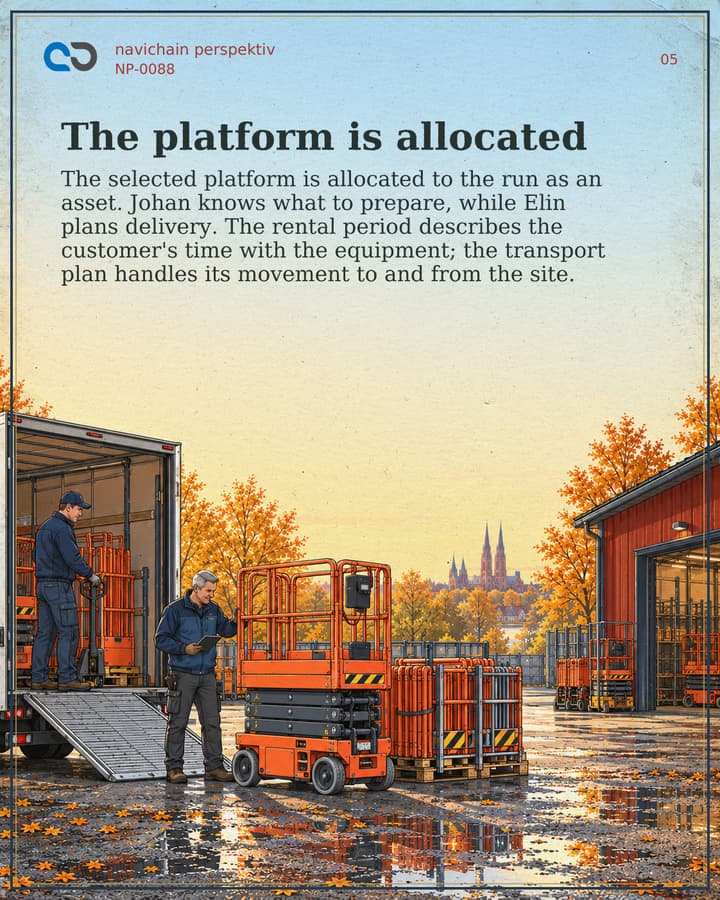
Sara assigns the hire booking to a run, and the chosen platform is allocated to that run as an asset. Because a run can represent a job, the planning model also accommodates the rental itself. 3 The allocation connects a specific resource to the job containing the customer’s booking.
Elin also organises the movement using navichain’s runs and transport planning. 2 Rental duration and transport duration serve different purposes: the customer may hire the platform for several days while delivery occupies only part of one working day. Planning must account for both the equipment commitment and the resources needed to deliver and collect it.
Elin needs equipment and transport requirements, an address, contact person and time window. navichain uses HERE-based routing, including truck-aware capabilities where supported. 2 Elin combines the route information with loading, unloading and other jobs. Johan knows which item to prepare; Sara can relate her answer to the booking and its plan. Changes to the item or rental period need to reach the people carrying out the work.
Delivery is a handover of responsibility
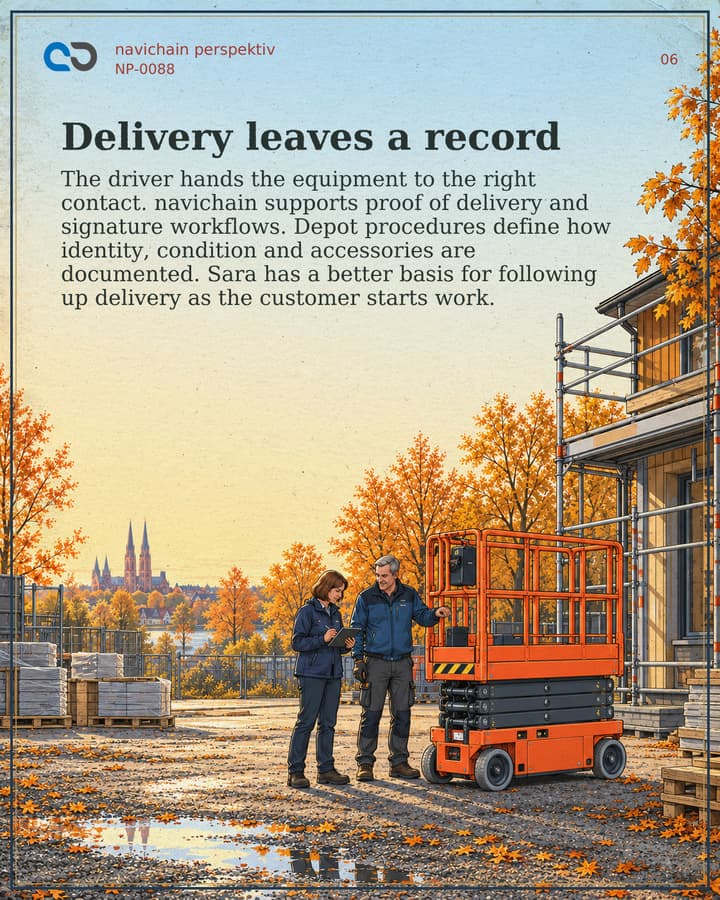
Johan prepares the platform and barriers, checks them against the order and gives the driver the information needed to deliver to the right person. navichain supports proof-of-delivery and signature workflows. 2 Depot procedures establish how equipment identity, condition and accessories are recorded at dispatch and return. This provides a better basis for resolving an exception while the information is still fresh, and helps the customer put the right equipment to work.
GPS needs the right connection
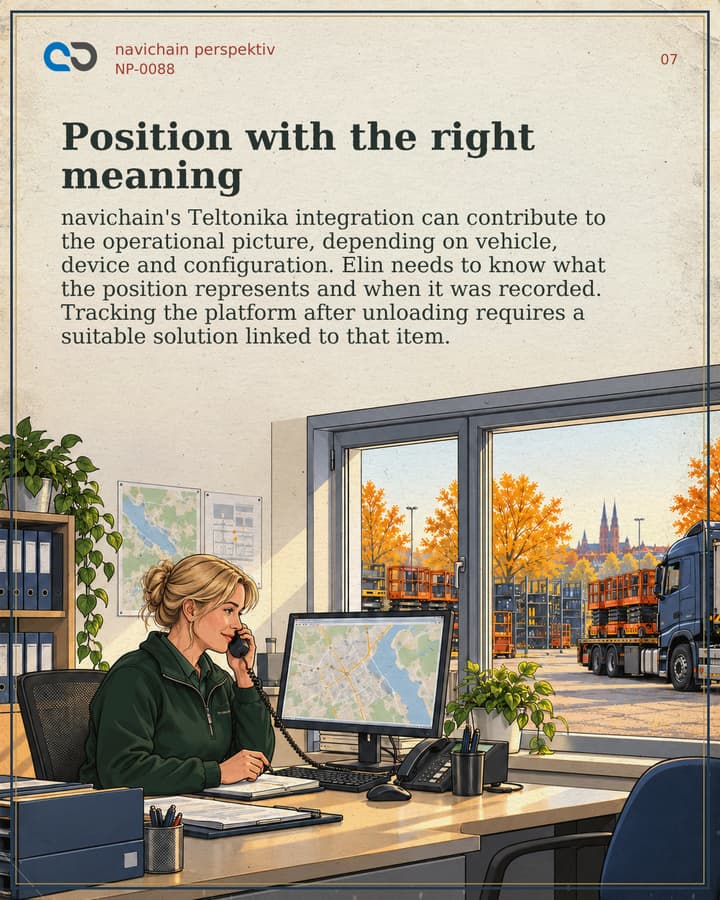
navichain integrates with Teltonika FMC650 and FMC003. Available values depend on the vehicle, device and interface configuration. 2 Position can therefore supplement a properly equipped transport operation.
Be precise about what is being tracked. A transport vehicle’s position describes that vehicle. Following the rental item after unloading requires a suitable connected tracking solution linked to that particular asset, selected for the equipment and operating environment.
Elin can use available location information when coordinating transport and investigating an exception. Read a position together with its observation time and the job status. Presence at the customer’s site does not establish that handover is complete or that the hire should end.
When the customer needs two more days
On Thursday, the customer requests an extension. Sara checks the next commitment with Johan before confirming: is the same platform already needed elsewhere, could another item be used, and what happens to collection, inspection and the next dispatch?
In this example, Sara agrees the revised period and price after checking the next customer’s needs. The rental allocation and chargeable time need to reflect that agreement. Elin changes the transport plan, and Johan and Amir receive the new return time. The extension is thus handled in both the customer transaction and the operating plan.
That coordinated decision creates confidence. Its consequences are understood across roles, and the next customer’s delivery remains part of the decision.
The return prepares the next income
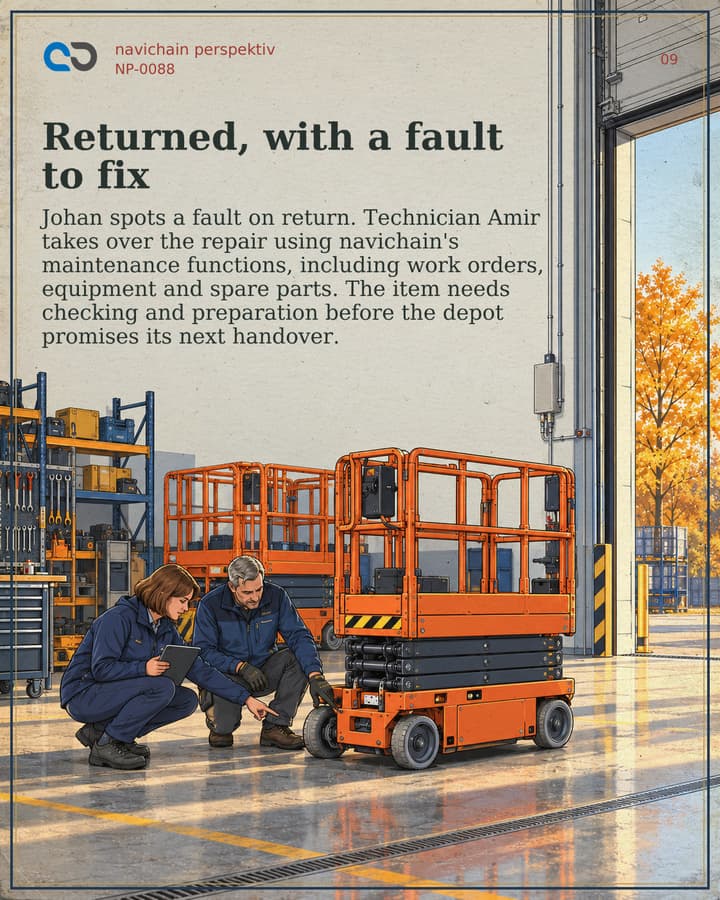
Johan checks identity, accessories and condition when the platform returns. A fault requires Amir’s attention. navichain maintenance includes work orders, records, parts, equipment and workshops. 2 These provide a basis for organising and documenting the repair; inspection templates and fault handling are applied to the equipment used by the business.
The responsible person then confirms when the platform is usable again. Stock information and rental planning must reflect that decision through the agreed working procedure. The full turnaround includes collection, transport, receipt, inspection, repair and preparation. Understanding where that time is spent helps identify the right improvement.
The booking can then be invoiced
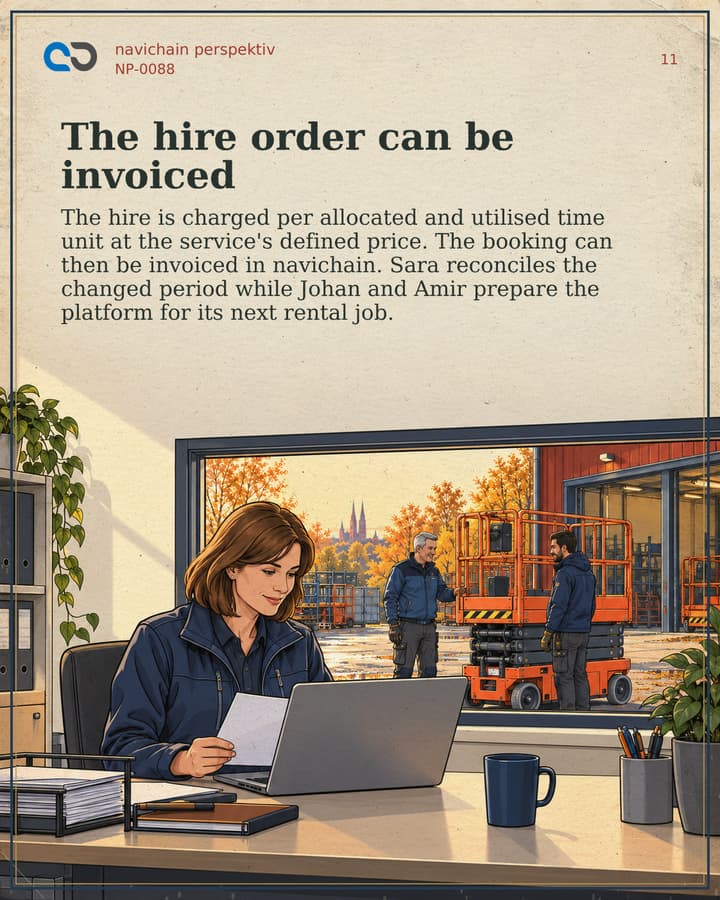
The service’s defined rate is used to charge the allocated and utilised rental time, and the hire booking can be invoiced in navichain. 3 Sara and the person responsible for invoicing need consistent information on the original period, extensions and agreed services.
The commercial transaction remains connected even when collection moves. Reconcile the period chargeable under the agreement. Subsequent workshop activity is a separate operational matter governed by the applicable terms; a GPS position or physical arrival at the depot does not replace that reconciliation.
Booking, job, asset and time-based service make the hire a transaction that can be planned and invoiced. The customer can understand the charge, while the hire company can follow the same job from order to invoice.
Purchasing supports maintenance and capacity
Amir needs a replacement part. Purchasing needs its specification, the required date and the repair it supports. A supplier’s promised delivery must be followed by actual receipt before the workshop can rely on the part.
Distinguish spare-parts requirements from additional rental capacity. Recurring demand for the same product calls for a different decision from a one-off peak: purchase further equipment or arrange supplementary capacity from an external supplier.
Review how purchase orders, goods receipt, stock and the service or rental requirement relate in your setup. Purchasing knows what is needed, the depot knows what is expected and the workshop knows when it can proceed. Ordered equipment remains incoming capacity until received and ready for use.
Value in the promise and the working day
Customers benefit from the right equipment, clear terms and useful answers when plans change. Staff benefit from less repeated information gathering at each handover. Management can examine where available time is lost, which shortages recur and how often a delivery requires last-minute intervention.
| Measure | Practical definition | What it reveals | | Complete, on-time deliveries | Deliveries with agreed equipment and accessories within the confirmed window / all deliveries | Whether the customer promise holds | | Return-to-ready time | Time from physical receipt to confirmed readiness | Where equipment is tied up between hires | | Availability | Usable equipment time / the defined calendar basis | The effect of maintenance and waiting | | Rental utilisation | Time on hire / a consistent comparison basis | Capacity use, distinct from actual machine operation | | Urgent replanning | Late changes requiring intervention | Planning stability | | Invoice queries | Questions about periods, services or extras | Clarity of terms and records |
Define measurement rules and establish a baseline before comparing results. These are suggested business measures, not promises of standard reports or guaranteed savings.
Start with a real rental flow
Choose one representative product family. Work through booking, asset selection, service price, allocation, delivery, extension, collection, inspection and the next booking using your own accessories, transport constraints and terms.
Decide who can confirm availability and change a customer commitment. Review the effect of maintenance on planning, how purchasing serves the requirement and which items need their own tracker. Include a late return and an identified fault: these expose whether handovers work when they matter most.
Peace of mind comes when each party understands what was agreed, what has happened and who takes the next step. Today’s return becomes an orderly preparation for tomorrow’s delivery.
Related perspectives
- NP-0066 – The depot that forgot what it had hired out Rental and depot visibility.
- NP-0040 – The service book Maintenance as part of operations.
- NP-0045 – The supplier said one hundred. The warehouse counted sixty-three. Purchasing and goods actually received.
Try today! Start for free.
Getting started is easy. Create your account and try navichain with your next transport. Follow one of your own hires from available equipment to invoice.
Try today! Start for free. · navichain
Sources
1. European Rental Association: Rental digitalisation (2023-01-25); Accessed 2026-09-08. https://erarental.org/publications/the-impact-of-digitalisation-in-the-equipment-rental-industry/
2. navichain: Product documentation: bookings, planning, maintenance, proof of delivery and telematics. (2026-08-29 / 2026-09-04); Accessed 2026-09-08.
3. navichain: Rental model: time pricing, booking on a run, asset allocation and invoicing. (2026-09-08); Accessed 2026-09-08.
4. European Rental Association: Rental manifesto (2022-08-30); Accessed 2026-09-08. https://erarental.org/publications/manifesto-on-the-environmental-benefits-of-rental/