The customer needs proof of delivery. Not the driver’s entire working day.
By navichain team








Make data protection part of the transport day with clear roles, relevant information and controlled access.
Summary
Personal data accompanies a transport from the initial booking to the final acknowledgement. Problems often arise during handovers: a phone number enters a private chat, a screenshot includes another customer’s jobs, or temporary access remains after the work ends. Start by deciding who needs which information, for what task and for how long. navichain supports bookings and runs, digital proof of delivery, a customer portal, and permissions by user and department. Driver-data management, customer isolation and traceable changes to important records provide tools for implementing the business’s decisions. This perspective follows an illustrative job and explains how dispatchers, drivers, customers and administrators can work together without creating an unnecessary copy at each handover.
14:17: ‘Could you send the records?’
This is an illustrative scenario, not a customer case or a measured result. Sara works in dispatch at a haulier outside Uppsala. Erik has just delivered three pallets to a wholesaler. The customer calls to check that the goods have been received. A screenshot of the planning screen would be quick, but it also contains other jobs, an internal telephone number and unrelated details. Sara asks what the customer actually needs: proof of delivery for its shipment.
Using the appropriate record can improve the answer while keeping more information within its working context. Erik need not wonder which parts of his day were included. Another colleague need not search through five competing email copies.
Start with the task
The navichain blog explains the wider data categories and questions in The personal data a haulier forgets it holds (Swedish). This perspective develops the practical next step: implementing that knowledge during a transport day. 1
Dispatch needs to plan, the driver needs to deliver, the customer needs its shipment records, and the administrator needs to manage access. The following is an implementation checklist, not a statement of default account permissions.
| Task | Relevant information | Decision to implement | | Plan delivery | Booking, address, necessary contact and instructions | Which dispatch roles and departments require access? | | Carry out the job | Run, goods and delivery instructions | Use individual accounts; check actual role scope | | Confirm receipt | The shipment’s proof and relevant events | Verify the customer organisation and authorised portal users | | Handle an exception | Evidence needed for that specific issue | Name an owner and review external disclosure | | End access and review retention | Temporary permissions and data no longer needed | Assign responsibility for revocation and deletion decisions |
Data protection by design means building necessity and access into the workflow. EDPB explains that this responsibility extends throughout processing. 4
07:10: give the booking a working context
Sara creates the transport booking and plans it on a run. navichain connects bookings, runs and transport planning, allowing colleagues to work from shared records. 3 Erik needs the goods-reception number and an instruction to use gate two. He does not need an email discussion of somebody’s absence.
Sara selects the relevant instruction. The booking does not independently decide which free-text information is appropriate. The team agrees to describe the next action and the facts needed to perform it, avoiding personal judgements and unrelated background. This also makes the instruction easier to understand at the gate.
08:05: a colleague takes over
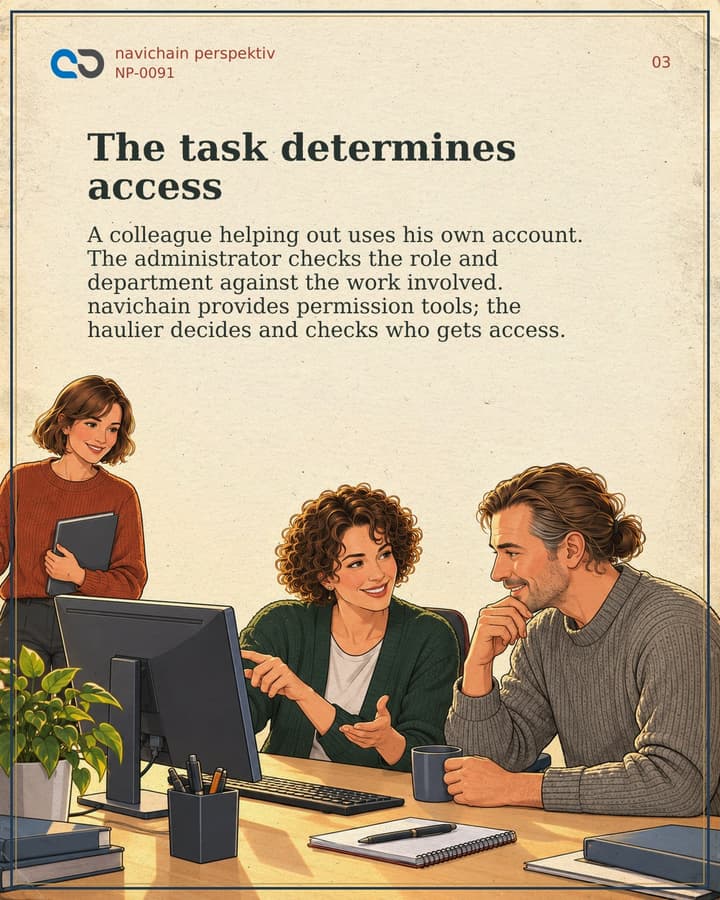
The colleague uses his own account. His manager decides what access the task requires; the administrator implements that decision and checks it using representative accounts. A suitable-sounding role name is insufficient: inspect what the user can actually reach.
navichain supports roles and permissions by user and department, administrator two-factor authentication and field-level change history for important records. These help allocate work and follow relevant changes. 1 They do not remove the need for decisions when somebody changes department or leaves. Sara assigns a follow-up task for the temporary permission. The task organises the work; the administrator performs the permission change.
10:40: a delay needs a useful message
Erik waits at an earlier unloading point. Sara explains what has changed for this shipment, its consequences and what the recipient needs to do. She does not use the entire vehicle map as a shortcut.
The notifications customers want (Swedish) discusses useful updates. Here the additional question is which personal data the update needs. navichain’s portal brings together the customer organisation’s shipments, notifications and records. 2
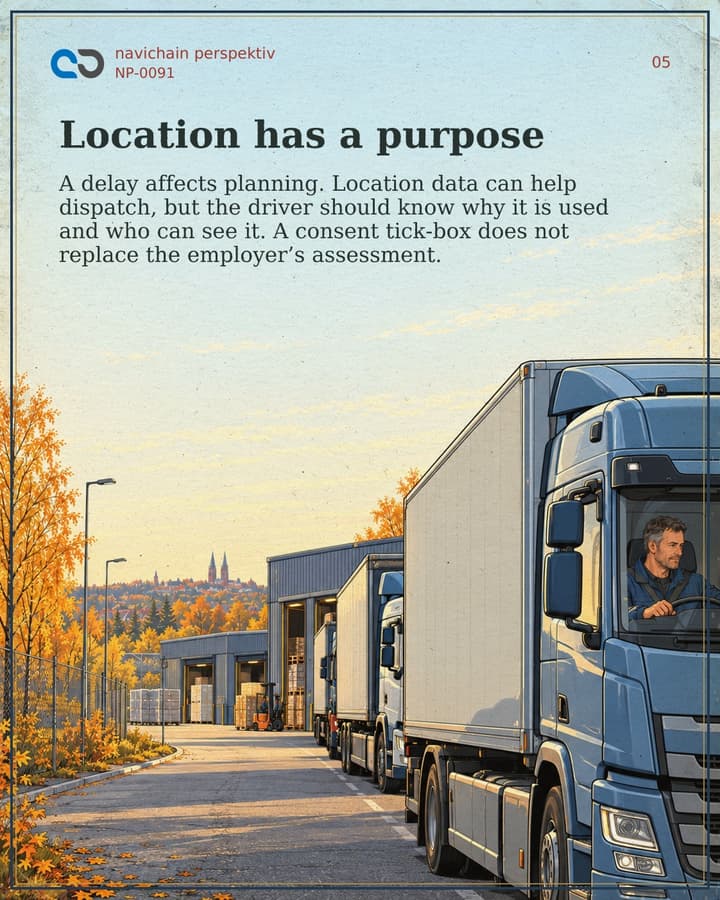
Location data also requires clarity towards the driver. Sweden’s IMY stresses concrete operational purposes, information for employees and avoiding reuse for incompatible monitoring purposes. Employee consent alone does not make surveillance lawful. A platform’s consent-management capability does not replace the employer’s assessment. 5 The haulier must explain the purposes, access and operating rules before location data enters planning.
14:05: delivery creates its own evidence
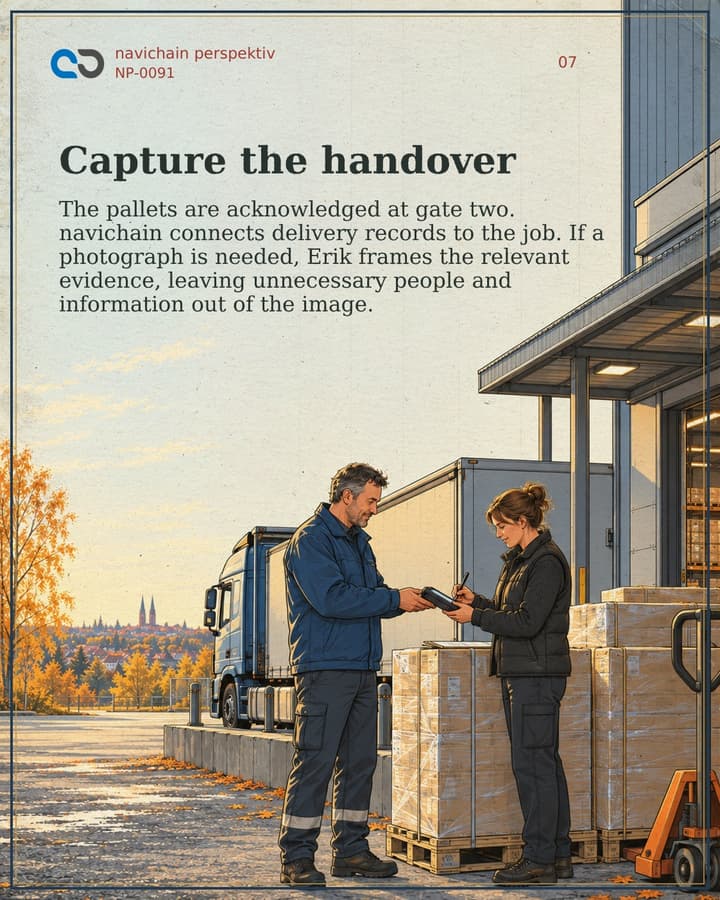
At gate two, the goods are acknowledged in the delivery workflow. navichain supports digital CMR and proof-of-delivery workflows with signatures; driver workflows include delivery details, comments, images and times. The evidence belongs to the transport job. 3
If a photograph is necessary, Erik captures the goods, marking or relevant damage. He avoids including unrelated people behind the pallet. Photography therefore belongs in the driver’s working instructions.
An authorised customer user can retrieve proof in the portal. Instead of Sara compiling another copy for every enquiry, the customer accesses its own shipment record. The business checks who represents the customer organisation and reviews account changes. 2 Self-service can reduce copying and improve service, provided customer links, accounts and documents are correctly configured.
Answer the question, then investigate what remains
At 14:17 the buyer asks for ‘everything from the run’ to check delivery time. Sara starts with proof of delivery and asks what remains unclear. If an exception needs investigation, the responsible dispatcher gathers the relevant evidence for that issue. A broad phrase on the telephone should not define the information boundary.
If incorrect information has already been shared, refer the event immediately to the company’s incident owner under its procedure. Limit further sharing, preserve relevant assessment evidence and determine the next actions. Access controls cannot prevent every human mistake or recall every downloaded copy.
Delivery is finished; access and retention still need decisions
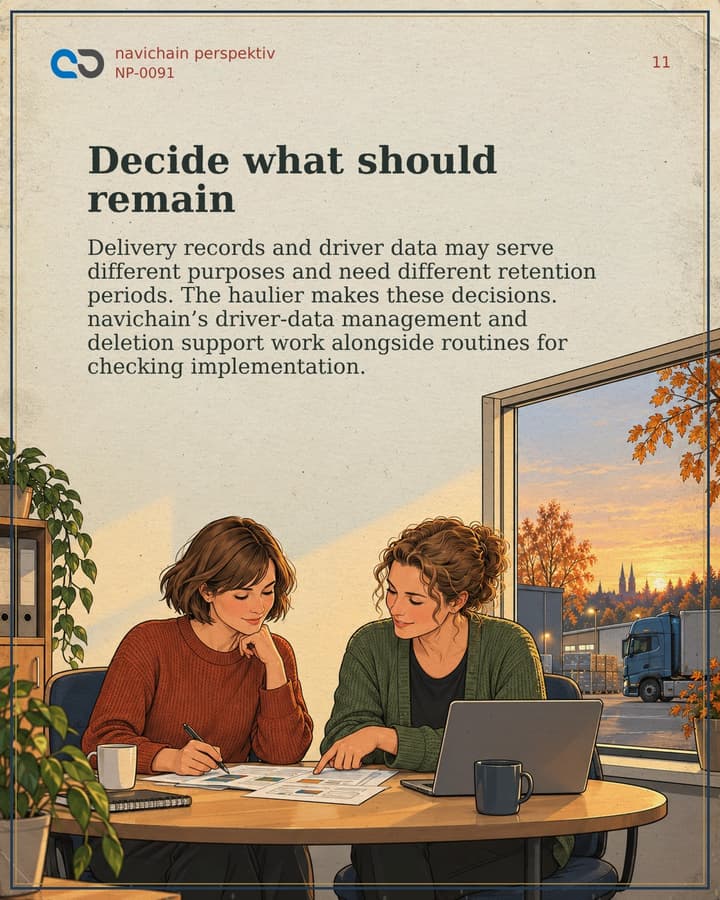
A completed transport may leave records needed for a defined purpose, while other data has outlived its purpose. Ending access to a work function and deciding retention periods are separate actions. navichain supports consent, retention periods and the ability to delete driver data. Use this with documented decisions about scope, ownership and follow-up; do not apply one convenient retention period to every category. 1
The administrator reviews temporary access after the shift. The owner of data-protection routines separately checks retention decisions. Include copies in integrations, exports and local folders in the inventory. When somebody asks about their personal data, staff should know who receives and handles the request and where records are held. A connected transport workflow helps navigation; it does not replace the assessment or cover every other system.
EU hosting provides a foundation
Each navichain customer has its own isolated database in the EU. Together with permissions, this separates customer environments and gives the haulier concrete information for customer discussions. 6 Still examine actual data flows and responsibilities: who determines purposes and means, who processes on instructions, and which services are involved? EDPB distinguishes controllers and processors by their actual roles, not merely the labels customer and supplier. 7
What EU hosting really means when a customer asks (Swedish) develops the supplier questions. Connect the answers to daily routines: who can see or change what, and who performs the next action?
Begin with one job and four roles
Choose an ordinary transport and a real customer organisation, using representative information in a suitable test environment. Follow booking, driver handover, delivery, customer retrieval and closure. Include a delay and a colleague temporarily helping out.
Ask dispatch, a driver, a customer representative and an administrator to explain their tasks. Test each role’s actual access, including both necessary records and information it has no reason to see. Assign owners for instructions, permissions, retention and integrations.
Measure manual proof-of-delivery sending, extra copies, permissions remaining after their purpose ends and instructions requiring clarification. Compare before and after, rather than relying on a promised percentage. Sara should answer with the right record; Erik should understand the boundaries; the customer should find its evidence; management should see data protection become part of normal operations.
Further perspectives
NP-0050 covers automatic booking reception and the customer portal. NP-0052 discusses data sovereignty and the ability to leave a system. Contact navichain for these editions.
Try today! Start for free.
Getting started is easy. Create your account and try navichain with your next transport. Begin by reviewing who needs which information, from booking to ending access.
Create an account · Read more about navichain
Sources and further reading
1. navichain: The personal data a haulier forgets it holds. Swedish, 7 September 2026. Data categories, permissions, change history and driver-data management.
2. navichain: The notifications customers want. Swedish, 9 September 2026. Organisation-scoped portal, shipment updates and delivery records.
3. navichain: One platform, from booking to delivery. Swedish; documentation dated 29 August 2026. Bookings, runs, CMR, proof of delivery and tasks.
4. EDPB: Data protection guide for small business. English. Data protection by design and default, and processing records.
5. IMY: Employers’ use of location services (GPS). Swedish, updated 30 March 2026. Purposes, employee information and the limits of consent in employment.
6. navichain: What EU hosting really means. Swedish, 24 August 2026. Isolated customer databases and supplier questions.
7. EDPB: Data controller or data processor. English. Responsibilities based on purposes, means and instructions.