Freight documentation in Swedish haulage companies – White Paper
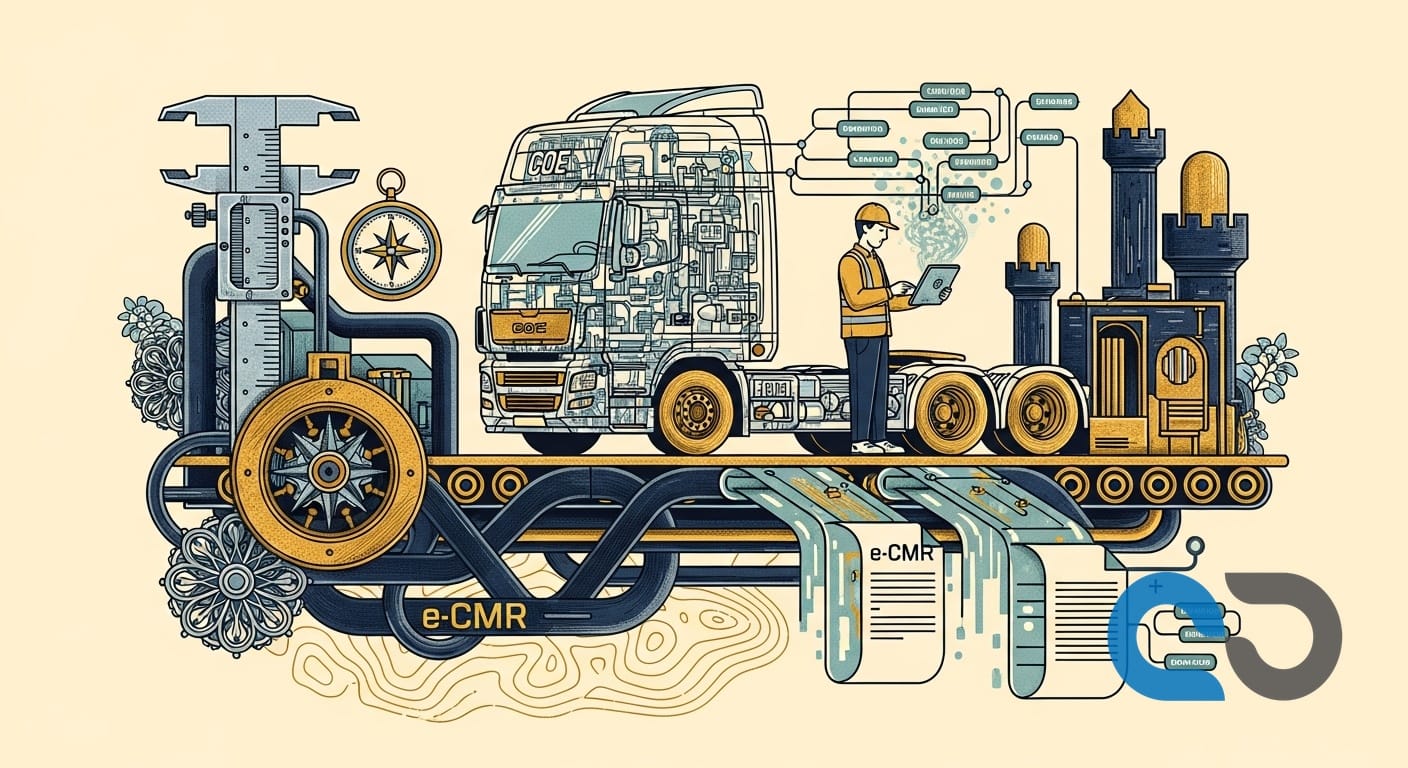
Freight Documentation in Swedish Haulage Companies – White PaperWhite PaperApril 2026Freight Documentation & Digitalization
Paper, pixels and
parallel realities
A review of how small and medium-sized haulage companies in Scandinavia – and Sweden in particular – handle freight documentation, which IT support is used, and what the lack of proper system support actually costs.
Scandinavia · Road Transport
SME segment · TMS & e-CMR~10 000haulage companies in Sweden85 %with 1–5 vehicles80 %of all goods by truck
The Swedish haulage industry is overwhelmingly a small business sector. Of the country's approximately 10,000 haulage companies, 85 percent have between one and five vehicles. Although trucks carry 80 percent of all goods transported within Sweden, this sector is still – in 2026 – characterized by paper-based waybills, ad hoc administration in Excel and WhatsApp, and a fragmented digital landscape where IT support is either completely lacking or is a system owned and dictated by another actor.
This report maps out how documentation management looks in different segments of the haulage industry, what types of IT systems are used and by whom, and discusses the operational and strategic risks that arise in each scenario: with no system at all, and with a system one does not own.
01 — Industry Structure
A sector of small businesses behind large volumes
The haulage industry is one of Sweden's most important socio-economic sectors. With nearly 10,000 haulage companies, over 225,000 employees and an annual turnover of 170 billion kronor, the industry accounts for approximately 4 percent of GDP. Every year, more than 422 million tons of goods are transported by truck on Swedish roads – practically everything we consume in our daily lives.
~10 000haulage companies in Sweden225 000+employees in the industry170 bn SEKannual turnover80 %of all goods transported by truck
Despite these volumes, the industry is deeply fragmented. According to Sveriges Åkeriföretag, the industry organization with around 6,000 member companies, approximately half of them operate as sole proprietorships. Overall, 85 percent of all active hauliers are in the 1–5 vehicle segment. It is therefore primarily family businesses and sole proprietorships, not organizations with dedicated IT departments or capital for system implementations.
"85 percent of hauliers run small businesses, with one to five vehicles. When the haulage industry is discussed, it is often the large logistics conglomerates that come into focus – but that is not how the industry looks in practice."
— Ulric Långberg, Head of Social Policy, Sveriges Åkeriföretag (2024)
The industry trend is towards consolidation: the number of sole proprietorships is steadily decreasing, while medium-sized haulage companies are growing. However, consolidation is slow, and the vast majority of actors remain micro-enterprises for the foreseeable future. Seven out of ten truck transports start and end in the same county, emphasizing that regional and local flows are at the core of the industry.
The Scandinavian context
The picture in Norway and Denmark resembles the Swedish one: SME dominance, strong internal distribution networks, and a landscape of subcontractor relationships. Across Europe, SMEs make up 85 percent of companies in the road transport sector, and they form the critical backbone for local and regional distribution.
02 — Freight Documentation in Practice
The paper that still reigns
The waybill – known internationally as the CMR waybill – is the legal basis document in all road freight transport. It regulates liability, goods description, sender, recipient, and transport conditions. Despite its central role, it is still handled in large parts of the industry as a paper form in four copies.
The digital version, e-CMR, has been technically available for more than a decade. Sweden formally acceded to the e-CMR protocol in 2019 when the parliament voted yes to the proposal on electronic waybills for road transport.
"Although the introduction of e-CMR makes the transport process much more efficient, it has not yet gained widespread traction. This is partly due to the need to invest in necessary technology, and partly due to an unclear legal situation that has led to lack of acceptance."
— TIMOCOM, European freight marketplace (2024)
Segmented picture of digitalization degree
It is not possible to talk about a uniform degree of digitalization in the haulage industry. The picture varies greatly depending on company size, type of assignment, and position in the supply chain.
| Segment | Size | Share of the Industry | Documentation Model | IT Maturity |
|---|---|---|---|---|
| Micro Haulage Companies Sole proprietorships and family businesses | 1–3 vehicles | ~50–55 % | Paper + phone + WhatsApp | Minimal |
| Small Haulage Companies Subcontractors in hubs | 3–15 vehicles | ~25–30 % | Client's system or paper | Borrowed digital |
| Medium-Sized Haulage Companies Own contracts, own customers | 15–100 vehicles | ~10–12 % | Mixed: own systems + paper elements | Partial |
| Large Haulage Companies / Truck Hubs | 100+ vehicles / units | ~3–5 % | TMS with e-CMR integration | Advanced |
03 — IT Systems in the Haulage Industry
Whose system are you running with?
IT support for transport operations can be divided into three broad categories: Transportation Management Systems (TMS), simpler administrative tools (invoicing systems, Excel), and platforms owned by clients. The question of whose system you use is crucial for a haulage company's room for maneuver.
TMS – what is it and who has it?
A TMS is a software tool designed to manage shipments and transport planning. It collects orders, route optimization, document generation (waybills, e-CMR), invoicing, and customer communication in a flow.
"Developing a new TMS is not something you just do – it takes time and is a huge investment. Närkefrakt is one of the few Swedish truck hubs that has its own IT development department."
— Mika Salo, IT Manager Närkefrakt and CEO Motus Logistikutveckling AB, Dagens Logistik (Sept 2024)
Subcontractors under the large players
A large proportion of the country's haulage companies operate as subcontractors for DHL, DB Schenker, PostNord, DSV, and similar. The advantage: they do not need to invest in their own IT. The disadvantage is that they lack:
- Ownership of their own historical data
- Ability to take customer relationships with them when changing clients
- Capacity to invoice directly or report CO₂ to their own customers
04 — Problems
What does the lack of proper system support cost?
The lack of digital system support – or being locked into a system you do not own – creates concrete, measurable problems. They can be divided into operational problems (day-to-day friction), strategic problems (competitive position), and regulatory risks (upcoming legal requirements).
Excel, WhatsApp, and paper blocks
Haulage companies without system support manage their operations manually. It works – until it doesn't. The consequences are well-known in the industry:
- 6–8 hours of administration per week on tasks that competitors with TMS solve in 1–2 hours
- Paper waybills that get lost, are read incorrectly, or are filled out incompletely
- Delayed invoicing and tied-up working capital
- Inability to meet customer demands for CO₂ data and digital traceability
The system you use but do not own
Operating in a client's TMS means a technical dependency with deep business consequences:
- Historical data about your own transports is owned by the client
- Pricing and terms are dictated by the system owner
- No opportunities to build direct customer relationships
There is a business window right now for haulage companies in the mid-segment to establish their own, owned system support before regulatory requirements and customer demands make it a hygiene factor.
05 — Trends and Outlook
Towards a mandatory digital standard
The digitalization of freight documentation is moving from possibility to necessity. Three parallel forces drive the transformation:
1. Regulatory push
The EU's eFTI regulation creates a framework for digital freight information that authorities in all EU countries must accept, with expected full implementation in July 2027.
2. Customer demands up the chain
An increasing number of industrial clients require CO₂ reporting per transport, digital traceability, and automatic delivery receipts.
3. Economic incitements
Calculations from European industry organizations show that e-CMR saves approximately four euros per document compared to paper waybills.
06 — A Practical Way Forward
navichain: an ecosystem built for reality in Swedish haulage companies
navichain SaaS is a Swedish, cloud-based ecosystem specifically designed to meet the challenges: administrative burden, paper dependency, and lack of data sovereignty.
FreeFreemium level for up to 2 users199 SEKPer user per month - full access199 SEKPer vehicle per month - HaaS0 SEKImplementation cost
Addressing the problem at the root: Magic Drop and e-CMR in real time
The most common obstacle to digitalization is friction. navichain solves this with the function Magic Drop: AI that automatically reads PDF documents and converts them into active bookings.
With navichain, a haulage company moves from paper waybill to e-CMR, real-time tracking, and automated invoicing – without implementation cost.
Data sovereignty – a Swedish competitive advantage
All data is hosted in your own Swedish data center. Your business data never leaves Sweden and is not subject to the American Cloud Act.
07 — Conclusions
What does this mean for you?
There is no doubt: e-CMR and TMS support are moving from competitive advantage to hygiene factor. The haulage companies that act now position themselves to win contracts and reduce costs.
"Stop using paper waybills – use e-CMR. It is the easiest first step. A digitalized competitor spends 1–2 hours per week on administration. You spend 6–8."
— DORA TMS, guide to digitalization of transport companies (2025)
References and further reading
Read more on Navichain
- paper-based waybills
- 6–8 hours of administration per week
- route optimization
- eFTI regulation
- navichain SaaS is a Swedish, cloud-based ecosystem