Every fifth kilometer is free. For the customer.
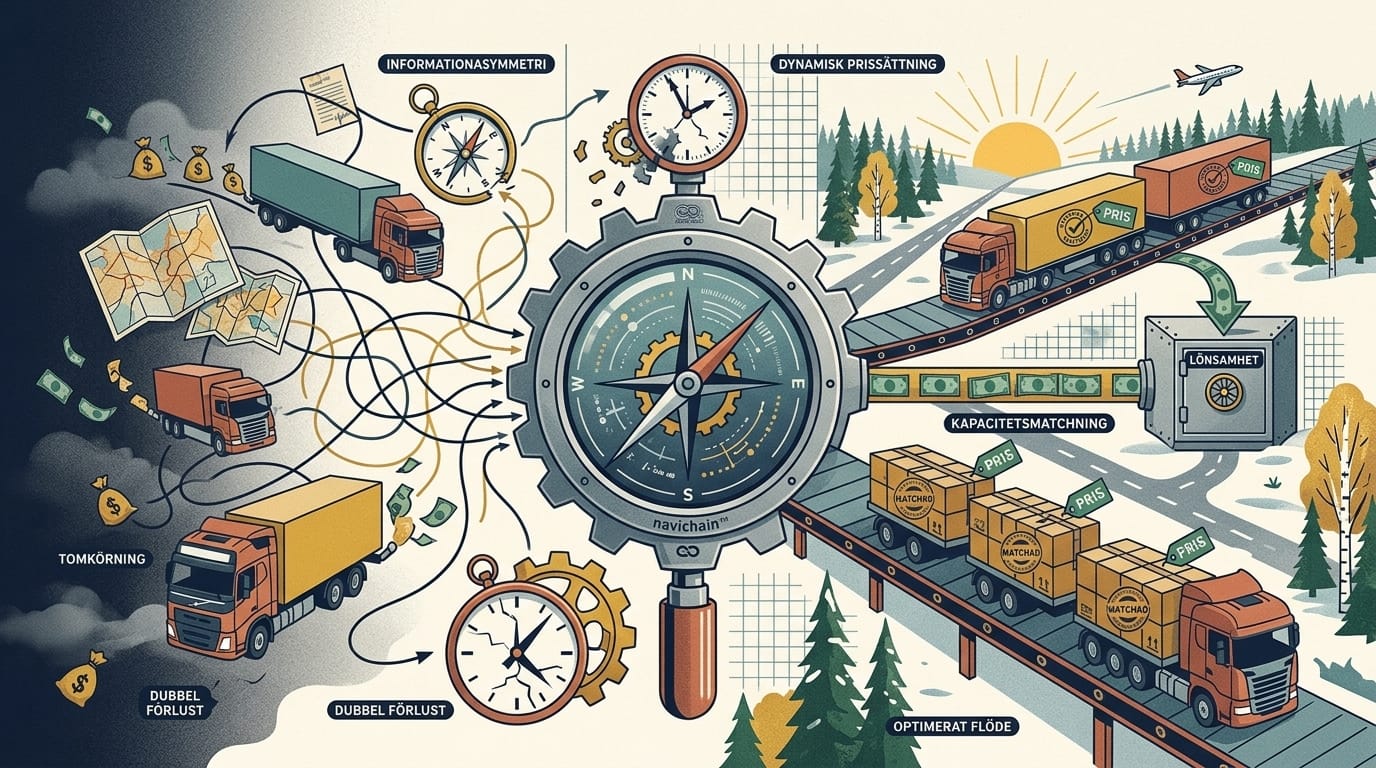
Every fifth kilometer
you drive is free.
For the customer.
22% of all heavy transport kilometers in the EU are driven with an empty trailer. This is not a rounding error – it is the industry's most costly secret. Navichain transforms deadhead haulage from an unavoidable cost into an optimization question with an answer.
It is called the industry's dirty secret. Almost every fifth kilometer that a heavy truck drives in Europe is driven without a load. The diesel still burns. The driver still works. The tires still wear out. But the revenue – that is completely missing. In an industry with margins of 2–5 percent, this is not an inefficiency you can live with. It is a structural hemorrhage that erodes profitability every day driven and has become dramatically worse since 2022, when fuel costs, wages, and maintenance costs have increased by over 30 percent without freight prices keeping up. Navichain has an answer to this problem – and it is an answer that changes how you think about what an empty return trip really is.
The math behind an empty trailer
A haulage company with 5 vehicles that drive 200,000 km/year per truck, with 22% deadhead haulage, burns 220,000 km × 3.50 kr = 770,000 kr/year in direct costs to drive without a load. This is an amount that disappears every year without giving a single customer price to push down, a single assignment to optimize, or a single invoice to send.
An empty kilometer is not zero revenue. It is negative revenue – you pay to drive nowhere.
Deadhead Haulage's Double Blow
Double Loss – Not Just Zero
Why an empty trailer is worse than you think
Direct Cost – You Pay to Drive Empty Miles
Diesel at 2.20 kr/km, driver wage per hour, tire wear, and engine wear. Every empty kilometer costs your haulage company 3–4 kronor in pure operating costs – regardless of whether there is cargo in the trailer or not.
Opportunity Cost – You Lose the Revenue You Could Have Had
Every hour the driver drives empty is an hour he does not drive with paid cargo. It is not just the cost you bear – it is the revenue you miss. And in the industry with a driver shortage, every available driving hour is more expensive and rarer than ever.
CO2 Tax – You Soon Pay to Pollute Without Earning
With ETS2 – the EU's expanded emissions trading gradually coming into force – a carbon dioxide tax is introduced on road transport. It is levied per emission, regardless of whether the truck is loaded or not. Deadhead haulage will soon not only be a revenue loss but an active tax object.
The Information Asymmetry – The Real Problem
Why are 22% of all heavy traffic driven empty? Not because there is a lack of cargo to transport – there is not. But because those who have cargo do not know where the capacity is, and those who have capacity do not know where the cargo is. This is an information asymmetry that costs the industry billions every year.
The traditional answer to this problem has been freight exchanges and phone calls to brokers. It works, but it is reactive and inefficient. Navichain solves it proactively, built into route planning, with algorithmic capacity matching and dynamic pricing – a model borrowed from the airline and rideshare industries and adapted for freight transport.
The Airline Industry's Secret – Now for Haulage Companies
Why does a flight ticket cost €50 today and €200 tomorrow? And why doesn't your haulage company do the same thing?
Airlines price capacity dynamically based on supply and demand. An empty seat on an airplane generates zero revenue – but a half-price ticket generates more than zero. The same logic applies to an empty trailer on the return trip from Munich to Verona.
Navichain analyzes spot market data in real-time, identifies available loads along the return route, and suggests a minimum price level that is always better than driving empty – while the system protects against prices that fall below actual operating costs.
How Navichain's Capacity Optimization Works
Return Route is Analyzed Automatically Automatic
Even when a trip is planned, Navichain analyzes the return route. The system identifies the window of available capacity and when and where the truck is empty and mobile – without the transport manager having to do anything active.
Spot Market and Available Loads are Matched Real-Time
Navichain connects return capacity with available loads along the route – via integrated freight exchanges and the network of users in the system. The matching takes into account load type, weight, cargo specifications, and time frames.
Dynamic Price Level is Suggested Algorithmic
Based on current market data, actual operating costs per kilometer, and time pressure, the system calculates a price level that maximizes revenue – never below cost price, but flexible enough to win the deal against an empty return trip.
New Booking is Integrated Seamlessly Automatic
If a return load is accepted, the booking is created directly in Navichain. The driver sees the assignment in the app. e-CMR is generated. The invoice is triggered upon delivery. The entire flow is handled in the same system as the primary assignment.
What Halving Deadhead Haulage Actually Means
It is not about eliminating deadhead haulage – that is unrealistic. It is about systematically reducing it with the tools available. Halving from 22% to 11% is an ambitious but realistic goal for a haulage company that starts actively working with capacity matching. And the result, as the calculation above shows, is dramatic in relation to the investment.
Capacity Utilization as a Strategy, Not Chance
The system automatically identifies available capacity per vehicle, time, and route corridors – without manual review of driving orders.
Navichain connects your available capacity with available loads in real-time. The system filters for cargo type matching, time frames, and profitability.
The algorithm calculates the minimum price level based on actual operating costs and current market data – never below cost price, always better than empty.
AI analysis identifies systematic deadhead haulage routes and time periods. Basis for active work with business development and customer portfolio management.
Accepted return loads create bookings directly in the TMS. The driver sees the assignment in the app. e-CMR and invoice are handled automatically.
Reduced deadhead haulage reduces emissions. With ETS2, this means lower future carbon dioxide taxes and a stronger sustainability argument to customers with ESG requirements.
Calculate what your deadhead haulage costs. Free. Today.
Navichain is free up to two users and approximately fifty bookings per month – more than enough to run your fleet through the system and get your first AI analysis of the deadhead haulage profile. Start seeing what you are losing. And start winning it back.
- Create a free account at navichain.se – in less than two minutes, no credit card
- Register your fleet and enter existing driving orders – manually or via Drop & Go with historical waybills
- See AI analysis identify your deadhead haulage routes, times, and opportunities for capacity matching
- Activate spot market matching and receive the first suggestion for a return load that is more profitable than driving empty
- Calculate what halving deadhead haulage is worth to you – and compare it with what Navichain costs
Free up to 2 users · ~50 bookings/month · 199 kr/user/month for full functionality · Capacity matching, dynamic pricing & AI deadhead haulage analysis included · All data on Swedish servers · No commitment period
The Industry's Dirty Secret Stops Being a Secret
22% deadhead haulage has been accepted as a fact of nature in the transport industry for decades. It is not. It is a consequence of information asymmetry and static pricing thinking – and both can be solved with the right tools. Navichain is that tool. And it costs 199 kronor per user and month. It is, in a well-managed medium-sized haulage company, a fraction of a single empty return trip that could have been sold at spot price instead.