Beyond the hype: The real, operational challenges of implementing e-CMR
🇬🇧 Read this article in English
Beyond the hype: The real, operational challenges of implementing e-CMR
Challenges With E Cmr Implementation Logistics
The transition to digital consignment notes (e-CMR) is often described as a simple "no-brainer" for the logistics industry. The promise is paperless efficiency, saved time, and reduced administrative work. But for the haulage companies and logistics firms actually standing in the starting blocks to implement the technology, reality is significantly more complex.
Many quickly discover that the step from paper to digital is not just about changing the medium, but about navigating a minefield of technical standards, reluctant workflows, and legal uncertainty. This white paper examines the concrete, operational obstacles that hinder e-CMR adoption and presents a pragmatic way forward that focuses on simplicity and usability rather than technical "hype".
Summary: When the map doesn't match the terrain
While the drive for e-CMR is strong at an overall level, significant operational challenges remain for those who need to implement it in practice.
The EU and the UN (UNECE) are strongly promoting the e-CMR convention. The vision is clear: seamless, cross-border digital trade. But for an operations manager at a medium-sized haulage company, the vision is secondary to day-to-day operations. The questions asked are practical: "How do I get my 60-year-old driver to use the app?", "What happens when the police in Germany want to see a paper slip?", and "Why doesn't my e-CMR system talk to my customer's warehouse management system?".
These are not fringe phenomena; they are core problems. Ignoring them leads to failed implementations where digital tools become more work than the paper handling they were supposed to replace.
Part 1: The Challenge
The biggest technical bottleneck is the lack of standardization.
The biggest technical bottleneck is the lack of standardization. The market has been flooded with e-CMR solutions, but few of them talk to each other.
Fragmented ecosystems
A carrier can have five different large customers. Customer A requires the use of e-CMR platform X. Customer B uses platform Y. Customer C requires an EDI connection to their own ERP. The result for the haulage company is not a simplified everyday life, but a fragmented mess where dispatch needs to log in to several different portals and drivers need to have five different apps installed on their phones. This creates "swivel-chair integration" – you sit and spin on the chair between different screens to manually move data.
Integration hurdle
Integrating a standalone e-CMR solution with existing Transport Management Systems (TMS) is often expensive and complicated. Many e-CMR tools are built as "silos" that handle the document well but lack deep integration with orders, invoicing, and route planning. Without this link, e-CMR becomes just another isolated system that requires manual intervention.
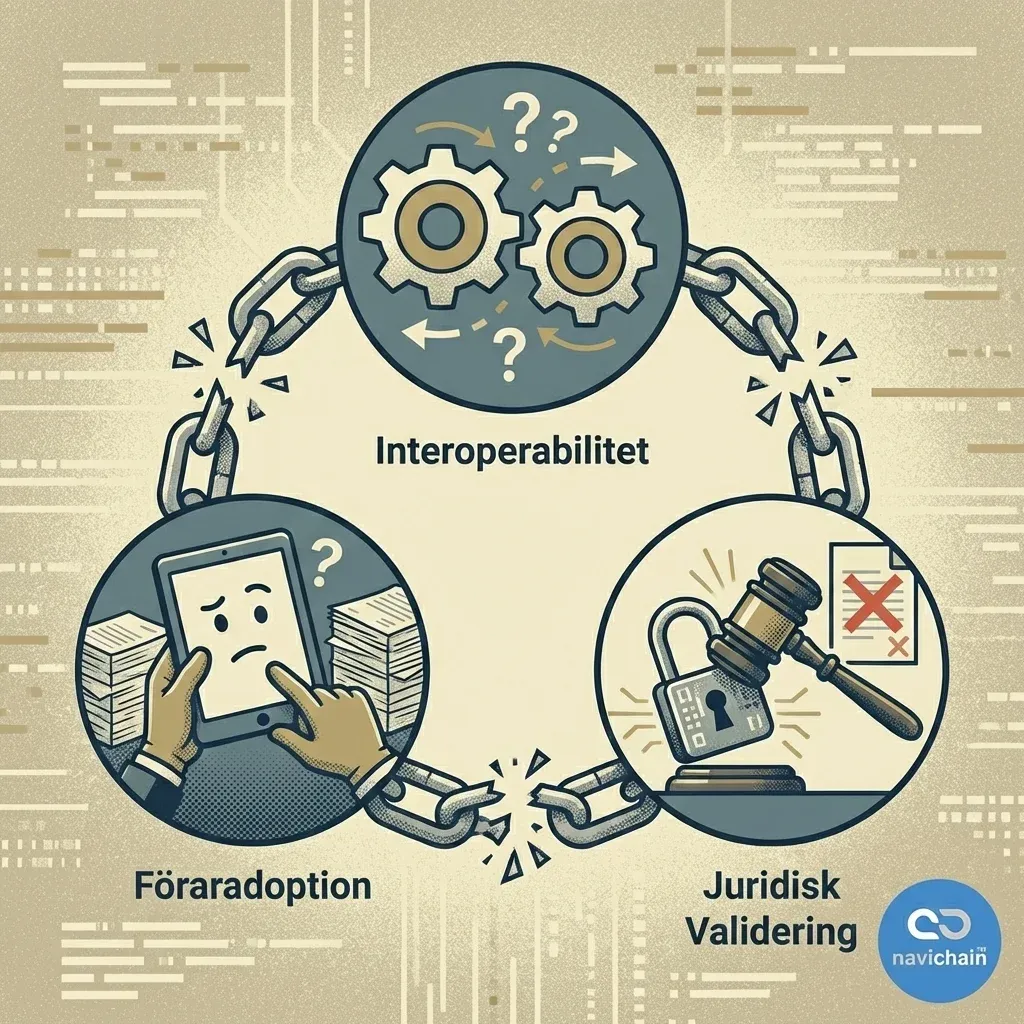
The diagram illustrates the main challenges with fragmented e-CMR solutions and lack of integration with existing systems.
Part 2: The human factor and adoption
Technology is often the easy part.
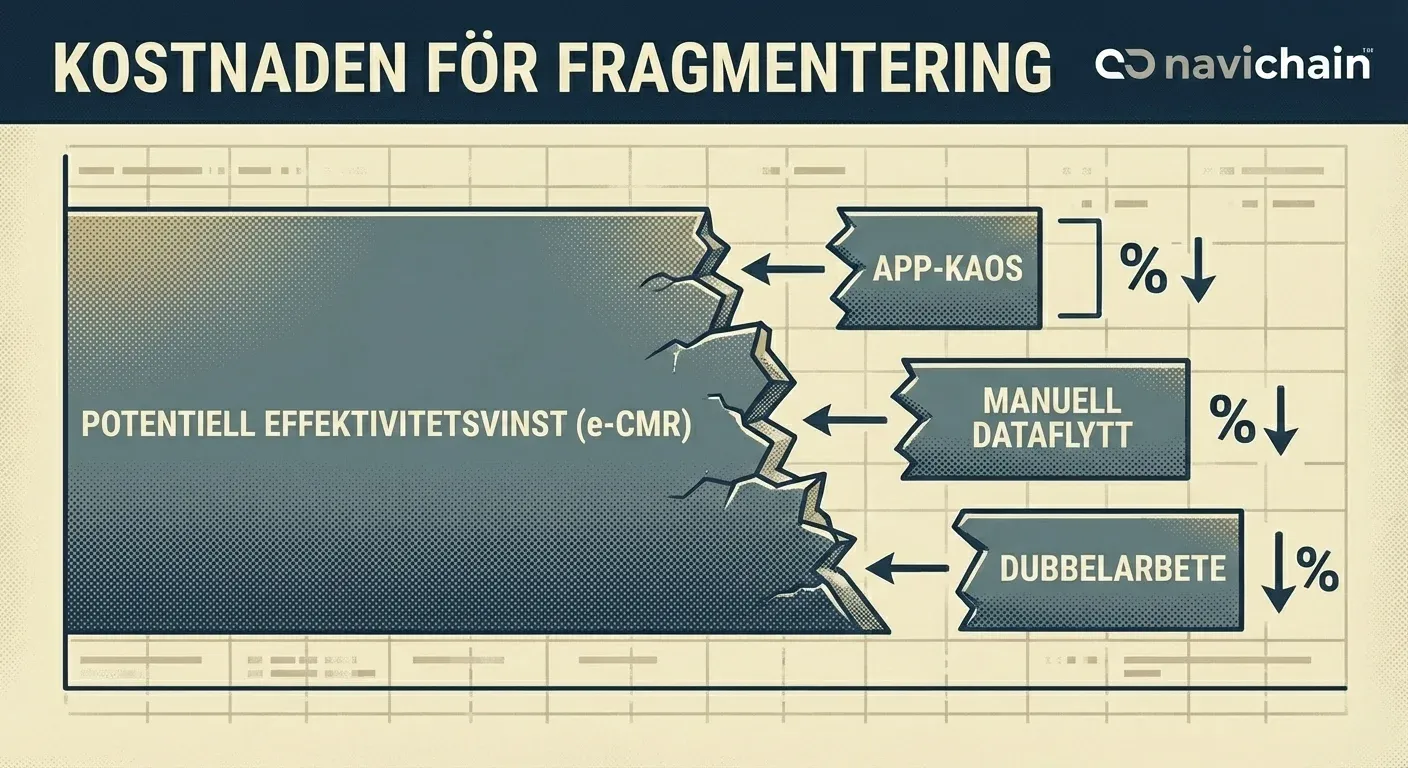
The diagram visualizes the main obstacles to successful e-CMR implementation, including technical challenges and user resistance.
Technology is often the easy part. People are the hard part. Logistics is an industry that has functioned for decades based on physical papers. The consignment note is not just a document; it is proof, a receipt, and a security blanket.
Driver resistance
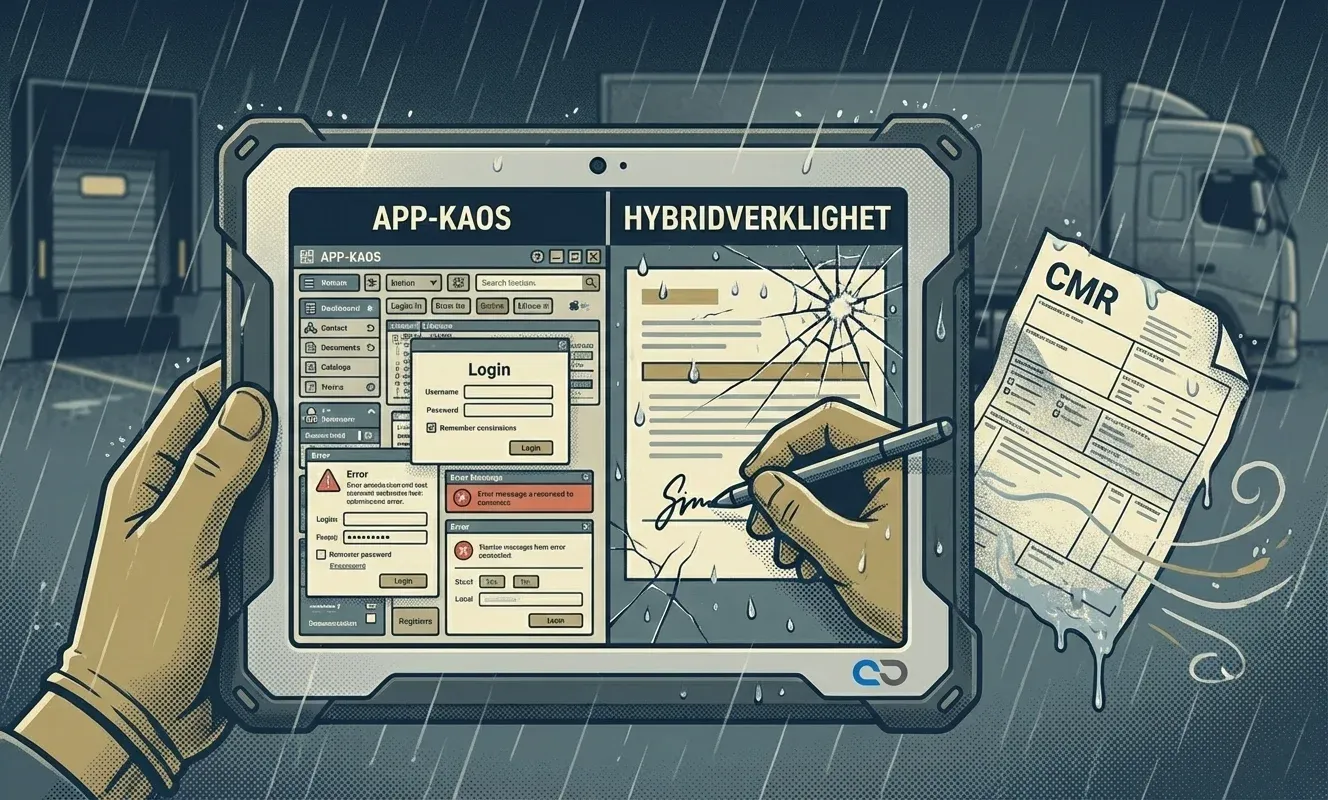
Asking a driver who has been driving for 30 years to replace his familiar paper block with a smartphone app is a significant change management challenge. * User-friendliness: Many e-CMR apps are designed by engineers, not for users who are standing in the rain on a loading dock with gloves on. Small buttons, cumbersome logins, and unclear flows create frustration. * Hardware troubles: Batteries run out, screens crack, coverage is missing. Paper works without a battery. When technology fails, the delivery stops, which creates an immediate economic consequence.
Hybrid chaos (the worst of two worlds)
During a transition period – which can last for years – many companies have to handle both paper and digital. Some recipients refuse to sign digitally. Some shippers do not print QR codes. The haulage company ends up in a "hybrid chaos" where they have to maintain dual routines. The risk of errors increases significantly when half of the information is digital and half is in a plastic pocket. The administrative work increases instead of decreasing.
Part 3: Legal validation and authority acceptance
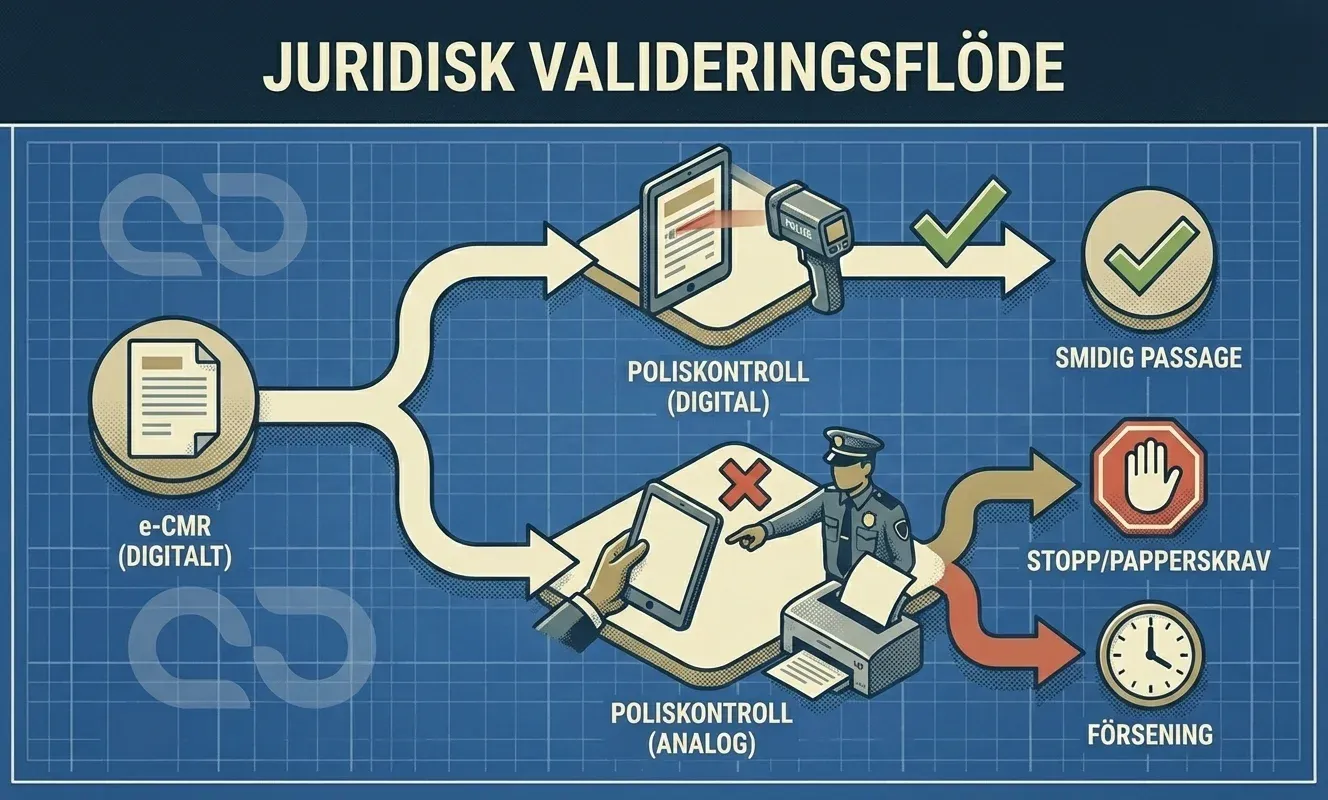
Although the e-CMR protocol has been ratified by many countries, its practical application by border police and inspectors is uneven.
Schematic overview of the challenges that arise when implementing e-CMR, including "hybrid chaos" and lack of legal acceptance.
Although the e-CMR protocol has been ratified by many countries, its practical application by border police and inspectors is uneven.
- Uncertainty at checks: A driver stopped at a road check in France or Poland may still encounter skepticism if they only show a screen. The fear of fines or delays means that many carriers continue to print paper copies "just in case". This eliminates the entire environmental benefit and efficiency of e-CMR.
- Burden of proof: In the event of a dispute over goods damage, the paper consignment note with a physical signature is a well-established legal instrument. The digital signature (Sign-on-Glass) has theoretically the same value, but the testing in court is less proven, which creates uncertainty for insurance companies and legal departments.
The solution: A pragmatic platform strategy
To overcome these challenges, logistics companies must stop seeing e-CMR as an isolated "app" or a separate project.
To overcome these challenges, logistics companies must stop seeing e-CMR as an isolated "app" or a separate project. It must be seen as an integrated part of the operational flow.
Schematic overview of a pragmatic platform strategy for e-CMR, where consolidation and user-centered design are the focus to facilitate implementation and overcome challenges.
Consolidation instead of app chaos
The solution to the interoperability problem is not to build more connections, but to use platforms that consolidate functions. Instead of a separate e-CMR app, the function should be built into the driver's daily tool for order management and routing. When e-CMR is a natural part of the "job" in the driver's handheld computer – not a separate app that needs to be opened and synced – friction is drastically reduced.
User-centered design
To win the drivers' trust, the tools must be extremely intuitive. * "One-click" signing: The process of handing over goods and obtaining a signature must be as quick as with paper and pen. * Work offline: The system must be robust enough to handle the signing process even in basements or remote areas where 5G is missing, and sync data when connectivity is restored.
Digital "bridges" for the hybrid world
A realistic strategy acknowledges that paper will be around for a while. Modern systems must be able to handle hybrid flows: scan a paper and digitize it directly, or generate a QR code that can be printed if the recipient requires it. Flexibility is the key to surviving the transition period.
A seamless and integrated e-CMR solution reduces friction and increases user-friendliness for all parties.
Navichain: E-CMR as a natural part of everyday life
Navichain takes a fundamentally different approach than standalone e-CMR providers. We understand that a haulage company doesn't need more apps, but better connected tools.
In the Navichain platform, e-CMR is not an add-on module. It is an integrated part of our Transport Management System (TMS). 1. Seamless integration: When a dispatch manager creates an order, the digital consignment note is automatically prepared. No double entry. 2. One app for everything: The driver sees the order, the route, and the consignment note in the same view. At delivery, the customer signs directly on the glass in the same flow that completes the job. 3. Hybrid-ready: We support both fully digital flows and situations where paper needs to be scanned and archived digitally. The system adapts to reality, not the other way around.
By baking e-CMR functionality into the core operating system, we eliminate fragmentation and make the digital step a natural evolution, rather than a technological revolution.
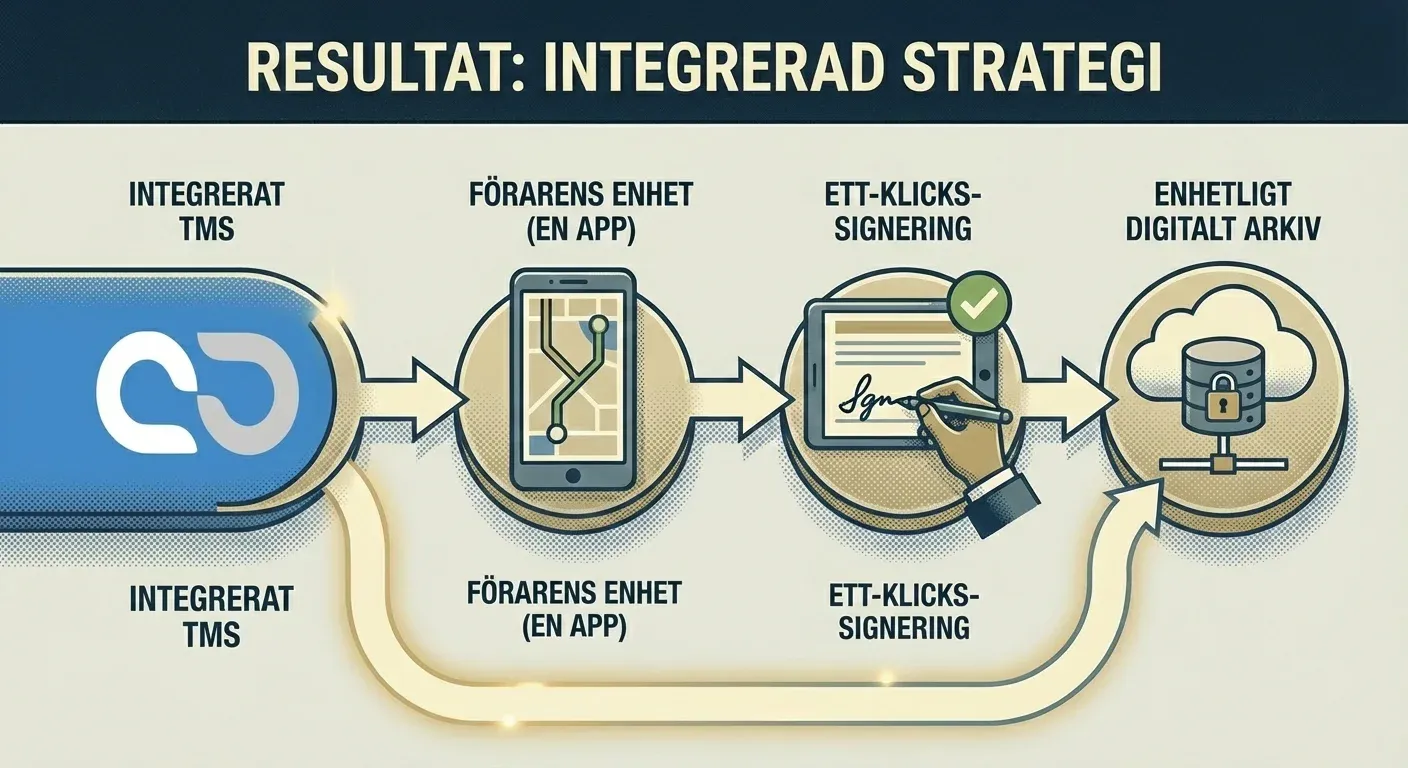
The result of an integrated e-CMR solution: reduced administration, increased transparency, and faster payments.
References/sources
- UNECE: Status of the e-CMR Protocol. https://unece.org/transport/standards/transport/vehicle-regulations-wp29
- IRU (International Road Transport Union): Implementing e-CMR in Europe - Practical Guide. https://www.iru.org/resources/tools-apps/e-cmr
- Digital Transport and Logistics Forum (DTLF): Report on Electronic Transport Documents. https://transport.ec.europa.eu/transport-themes/digital-transport-logistics-forum-dtlf_en
- Sveriges Åkeriföretag: Digitaliseringsguide för åkerier. https://www.akeri.se
Navichain offers a platform for digitizing logistics flows, which can streamline the implementation of e-CMR.
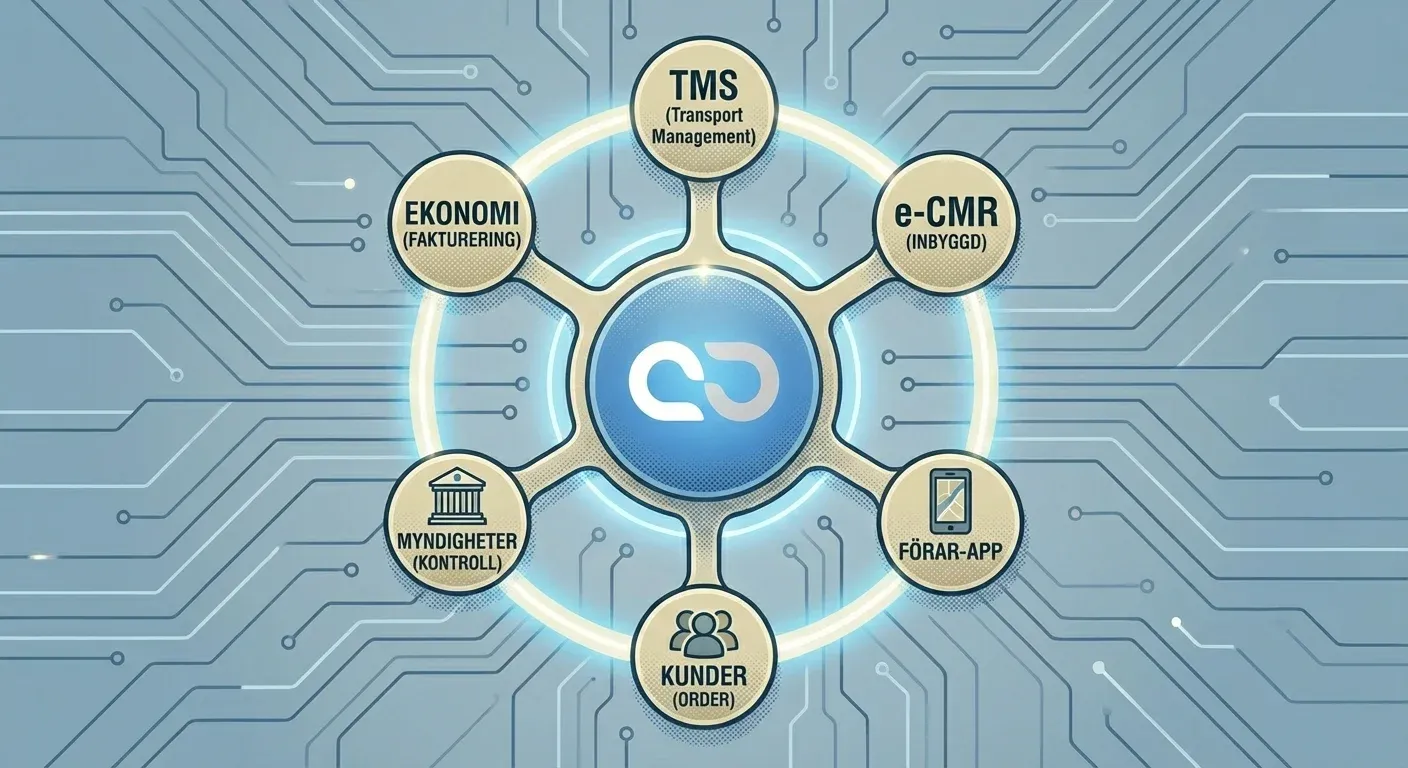
Navichain offers a platform for digitizing logistics flows. The platform can streamline the implementation of e-CMR.