The Paradox of Growth in European Haulage Industry: How Digitalization Breaks the Administrative Cost Curve During Scaling - Blog
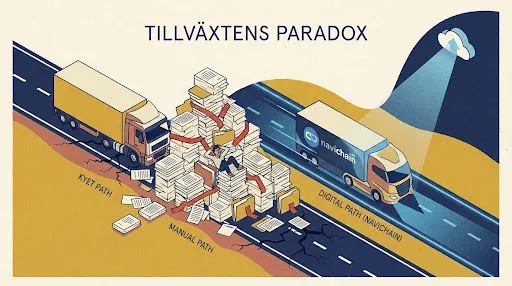
For European haulage companies, growth often leads to exponentially increasing administrative costs. This whitepaper explores how digitalization—particularly through cloud-based TMS and e-CMR—breaks the administrative cost curve, enabling haulage companies to decouple overhead from volume and achieve sustainable, profitable growth while ensuring compliance with the upcoming eFTI requirements.
Summary: * The Growth Paradox: Manual administrative costs increase linearly with new transport volumes, eroding operational economies of scale. * eFTI Compliance: The 2027 EU regulation makes digital freight documents mandatory, rendering paper-based processes obsolete. * Digital Decoupling: Integration of TMS and e-CMR transforms administration from a variable to a fixed cost, breaking the cost curve. * The Advantage of Navichain: A comprehensive SaaS platform designed to automate order management, route planning, and invoicing for structural profitability.
European haulage companies face a unique challenge: growth often leads to exponentially increasing administrative costs that erode profit margins. This whitepaper explores how digitalization – particularly through Navichain SaaS – can break this pattern and create structural economies of scale.
The European transport sector is characterized by fragmentation and tight margins. Traditionally, manual administrative processes have created a growth paradox where increased volumes lead to proportionally increased costs for handling paperwork, order administration, and invoicing. This whitepaper analyzes in depth how the implementation of digital solutions, such as cloud-based Transport Management Systems (TMS), What is EDI? Electronic Data Interchange (EDI/API) and electronic consignment notes (e-CMR), can decouple volume growth from administrative costs. We present quantified assumptions based on research and industry data showing how digitalization reduces time consumption, frees up working capital, and minimizes error rates. Navichain SaaS is positioned as a strategic solution to achieve structural economies of scale and ensure profitable growth in the future European logistics apparatus, particularly in light of the upcoming eFTI regulation. This whitepaper specifically addresses the challenges associated with manual processes and illustrates how a shift to digital workflows enables haulage companies to not only reduce their administrative costs but also increase their operational efficiency and improve cash flow. The whitepaper also emphasizes the importance of adapting to the new What is eFTI? EU regulation on electronic freight transport information (eFTI) which comes into full force by 2027 at the latest.
1. What is the European context for the fragmented market?

The European transport and haulage industry functions as a vital artery in the internal market but is characterized by a historical paradox: despite its importance for trade, it suffers from extreme fragmentation, intense competition, and thus tight profit margins, often around 2–5 percent (Trans.INFO, 2025). This fragmentation is further complicated by a disproportionately large administrative burden, which significantly impacts profitability. As a transport company grows in volume, it is theoretically expected to achieve economies of scale in the actual vehicle operation, e.g., through better fuel prices or optimized routes. Empirical research, however, shows a different reality for companies that rely on traditional, manual processes. Here, a pronounced growth paradox arises: the potential operational gains are neutralized – or even outweighed – by linearly, or even exponentially, increasing administrative overhead costs. These costs are directly related to the increased handling of paper documents, manual data entry, communication via phone and email, and the increased complexity of invoicing and payment handling.
From a broader European perspective, the transition away from this outdated way of working is no longer just a matter of competitive advantage but a necessary adaptation to new regulatory requirements. What is eFTI? The EU regulation on electronic freight transport information (eFTI – Regulation EU 2020/1056) represents a radical change. This regulation, which will be rolled out with full application by 2027 at the latest, obliges the authorities of member states to accept digital freight information, equivalent to paper-based documents. The eFTI directive aims to eliminate the remaining paper-based barriers at borders, estimated to cost the industry billions of euros annually (HOPI Logistics / EU Council Analytics, 2024). To achieve this, eFTI harmonizes the requirements for how data should be presented and exchanged between different actors in the supply chain, requiring a standardized and interoperable infrastructure. Companies that proactively adapt to eFTI will not only reduce their administrative costs but also position themselves as leaders in an increasingly digitalized market. Failure to adapt risks leading to competitive disadvantages and potential sanctions.
2. How does the manual trap create administrative diseconomies of scale?
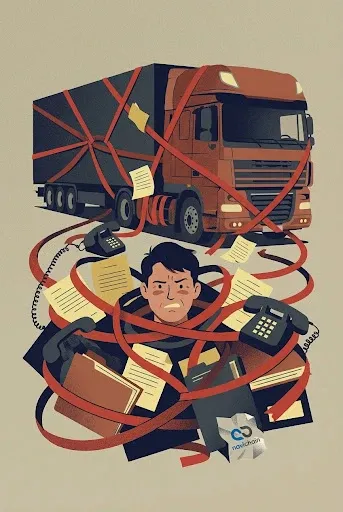
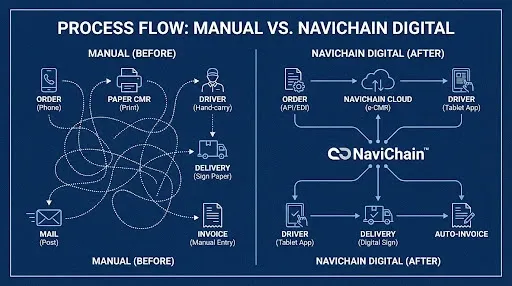
In a traditional, manually managed transport company, administration is often seen as an unavoidable variable cost, directly linked to each individual transport. Each international transport requires a multitude of documents, often in several copies: physical consignment notes (e.g., paper CMR), manual customs handling, and extensive communication via phone and email. This process is not only time-consuming but also prone to errors, leading to additional delays and costs.
When such a company expands its vehicle fleet, it quickly faces administrative diseconomies of scale. The administrative burden does not increase linearly but in many cases exponentially with the number of new assignments. More trucks inevitably mean that the company has to hire more dispatchers, payroll administrators, and invoicers at the same pace, eroding the potential economies of scale in vehicle operation. Furthermore, industry data shows that manual order handling often involves long lead times – from receiving an order to final delivery confirmation, it can take 2–3 days, excluding the time drivers themselves spend handling paperwork. This long lead time affects not only customer satisfaction but also the company's cash flow, as invoicing is delayed. Growth in a manual context inevitably leads to more human error sources (data entry errors), creating hidden costs in the form of customer disputes, delayed payments, and increased need for corrective actions. These errors can include incorrect data entry in invoices, incorrect delivery addresses, and misunderstandings regarding delivery terms, which in turn require additional time and resources to correct. The consequences of these errors range from reduced customer satisfaction to increased administrative costs and potential legal problems.
A concrete example of the administrative diseconomies of scale is the handling of consignment notes. Each consignment note requires manual entry of information, including sender, recipient, item description, weight, and volume. This information must then be transferred to various systems for transport planning, invoicing, and reporting. In a manual environment, this is a time-consuming and repetitive process that increases the risk of errors. With an increase in the number of consignment notes, the need to hire more administrators to handle this workload also increases. This leads to increased payroll costs and reduced profit margins.
Furthermore, the manual handling of documents creates a lack of transparency and real-time information. It is difficult to track shipments and get an overview of the entire supply chain. This can lead to delays, lost shipments, and reduced customer satisfaction. Additionally, the manual handling of documents hinders the ability to analyze data and identify areas for improvement. This prevents the company from optimizing its processes and reducing costs.
3. How can digital decoupling build structural economies of scale?
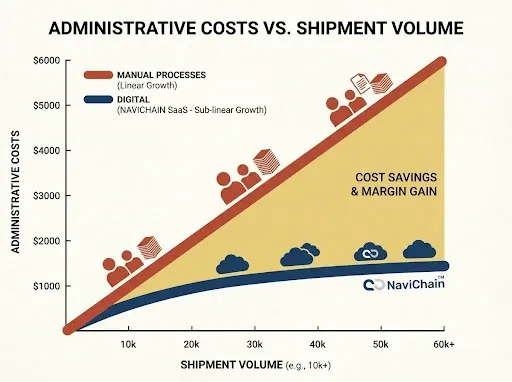
Companies that strategically invest in deep digitalization – by implementing cloud-based Transport Management Systems (TMS) such as Navichain SaaS, What is EDI? Electronic Data Interchange (EDI/API) for seamless data exchange, and electronic consignment notes (e-CMR) – fundamentally transform their cost structure. This digital transformation not only creates operational efficiency gains but also a strategic advantage by decoupling volume growth from administrative costs.
Digitalization acts as a decoupling mechanism between volume growth and administrative growth. By entering data once and automatically validating it throughout the supply chain, administration is transformed from a variable to a fixed (or sub-linear) cost. A digitalized system handling 1,000 freight documents can scale up to 10,000 or even 100,000 without requiring a proportional or even noticeable increase in staff. The marginal cost of administration per new order thus approaches zero, meaning that the company's growth directly contributes to an increased profit margin and improved competitiveness. This decoupling is enabled by the automation of repetitive tasks, standardization of processes, and centralization of data.
Navichain SaaS offers a comprehensive platform for digitalizing transport processes. By integrating functions for order management, transport planning, tracking, and invoicing into a single cloud-based solution, Navichain SaaS eliminates the need for manual data entry and reduces the risk of errors. The platform also enables seamless communication and data exchange between different actors in the supply chain, increasing transparency and efficiency. With Navichain SaaS, transport companies can automate the entire invoicing process, from creating invoices to payment reminders. The platform integrates with existing accounting systems and enables automatic reconciliation of payments. This reduces the administrative workload and improves cash flow. Navichain SaaS also facilitates the implementation of e-CMR, further reducing the need for paper documents and speeding up the delivery process. By digitalizing the consignment notes, transport companies can reduce their administrative costs, improve transparency, and minimize the risk of lost or damaged documents.
Concretely, this means that companies can handle an increasing volume of transports without needing to hire more administrators. The existing resources can instead focus on more strategic tasks, such as developing new business areas and improving customer relationships. Digitalization also enables a more data-driven approach to transport planning and optimization. By analyzing data from various sources, companies can identify inefficiencies and optimize their routes, reduce fuel consumption, and improve delivery precision. This leads to further cost savings and increased profitability. By using real-time data, transport companies can proactively manage deviations and avoid delays. This increases customer satisfaction and strengthens the company's competitiveness. Additionally, digitalization contributes to a more sustainable transport sector by reducing paper consumption and optimizing resource use.
4. What are the quantified assumptions for exponential profit?
Based on a synthesis of current research, European industry data, and analysis of successful digitalization projects, we can formulate quantified assumptions about how costs behave when a transport company grows, for example, by adding 10,000 new freight assignments per year. These assumptions provide a concrete picture of the potential benefits of digitalization and underscore the importance of investing in the right technology.
Assumption 1: Reduced Time Consumption and Direct Costs
Quantification: According to European pilot studies and industry analyses (including Trans.INFO, 2025), the transition from paper CMR to e-CMR reduces administrative time consumption by up to 60% per shipment and lowers direct document handling costs by nearly 70%. According to logistics experts (HOPI Logistics / EU Council Analytics, 2024), companies save between 20–50% of their total documentation costs. With a growth of 10,000 assignments, this results in radical savings in pure payroll costs and materials for the digital company, while the manual company must hire more administrators. For example, a company handling 10,000 consignment notes per year can save up to 6,000 hours by switching to e-CMR. This corresponds to the cost of several full-time positions. Additionally, the company reduces its expenses for paper, printing, and archiving. At the same time, the company can increase its productivity and efficiency by automating repetitive tasks and freeing up resources for more strategic activities.
Assumption 2: Cash Flow and Financing Growth (Working Capital)
Quantification: Manual processes require physical documents (Proof of Delivery) to be sent back before invoicing can take place, delaying payment. A scientific study published in MDPI (Gnap et al., 2022) examined the effect of e-CMR and found that digitalization shortens the average invoicing delay by a full 11.5 days. This immediately frees up approximately 7% of the tied-up working capital. A fast-growing digital company can use these funds to finance its own expansion interest-free (e.g., leasing new vehicles or investing in new technology), while the manual company risks acute liquidity shortages and is forced to utilize expensive overdrafts. This can be illustrated with an example: a company with an annual turnover of 10 million kronor can free up 700,000 kronor in working capital by digitalizing its invoicing processes. This capital can be used to finance the company's growth or invest in new business opportunities.
Assumption 3: Operational Efficiency and Error Rate
Quantification: According to McKinsey & Company, automation in the logistics sector can reduce total operational costs by 10 to 15% and shorten the total order processing time from days to 1–2 hours (Zyllem / McKinsey & Company Analytics, 2024). Automated data validation eliminates the input errors that, in a manual environment, increase proportionally with growth and cause costly rework. By reducing the error rate, companies can minimize their costs for corrective actions, improve customer satisfaction, and avoid legal problems. Additionally, time and resources are freed up that can be used to focus on more strategic activities. Concretely, a company that digitalizes its processes can reduce the number of incorrect invoices by up to 80%. This reduces the need to handle customer disputes and correct incorrect payments. At the same time, the company can improve its customer service by providing faster and more accurate information.
Conclusion: A transport company cannot "hire its way out" of its growth challenges. Companies that continue to work manually build in expensive, variable overhead costs that risk erasing the profit from new volumes. These companies will struggle to compete in an increasingly digitalized market. Those that digitalize their processes, on the other hand, build a platform where each new transport assignment is performed with an administrative marginal cost that is close to zero, which is an absolute prerequisite for survival and profitable growth in the future European logistics apparatus. Navichain SaaS offers a scalable and flexible solution for digitalizing transport processes and freeing companies from the administrative cost paradox. By investing in Navichain SaaS, transport companies can create a competitive advantage and ensure long-term profitability.
5. How does digitalization affect work processes in logistics?
The implementation of Navichain SaaS and digital solutions in logistics fundamentally transforms traditional work processes, leading to a more streamlined and efficient operation. This transformation encompasses several key areas:
Order Management: In a manual environment, order management often involves paper-based documents, phone communication, and manual data entry into various systems. This is a time-consuming and error-prone process. With Navichain SaaS, order management is automated, reducing the need for manual input and communication. Customers can place orders online, and the information is automatically transferred to the transport planning system. This reduces the risk of errors and speeds up the order process.
Transport Planning: Traditional transport planning is often done manually, using maps, tables, and experience. This is a complex and time-consuming task, especially for companies with a large vehicle fleet and many destinations. Navichain SaaS offers advanced transport planning functions that optimize routes, minimize fuel consumption, and improve delivery precision. The system takes into account factors such as traffic conditions, weather conditions, and load capacity to create the most efficient routes.
Tracking and Monitoring: In a manual environment, it is difficult to track shipments and get an overview of the entire supply chain. This can lead to delays, lost shipments, and reduced customer satisfaction. Navichain SaaS offers real-time tracking of shipments, allowing customers to follow their goods from sender to recipient. The system generates automatic notifications of delays or deviations, enabling the company to proactively manage problems and inform customers.
Invoicing and Payment: Manual invoicing is a time-consuming and error-prone process. Invoices must be created manually, sent by mail, and followed up for payment. Navichain SaaS automates the invoicing process, from creating invoices to payment reminders. The platform integrates with existing accounting systems and enables automatic reconciliation of payments. This reduces the administrative workload and improves cash flow.
Reporting and Analysis: In a manual environment, it is difficult to collect and analyze data on transport processes. This prevents the company from identifying areas for improvement and optimizing its processes. Navichain SaaS offers comprehensive reporting and analysis functions that provide the company with insights into its transport processes. The system generates reports on key performance indicators (KPIs), such as delivery precision, fuel consumption, and customer satisfaction. These reports can be used to identify inefficiencies and optimize processes.
About the Author: Manusha works with system integration and logistics automation at navichain. He specializes in helping transport and healthcare companies eliminate administrative complexity through secure, scalable SaaS solutions.
6. What are the scientific sources and references?
Gnap, J., Senko, Š., Kostrzewski, M., & Brída, P. (2022). The Impact of Digitization Transport Documents on the Competitiveness of Road Freight Transport Companies. MDPI. European Union (2020). Regulation (EU) 2020/1056 of the European Parliament and of the Council on electronic freight transport information (eFTI). Trans.INFO (2025). "The real numbers behind eCMR: 70% cost reduction, 60% time savings". Zyllem / McKinsey & Company Analytics (2024). "Manual vs. Digital: Transforming Transport Management and Distribution Logistics". HOPI Logistics / EU Council Analytics (2024). "Document Digitalization in Freight Transport".
Further reading: * Deloitte. (2023). Digital Transformation in Logistics: Opportunities and Challenges. * PwC. (2024). The Future of Logistics: A Data-Driven Perspective. * Accenture. (2025). Logistics 4.0: Revolutionizing the Supply Chain. * Gartner. (2026). The Top 10 Strategic Technology Trends Impacting Supply Chain in 2026.
**
Ready to break the administrative cost curve and thus decouple your growth from overhead costs? Navichain SaaS gives you the platform for the future of digital logistics without the need for heavy IT integrations.**