Find the bottleneck that costs you the most - Theory of Constraints
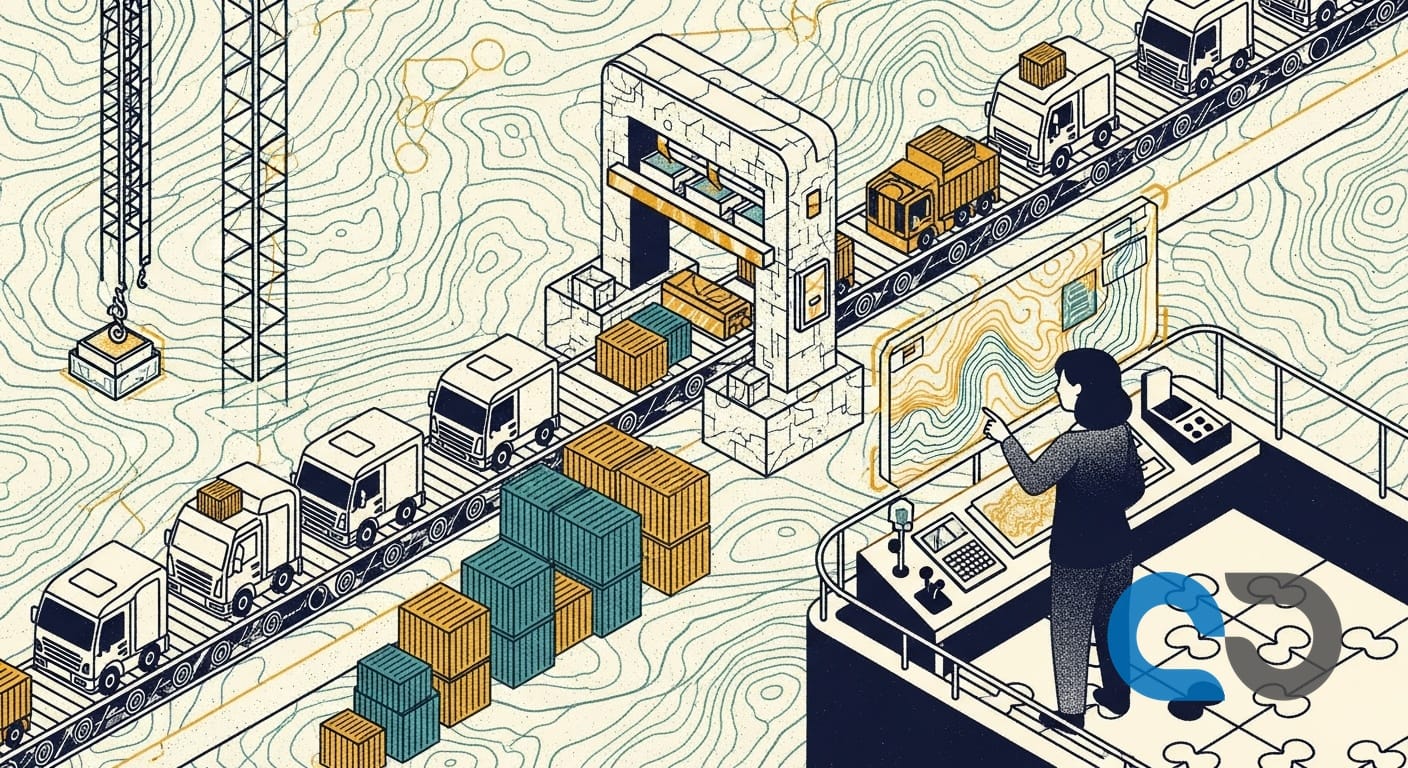
A chain is only as strong as its weakest link. That sounds obvious – but most companies spend their improvement budget on the strong links. They buy more trucks when it's actually the loading dock that's slowing things down. They invest in GPS optimization when it's the documentation process that's causing delays. The result is a more expensive flow that isn't one bit faster.
Theory of Constraints – TOC – is the methodology that flips the logic. Instead of improving everything a little bit, all energy is focused on the single factor that actually limits the entire system's performance.
Improving a non-bottleneck is a waste of time and money. If the port is clogged, you're just creating a bigger parking lot.
What is Theory of Constraints?
Eliyahu Goldratt introduced TOC in his classic The Goal (1984), and the methodology has since been reshaped into one of the most robust frameworks in operations management. The core is simple: a system can always perform up to its weakest link – never better. There is always exactly one place that limits the flow.
In logistics, the bottleneck can be anything: a weigh station, a documentation process, a crane in a terminal, or even a single regulation that slows down customs. The problem is that it's not always visible on the surface. It looks like there are too few trucks – but it's actually the unloading dock that's slowing down the entire queue.
Basic Definition
Theory of Constraints defines a constraint as the single resource or process whose capacity is lower than the demand on it. It and only it determines the system's total throughput.
The logic is mathematical: if the bottleneck processes 80 units per hour, the entire system can never produce more than 80 units per hour – no matter how much you improve everything else.
The Five Focusing Steps
Goldratt formulated five steps that form the core of the TOC methodology. They are designed to be iterated – when one bottleneck is eliminated, a new one always emerges.
Find the system's constraint. Where does the queue build up? Where is the freight waiting? It's rarely where it seems.
Extract maximum from the existing bottleneck without spending more money on it. Make sure it never stops.
Let everything else in the system adapt to the bottleneck's pace. Don't send more into the system than the bottleneck can handle.
Invest now – add resources, automate, restructure the bottleneck if steps 1–3 aren't enough.
Inertia must not become the next constraint. An eliminated bottleneck is replaced by a new one – start the process over.
The Illusion of Local Optima
This is the hardest to understand intuitively: improving a non-bottleneck is literally a cost without return. It's what Goldratt calls "local optima" – you optimize part of the system and measure it in isolation, without seeing that the whole doesn't change.
Classic examples in transport and logistics:
The haulage company invests in GPS optimization to shorten driving time. The problem: trucks are already waiting two hours at each customer due to manual documentation. Driving time is not the bottleneck.
The terminal buys an extra truck to move freight faster. The bottleneck is customs handling – the freight piles up anyway in the warehouse waiting for release.
The same terminal identifies that the customs system is the bottleneck and automates the documentation. Release time is halved – the rest of the flow can now perform at full capacity.
What the Data Says
TOC implementations in transport and logistics operations consistently show measurable results – often already in the first year of operation.
The last figure is the one that hits hardest: a haulage company that identifies that loading time – not driving speed – is the bottleneck can double its fleet utilization without buying a single new vehicle. Capital was not the problem. The diagnosis was.
What It Looks Like in Practice
Let's take a concrete transport scenario and go through the five steps:
Scenario: The Weigh Station is the Bottleneck
Trucks queue up to the weigh station. This is where the system gets stuck – not on the roads.
The weigh station is staffed during lunches and shift changes. It never stops for its own reasons.
Trucks do not leave the terminal until the weigh station signals that it is ready. No freight is pressed into an already full system.
Steps 1–3 not enough? Build a second jetty. Now with the basis for the right investment.
The flow increases for the entire system. The next bottleneck is now visible – the cycle begins again.
The key concept Drum-Buffer-Rope describes the rhythm: the bottleneck is the drum that sets the pace, the buffer protects the bottleneck from upstream disturbances, and the rope prevents more freight than necessary from being sent into the system.
Navichain as a Digital Flow Drum
TOC requires two things: visibility and discipline. Without data, you don't know where the bottleneck is. Without a system that keeps the entire operation disciplined towards the flow, the subordination loses power.
The Digital Drum
Navichain functions as the "drum" in your supply chain. The platform's analytics features visualize in real-time where freight piles up – where waiting times occur, where the documentation flow gets stuck, where vehicles stand still when they should be rolling.
The result is a decision basis that is difficult to achieve manually: "You have plenty of trucks – but your documentation process is the bottleneck." It is this kind of insight that makes investment decisions land correctly.
Explore Navichain Analytics →Real-World Applications
TOC is not an academic idea. Three of the world's most operationally effective organizations have built their performance on bottleneck thinking:
The fryer baskets are the eternal bottleneck. The entire kitchen flow – from ordering to assembly – is subordinated to the fryer never being empty. It's no coincidence that a Big Mac is always ready in 90 seconds.
Assembling an airplane involves thousands of components. Boeing uses TOC to control just-in-time deliveries to the specific assembly station that is the bottleneck – the rest of the supply chain adapts to it.
Ground turnaround time is the bottleneck. Southwest eliminated assigned seating and used double doors for boarding. The result: airplanes that spend more time in the air per day than competitors.
Strategic Conclusion
Stop polishing the strong links. Identify the broken link – and put all the power there. An improvement that doesn't affect the bottleneck is a cost that doesn't show up in the result.
Sources & Further Reading
- Harvard Business Review – Operations Management
- Investopedia – Business Essentials
- Lean Enterprise Institute – lean.org
- Eliyahu M. Goldratt – The Goal: A Process of Ongoing Improvement (1984)