The Insight Paradox: Why More Data Leads to Poorer Operational Decisions
🇬🇧 Read this article in English
Scandinavian logistics managers face enormous pressure to optimize complex routes, such as choosing between transshipment and direct delivery to the customer. Despite investments in multiple systems (TMS, WMS, invoicing), these high-risk decisions remain a daily "best guess." The conventional belief is that more data from more specialized tools leads to better insights. Reality is the opposite. This data fragmentation creates a "data-rich, insight-poor" paradox, making it impossible for AI to analyze operations holistically and provide the decision support you need. This white paper presents a strategic framework to break this paradox. It outlines a plan for a unified, sovereign logistics operating system – one that functions as a single source of truth, enabling embedded AI to finally deliver clear, actionable answers to your most critical operational questions.
The data-rich, insight-poor paradox
A multitude of factors, from fuel prices to delivery windows, make route optimization a daily challenge for Swedish haulage companies.
For the owner of a small to medium-sized (SME) haulage company in Sweden, the day is governed by thousands of high-risk decisions. Nothing is more enduring, or more costly, than the route problem. An order comes in. Should it be consolidated at a transshipment terminal (transshipment) or sent directly to the customer? The answer depends on a dizzying array of variables: fuel costs, driver availability, warehousing fees, the customer's delivery window, and the potential for a backhaul.
Today, this decision is usually made by an operations manager who relies on experience, spreadsheets, and gut feeling. It's a process that has worked for decades, but now it's breaking under the pressure of modern logistics. Why? You're collecting more data than ever, but you have less insight.
This is the central challenge for European SME logistics: the "Data-Rich, Insight-Poor" Paradox.
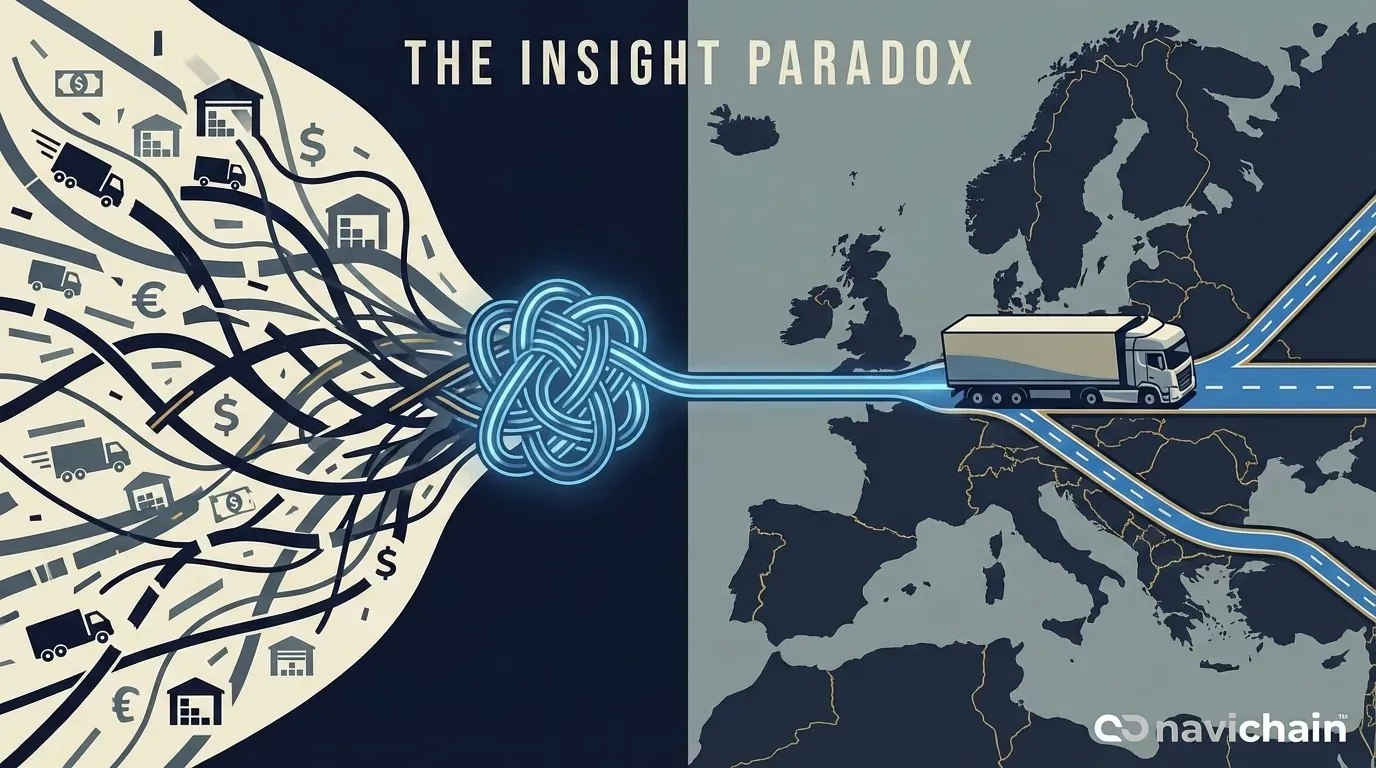
*Schematic overview of how data fragmentation leads to poorer decision-making in logistics.
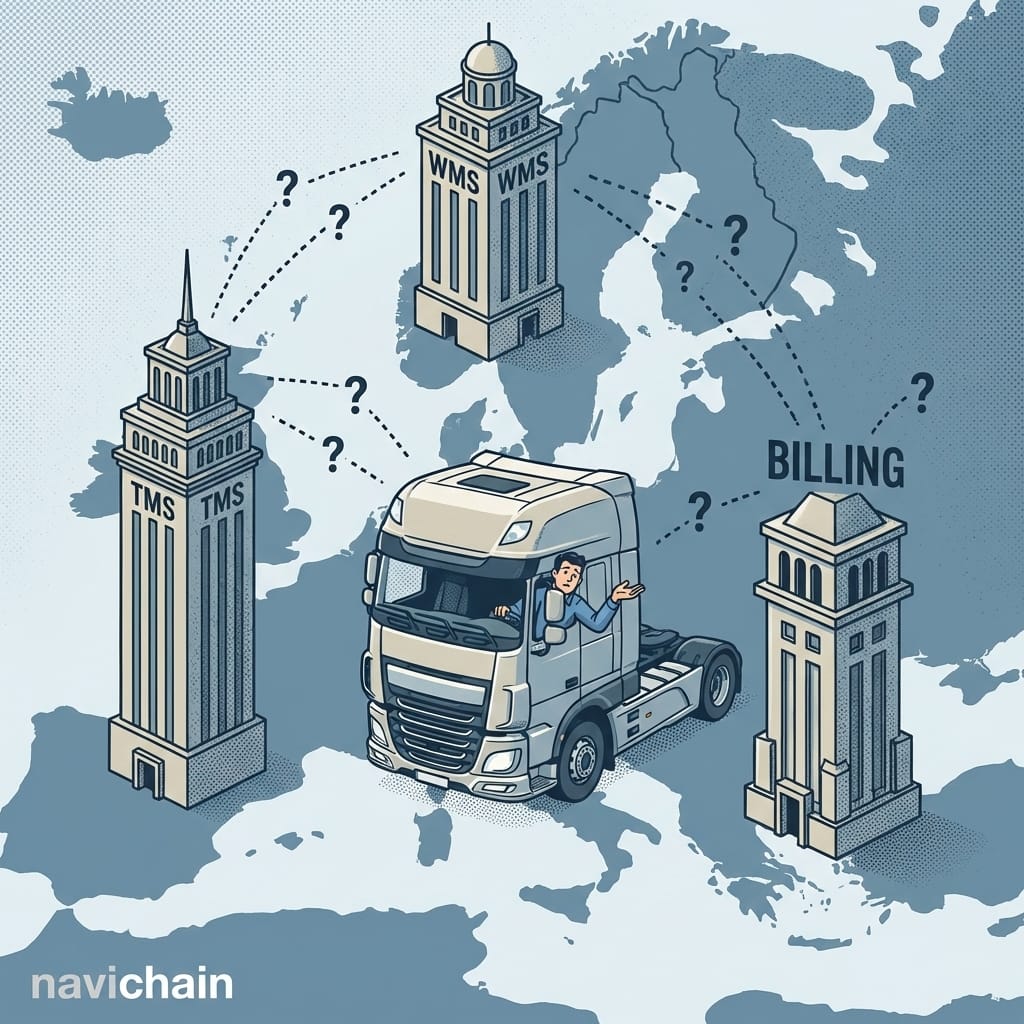
Your company likely works with a familiar collection of technologies. You have a Transportation Management System (TMS) to plan routes, a Warehouse Management System (WMS) to track inventory, an invoicing system to manage invoices, and perhaps telematics data streaming in from your fleet. Each of these systems is "best in class" and was purchased to solve a specific problem.
Individually, they work. Collectively, they create data silos.
Information from your TMS does not automatically account for the real-time labor costs in the warehouse from your WMS. Fuel consumption data from your telematics is not dynamically linked to profitability per customer in your invoicing system.
Because this data is fragmented – locked in separate applications, in different formats – it's impossible to analyze it holistically. You can't see the patterns. You can't identify the trends. You can't ask a simple, critical question like: "What was the real, total cost of 'Order 45B' compared to 'Order 46C'?" You are data-rich, but insight-poor. And that's where your profit margins are slipping away.
The AI opportunity gap
The industry buzzes with promises of artificial intelligence (AI). Larger competitors are already using it to optimize networks, predict maintenance, and automate pricing. You know this technology can solve your most complex problems. An AI could analyze all your operational variables in seconds and tell you the optimal choice between transshipment and direct routing for each individual order, saving you millions of kronor.
But there's a catch. AI can't work on fragmented data. It requires a single, clean, unified source of truth. Your data silos make it impossible for an AI to get the 'decision support' you so desperately need. This creates an AI Opportunity Gap, where the technology that could save your company is made useless by an architecture not designed for it.
This white paper isn't about the theoretical benefits of AI. It's a strategic plan for SME leaders to restructure their business, break down data silos, and build the foundation required to unlock true, AI-driven decision-making.
The high-risk guess: A case study in routing
Let's revisit the daily routing decision: transshipment vs. direct delivery. This single choice serves as the perfect microcosm for the SME data crisis.
On the surface, the choice seems simple. A direct delivery is faster but may involve an inefficient route for a single pallet, potentially with an empty backhaul. Transshipment enables consolidation, creating a more efficient full truckload (FTL) for the long haul, but it adds handling costs, time, and complexity at the terminal.
To make the correct (i.e., most profitable) decision, a logistics manager would immediately need to know and calculate the interplay of at least six dynamic variables for each individual order:
- Vehicle and fuel costs: What is the specific cost per kilometer for the available truck, and how does the direct route compare to the two-legged transshipment route?
- Driver hours (HOS): Does the driver for the direct route have enough legal driving hours, or will it force them into a costly overnight break? Would the consolidated route be more compatible?
- Warehousing costs: What is the exact, variable cost of receiving, sorting, and transshipping the specific pallet at your transshipment terminal? Most SME companies don't know this; they use a blended average.
- Customer delivery window (SLA): The direct route is faster. But is it too fast? Will the customer even be there to receive it? Or does the SLA allow the 12-hour delay of consolidation, making it a profitable, cheaper alternative?
- Network density: What other orders are in the system right now going to the same geographic area? Can you build a profitable direct route with multiple stops, or is consolidation the only way?
- Backhaul and asset utilization: Does the direct route leave the truck empty and stranded, while the transshipment route places it perfectly for a scheduled high-quality pickup?
Why gut feeling fails
No human, no matter how experienced, can perform this complex, multi-variable calculation in real-time across hundreds of orders per day.
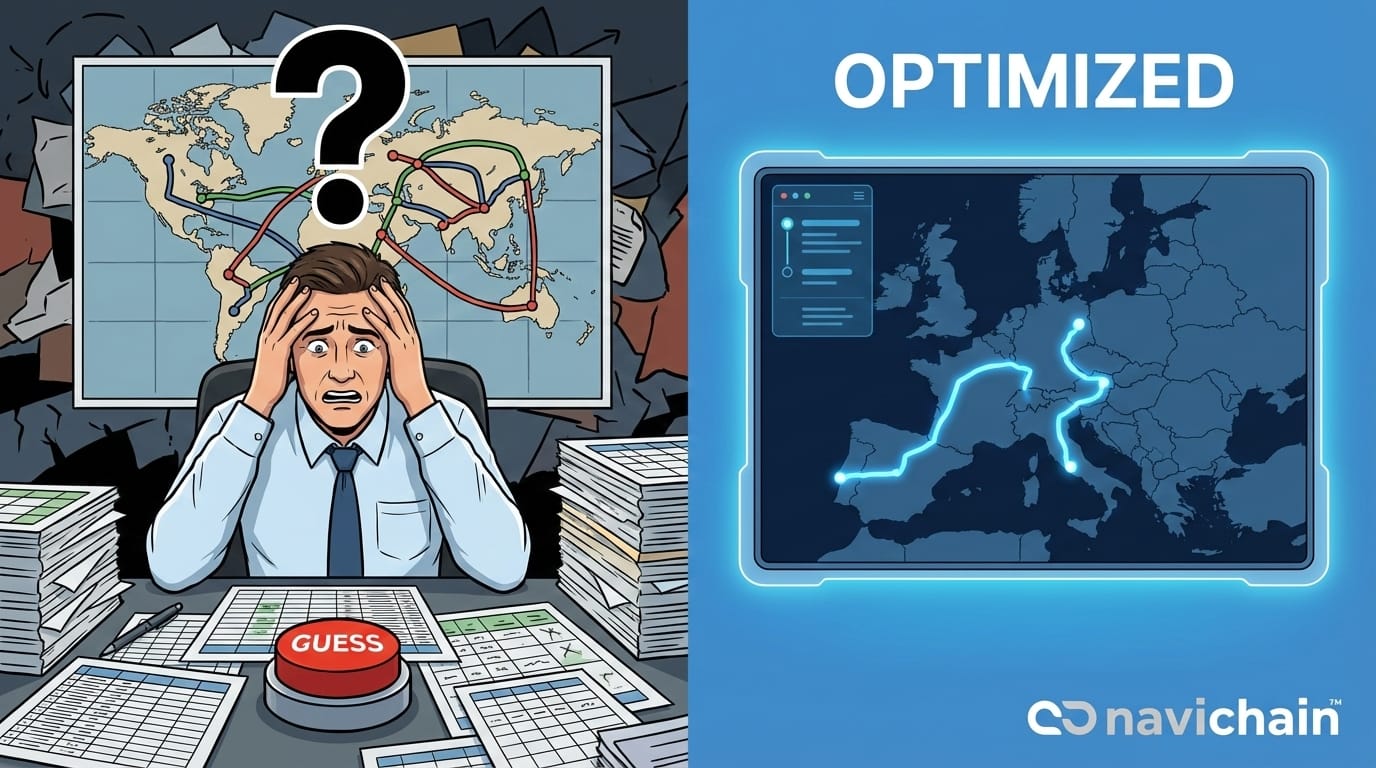
The diagram illustrates the complexity of decision-making for route optimization, where several factors must be weighed to achieve maximum efficiency and profitability.
This is not a problem on a human scale; it's a mathematical optimization problem. Your operations manager is forced to make a "best guess" based on experience. Sometimes they're right, and sometimes they're wrong. But without a unified data system, you have no way to even know when a decision was wrong, or how much the bad guess just cost you.
This is the strategic vulnerability that large carriers, with their unified platforms and data science teams, exploit. They don't guess. They calculate. The SME company, left to rely on instinct, competes in an analytics-driven market with one hand tied behind its back.
The hidden risk: When your data isn't your own
Let's assume you solve the fragmentation problem. You've invested heavily, perhaps with the help of integration tools (iPaaS) or a data lake, to bring all your data together in one place. You're ready to deploy an AI model. Now you're facing a second, more insidious problem: data sovereignty.
Where is your data? For the vast majority of European SME companies, the answer is in a public cloud – likely one hosted by a large American provider (e.g., AWS, Microsoft Azure, or Google Cloud). This has become standard, sold on the promise of scalability and low cost.
This standard choice creates a profound strategic risk. Your company's most sensitive operational data – your customer lists, your pricing, your routes, your driver information – is now physically stored in data centers outside your legal jurisdiction. This data is subject to foreign legislation, particularly the U.S. CLOUD Act (Clarifying Lawful Overseas Use of Data Act).
Cloud Act vs. GDPR
The U.S. CLOUD Act gives U.S. authorities the power to compel U.S. tech companies to hand over data stored on their servers, regardless of where in the world the server is located. This creates a direct and irreconcilable conflict with Europe's General Data Protection Regulation (GDPR).
- GDPR requires that you, the data controller, protect your customers' data and ensure it is not transferred or accessed illegally outside the EU.
- CLOUD Act allows a foreign government to access exactly that data, often without your knowledge or consent.
This puts you in an impossible situation. You are legally responsible under GDPR for a data access event that you have no power to prevent. The fines for non-compliance are high, but the damage to your customers' trust is fatal. How can you promise your customers that their sensitive consignment notes are secure when you yourself don't have ultimate control over them?
This is not just a compliance nightmare; it's a strategic dead end. You cannot build your company's core intelligence – your own AI models, your optimized route books – on a data foundation that is legally compromised. True operational resilience requires not just unified data, but sovereign data.
From diagnosis to design: The plan for a resilient logistics operating system
We've established two core challenges: the insight paradox (fragmented data) and the sovereignty risk (compromised data). Solving these problems isn't about buying yet another software. It requires a new strategic plan, a fundamental redesign of your technical foundation.
This plan is built on a "Logistics Operating System" (Logistics OS) concept, built on three non-negotiable principles. This is the checklist against which you must measure all future tech investments.
Principle 1: The unified operational network
First, you must eliminate data silos. This means you must move away from a collection of separate applications and toward a single, integrated platform where all core functions work as one. Your TMS, WMS, Asset Management, Billing, and Order Management should not be "connected" with fragile APIs; they must be embedded components in the same system, all reading from and writing to a single database.
This creates a unified operational network, a "central nervous system" for your entire business. When a new order is created, the routing engine (TMS) immediately sees real-time inventory and labor capacity (WMS), asset maintenance schedules (Asset Mgt), and the customer's payment history (Billing). This is the only way to achieve a single, undisputed source of truth.
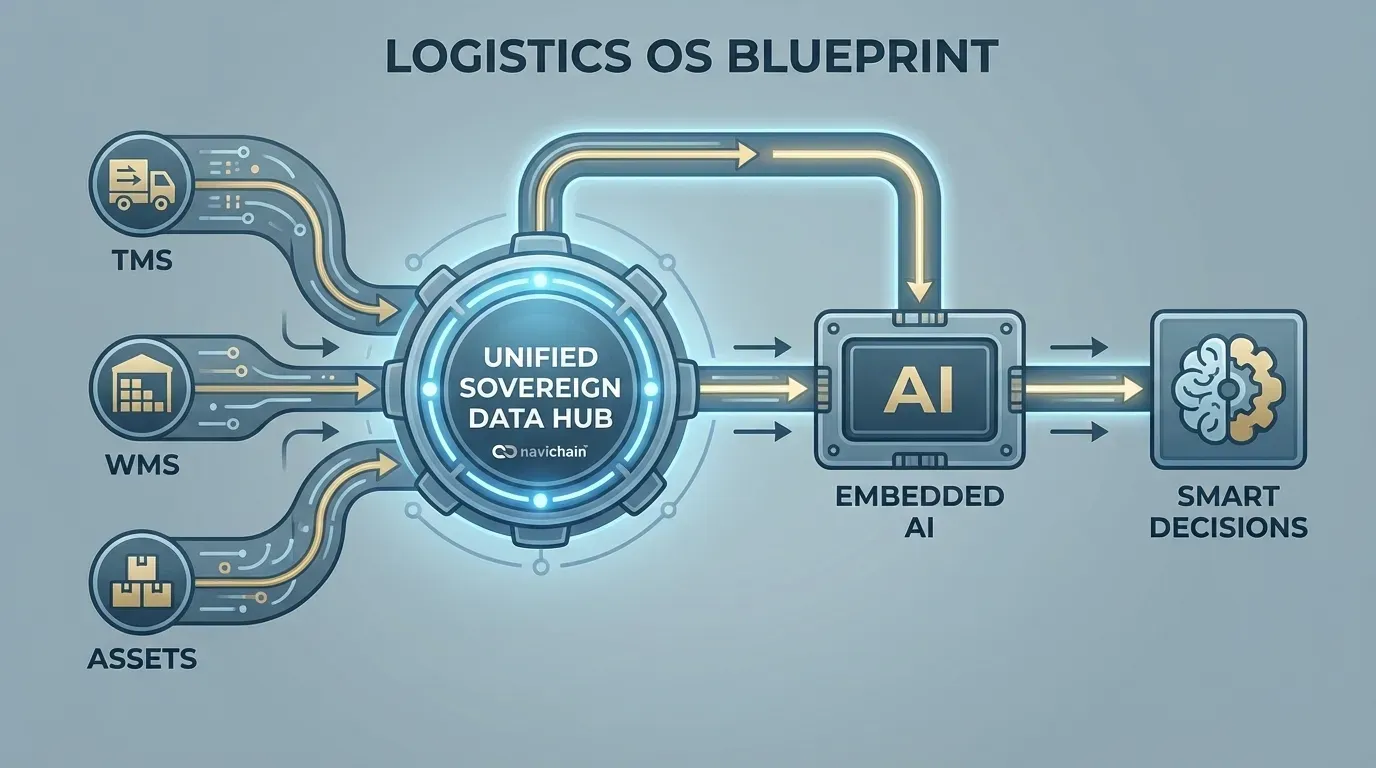
Schematic image illustrating the transition from fragmented data silos to a unified operational network, enabling real-time insight and better decision-making.
Principle 2: The sovereign data architecture
This unified network must be built on a foundation of sovereign data architecture. This principle is absolute. For a European SME company, operational data must be stored and processed entirely within your own legal jurisdiction.
This means you choose a partner whose infrastructure is in the EU, and preferably in your home country (e.g., Sweden). This partner must be legally headquartered in that country, ensuring that your data is exclusively governed by your laws (such as GDPR) and is immune to foreign legislation like the U.S. CLOUD Act. This is not just a "security feature"; it's the fundamental foundation for trust, risk management, and long-term strategic control. You cannot own your future if you don't own your data.
Principle 3: Embedded analytical intelligence
With a unified and sovereign data foundation in place, you can finally deploy the solution to your original problem. Embedded analytical intelligence is the AI layer that runs securely on top of your unified data, within your sovereign architecture.
Because AI has access to the whole, un-fragmented truth about your business (Principle 1) and can operate securely without compliance risk (Principle 2), it can finally answer your most complex questions.
An embedded AI can run optimization scenarios in real-time for your entire order book and immediately calculate the most profitable choice between transshipment and direct routing for each individual package. It can see patterns you never could, flag underperforming routes, predict customer churn, or identify new backhaul opportunities. This is not AI as a separate "project"; it's intelligence embedded directly into your daily workflow, providing decision support, not just more data.
References
- International Road Transport Union (IRU). (2023). Global Driver Shortage Report 2023. https://www.iru.org/resources/iru-library/global-driver-shortage-report-2023
- Transport Intelligence (Ti). (2024). European Road Freight Transport 2024 Report. (Provides data on cost and margin pressures in the EU market). https://ti-insight.com/
- European Parliament. (2018). The US CLOUD Act and its impact on the EU legal framework. [https://www.europarl.europa.eu/RegData/etudes/ATAG/2018/624_205/EPRS_ATA(2018](https://www.europarl.europa.eu/RegData/etudes/ATAG/2018/624_205/EPRS_ATA(2018)624205_EN.pdf](https://www.europarl.europa.eu/RegData/etudes/ATAG/2018/624_205/EPRS_ATA(2018)624205_EN.pdf)
- McKinsey & Company. (2023). Generative AI in logistics: The next frontier of efficiency. (Discusses the necessity of unified data for AI implementation). https://www.mckinsey.com/industries/travel-logistics-and-infrastructure/our-insights/generative-ai-in-logistics-the-next-frontier-of-efficiency
Enabling the plan: Navichain SaaS unified logistics platform
This white paper has described a strategic plan for SME haulage companies to move from a state of being "data-rich, insight-poor" to one of AI-driven, sovereign operations. The Navichain SaaS platform was designed from the ground up to be the concrete realization of this plan.
We are built to embody the three core principles – a unified network, sovereign architecture, and embedded intelligence – as a single, cost-effective solution.
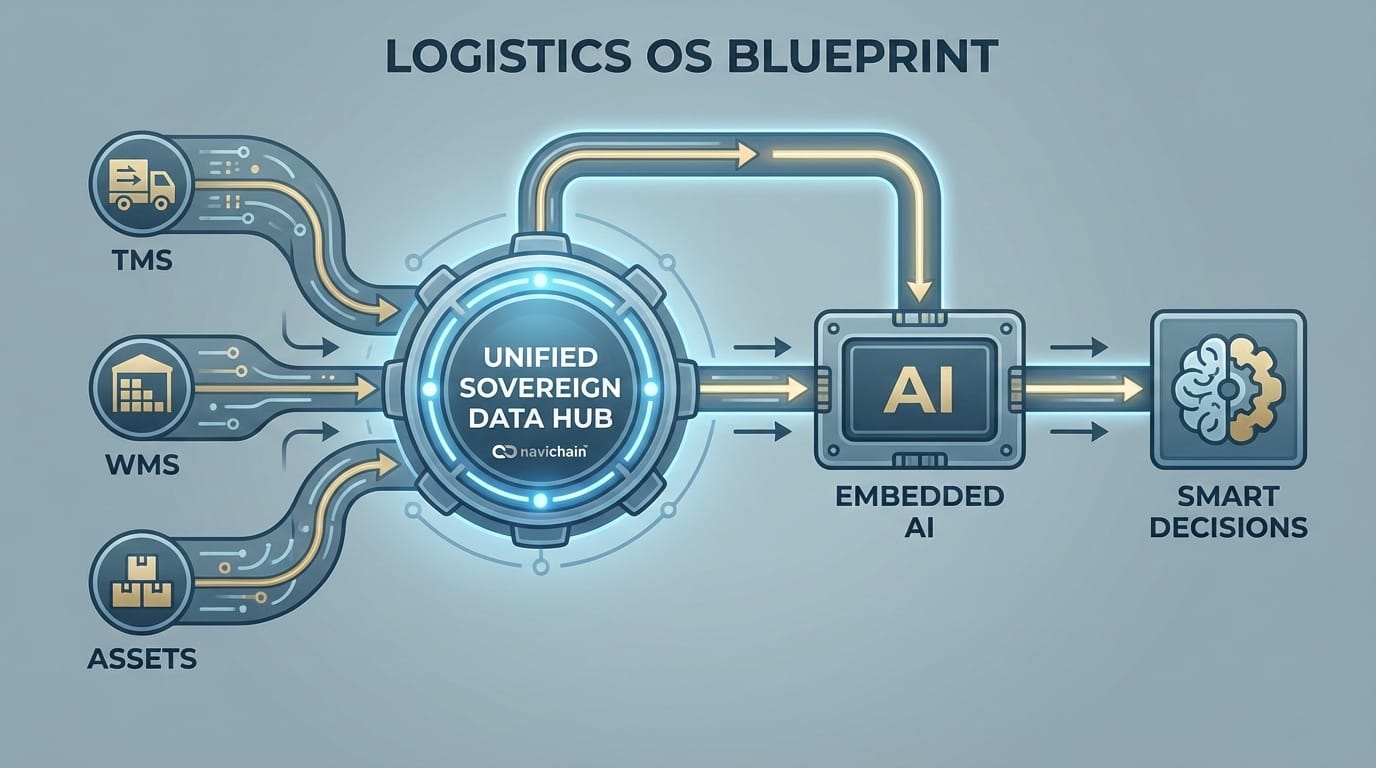
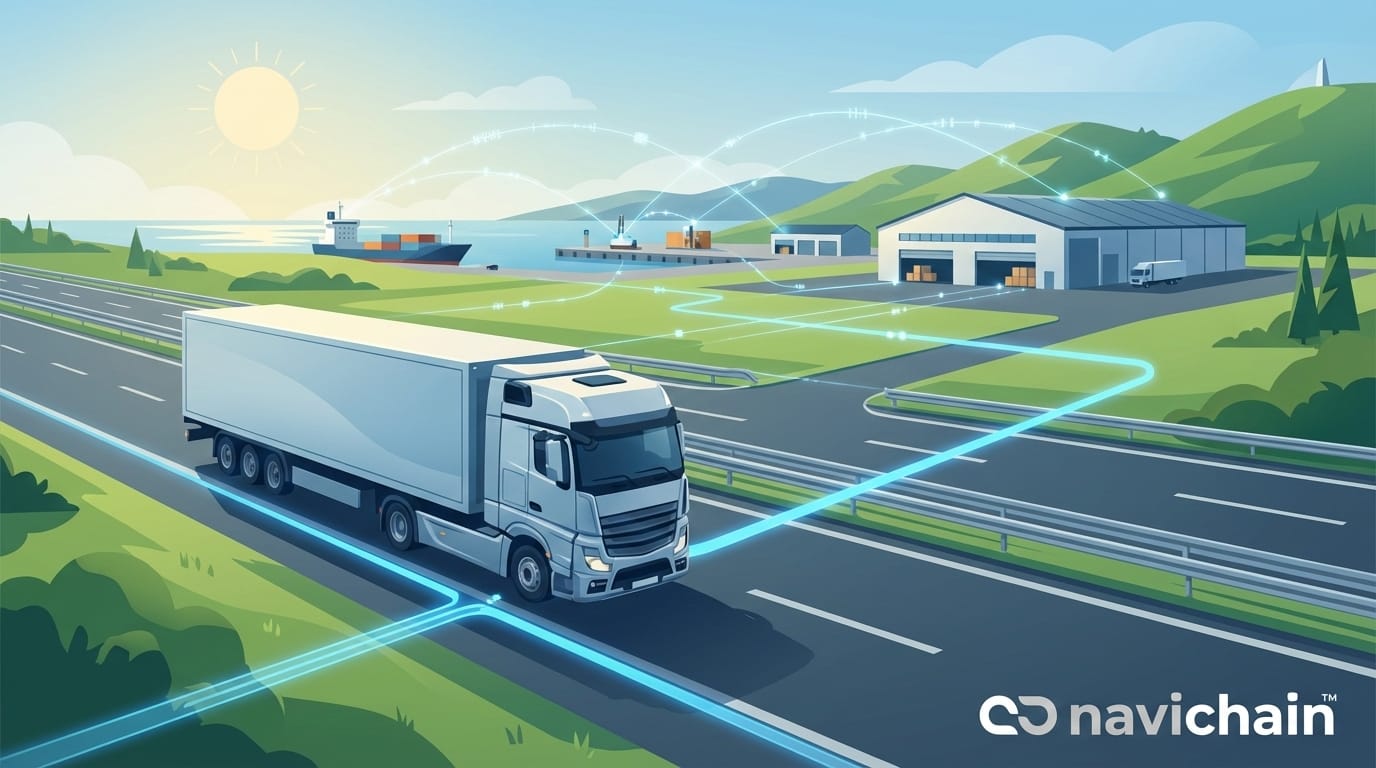
The unified Navichain SaaS platform enables data-driven insight and streamlining of logistics operations, overcoming the paradox of more data leading to weaker decisions.
- Embodies the unified operational network: Navichain SaaS is not a collection of separate modules. It is a true logistics operating system where Transportation Management (TMS), Warehouse Management (WMS), Asset Management, Billing Management, and Order Management are an integrated platform. This eliminates data silos and provides the single source of truth required by Principle 1.
- Delivers sovereign data architecture: This is our core differentiator and a non-negotiable commitment. The entire Navichain SaaS platform is hosted on our own integrated infrastructure in Sweden. Your data stays in Sweden, under Swedish jurisdiction. This guarantees full GDPR compliance and ensures that you are fully protected from the reach of foreign legislation like the US CLOUD Act. This is the foundation for trust and control that Principle 2 requires.
- Activates embedded analytical intelligence: Because your data is unified and secure on our Sweden-hosted platform, we can deploy our integrated AI to perform deep, secure data analysis. This AI engine is the tool that provides the 'decision support' you need, analyzing patterns and running optimization scenarios – such as transshipment vs. direct routing – to unlock efficiencies you could never see before.
Our mission is to democratize this technology and empower SME companies to increase efficiency, reduce costs, and deliver exceptional service. We provide the tools for you to stop guessing and start winning.
Navichain SaaS: An integrated platform for TMS, WMS, Asset Management, Billing Management, and Order Management, hosted in Sweden for sovereign data handling and full GDPR compliance.
Navichain SaaS platform: An integrated solution for managing your entire logistics operations, securely hosted in Sweden for optimal data handling and GDPR compliance.