The paradox of full trucks: Why maximizing load capacity decreases your profitability
🇬🇧 Read this article in English
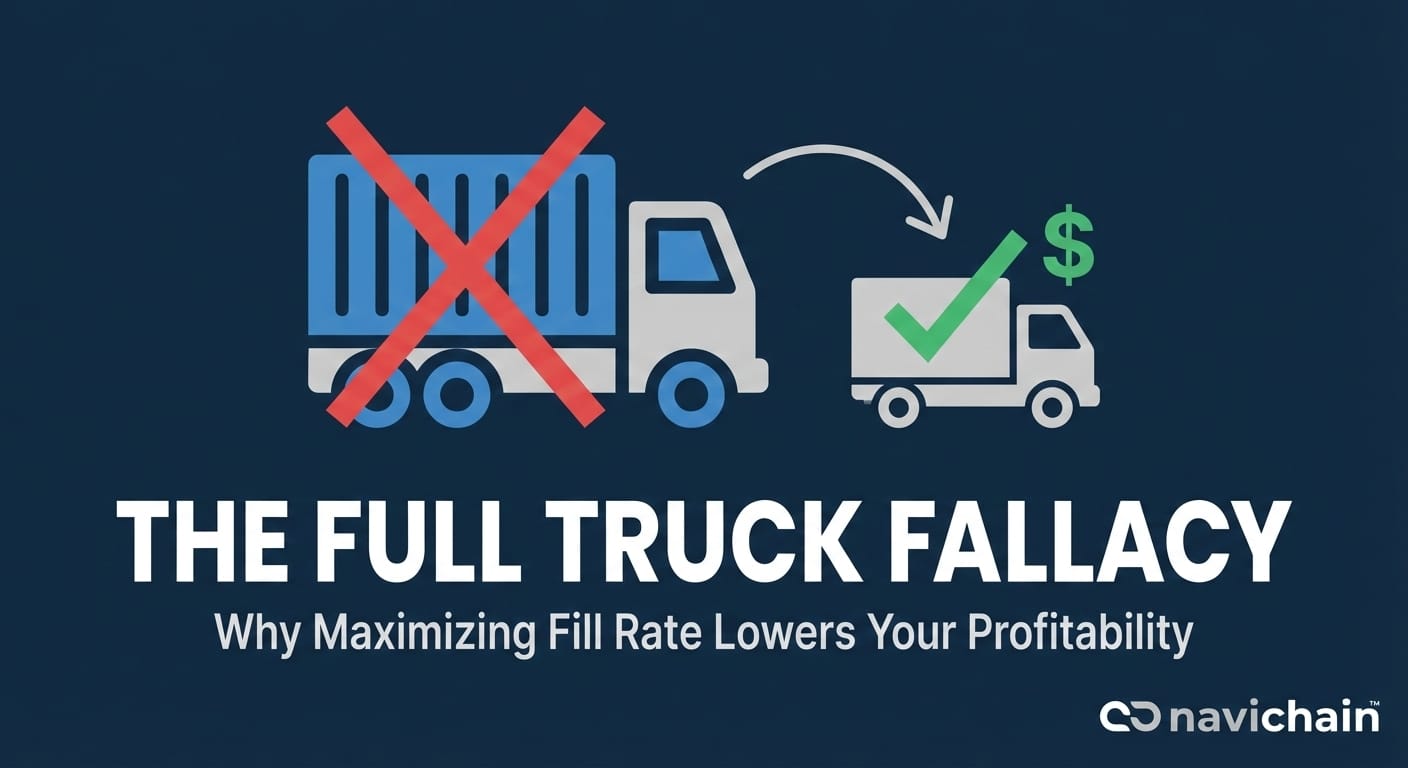
The Paradox of Full Trucks: Why Maximizing Fill Rate Lowers Your Profitability
European SME haulage companies face unparalleled margin pressure, with average profits squeezed to just 2.5%. In this environment, a low 'fill rate' – where empty running still accounts for nearly 20% of all truck miles in the EU – feels like the primary enemy. But what if this obsessive focus on 'full trucks' is a strategic trap? The 'Paradox of Full Trucks' is the assumption that a full truck is a profitable truck.
*Illustration of the challenges faced by European SME haulage companies, including margin pressure and competition.
Illustration of the challenges faced by European SME haulage companies, including margin pressure and competition.
*
Our analysis shows that without a unified view of operational data, managers are blind to the true costs per kilometer and often run 'full but unprofitable' routes that silently drain resources. This white paper presents a strategic framework to move beyond fill rate. It provides a new model for calculating true ROI for haulage companies, built on a foundation of unified data, embedded intelligence, and – critical for European SMEs – absolute data sovereignty.
The Haulage Company's Dilemma: Chasing Full Trucks but Missing Real Profit
This image illustrates the challenge for many haulage companies: the truck is full, but profit is missed due to hidden costs and inefficiency.
For a logistics manager at a small or medium-sized enterprise (SME) in Scandinavia, the dashboard is a source of constant concern. Fuel prices are volatile, driver shortages are chronic, and larger competitors with enormous resources are pressing margins to a razor-thin level of 2.5%. In this high-stakes environment, an empty space on a truck is not just waste; it feels like a failure. The directive from management is clear: increase fill rate.
This directive is logical. After all, data from the International Road Transport Union (IRU) suggests that empty running (driving without a load) still accounts for around 20% of all truck miles in the EU. Filling this gap seems like the most obvious path to profitability.
But it's a trap.
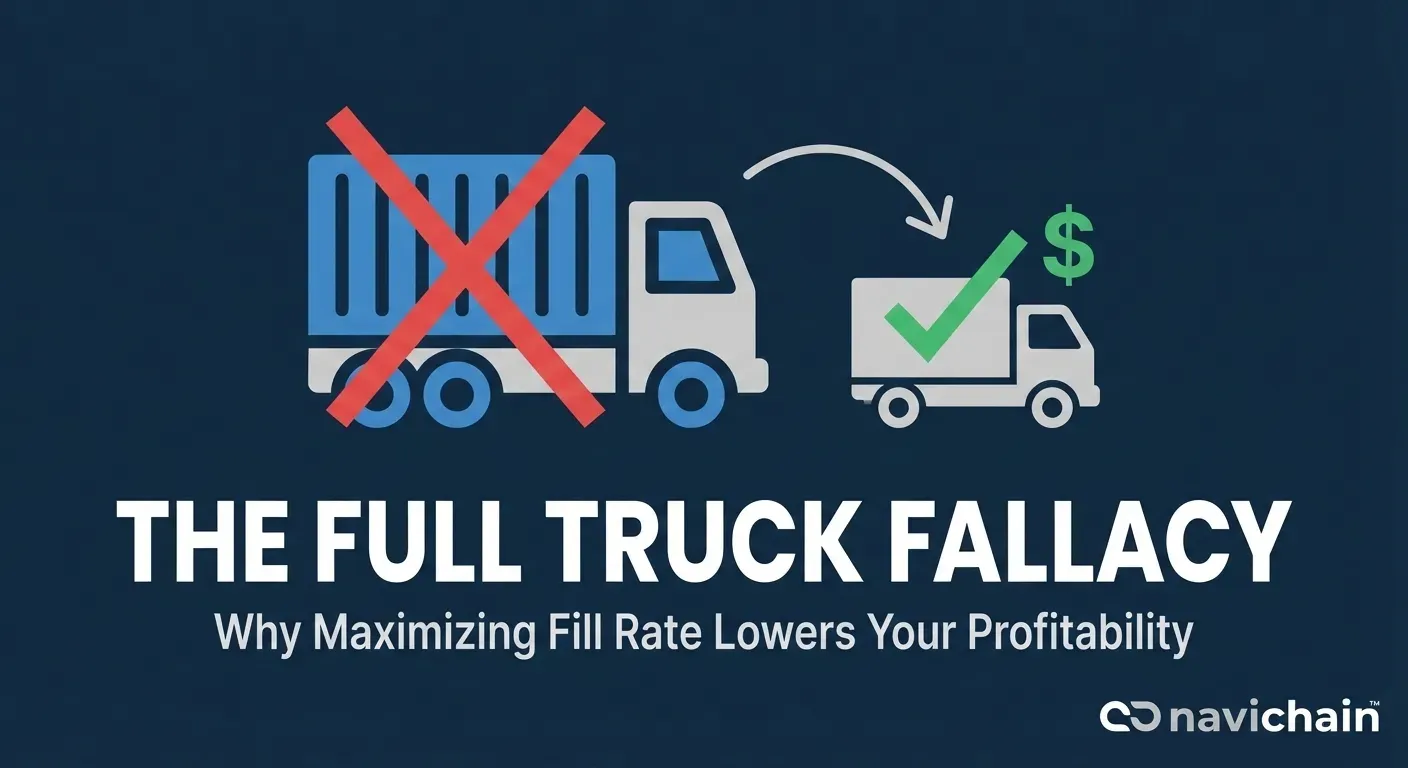
We call this the Paradox of Full Trucks: the deeply held, intuitive belief that a full truck is a profitable truck. This report argues that for the modern SME haulage company, this focus is a dangerous distraction. The real crisis is not empty space; it is 'Profit Blindness'. This blindness is an inability to see the true return on investment (ROI) per kilometer for each individual trip, asset, or customer. It is caused by the fragmented data silos that plague most SME operations, and it hides the fact that many of your 'full' trucks may be silently draining your profits.
This report presents a framework to dismantle this blindness. It suggests that survival and growth in the modern logistics landscape do not depend on maximizing fill rate, but on achieving profit visibility. We will dissect the anatomy of this blindness, introduce a new set of ROI-centered metrics, and sketch a strategic blueprint for a unified, sovereign, and intelligent logistics system that reveals the truth.
Section 1: The Anatomy of Profit Blindness
Fig 2: Do their inefficient receiving docks cause your drivers to wait an extra 45 minutes (asset downtime) at each delivery?*
*
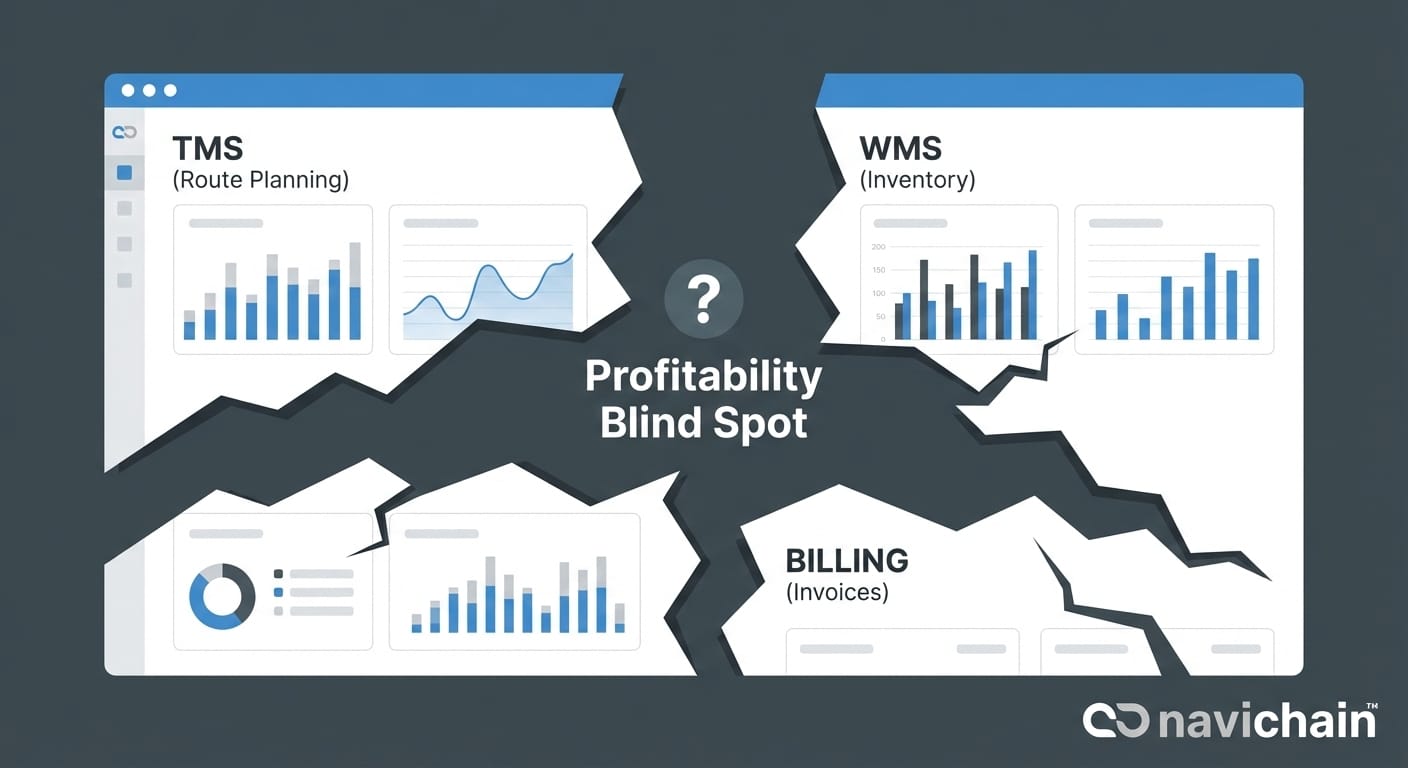
Profit blindness is not a single problem; it is a systemic failure stemming from technological fragmentation. For decades, SMEs have adopted software piecemeal: a transport management system (TMS) to plan routes, a warehouse management system (WMS) to track inventory, and a separate accounting package to send invoices. Each system does its job, but none of them talk to each other effectively.
Data Silos as Margin Killers
*Fig 1: Data is locked in separate, incompatible systems.
Consider a simple shipment. The TMS calculates the 'optimal' route. The WMS tracks the time and labor to pick and pack the order. The driver's asset management app tracks fuel consumption and driving hours. The billing system generates an invoice based on a rate sheet.
Where is the single entry that combines the actual cost of that shipment – including warehouse labor, the actual fuel consumed, the driver's pro-rata wage, and the allocated asset depreciation – and compares it to the actual revenue generated?
For most SMEs, it doesn't exist. The data is locked in separate, incompatible systems. The manager can see revenue from the invoice and the estimated cost from the TMS, but the actual, granular profit is invisible. This is the problem with data silos, and it makes strategic decisions impossible.
The Impossibility of True Cost Accounting
Without a unified data stream, you cannot answer the most basic questions about profitability:
- Is this customer profitable? You know what they pay (revenue), but do you know their true cost-to-serve? Do their non-standard pallet sizes require manual handling in the WMS?
*Fig 2: Do their inefficient receiving docks cause your drivers to wait an extra 45 minutes (asset downtime) at each delivery?
When you cannot answer these questions, you are flying blind. You fall back on the only metric you can see: fill rate.
The 'Full but Unprofitable' Trap
Here is the heart of the paradox. A manager, under pressure to increase fill rate, accepts a low-margin backhaul from a new customer just to avoid running empty.
Visual representation of how a focus on fill rate can lead to decreased profitability.
On the dashboard, the 'empty mileage' metric improves. The truck is 'full'. This looks like a win.
But profit blindness hides the true cost: 1. Price Erosion: The low-margin load anchors your price expectations for that route. 2. Operational Cost: The new customer's load is troublesome and requires 30 minutes of extra handling, delaying the driver's next (high-margin) pickup. 3. Opportunity Cost: While time was spent securing and servicing this 'fill load', an opportunity on the spot market for a high-margin, partial load from a regular partner was missed.
The manager has successfully increased utilization but decreased overall profitability. They have fallen into the 'full but unprofitable' trap, all because their system could only report on volume, not value.
The diagram illustrates how increased fill rate can lead to decreased profitability through price erosion, increased operational costs, and missed opportunities.
Section 2: Beyond Fill Rate: The New ROI Metrics for Haulage Companies
To escape the Paradox of Full Trucks, management must shift the organization's focus from 'Are we full?' to 'Are we profitable?'. This requires a new set of key performance indicators (KPIs), all of which are impossible to track without a unified data platform.
Metric 1: True Profit per Kilometer
This is the guiding star. It is the definitive, granular measure of financial performance.
Formula: (Total Trip Revenue) - (All Associated Variable Costs + Allocated Fixed Costs) / (Total Trip Kilometers)
- Total Revenue: The actual billed amount for all shipments on the truck.
- Variable Costs: Includes actual fuel consumed (not estimated), driver wages for the trip, tolls, and any trip-specific handling costs.
- Allocated Fixed Costs: A pro-rata amount of the truck's depreciation, insurance, and maintenance, as well as warehouse and administrative costs.
Tracking this reveals shocking truths. The 'utilized' city route you thought was a winner may be a high-cost, low-profit drain, while a less frequent route with partial loads to a specific customer may be your hidden gem.
Metric 2: Asset Utilization Value (AUV)
This metric evolves 'fill rate' from a simple volume measure to a value measure. It defines 'utilization' not as 'moving vs. stopped' but as 'revenue-generating vs. non-revenue-generating'.
Calculation: Segment all 24 hours of an asset's day into states: * Revenue-Generating: Driving with paid load.
- Operational Cost: Driving empty to the next pickup, loading/unloading, refueling, planned maintenance.
- Downtime Waste: Stopped (not loading/unloading), stuck in traffic (beyond baseline), waiting at the depot, unplanned downtime.
Your goal is to maximize 'Revenue-Generating' time and minimize 'Downtime Waste'. A high fill rate is worthless if the asset spends 30% of its day in 'Downtime Waste' waiting at inefficient customer docks.
Metric 3: Customer/Route Profitability Score
By combining Profit per Kilometer and AUV, you can now score each customer and each route. This model weighs in 'soft' costs that were previously invisible.
- High-Profit Customer: Pays on time, uses standard pallets, has efficient docks, provides predictable volume, and is on routes that link to other profitable loads.
- Low-Profit Customer: Pays late, requires high administrative touch, has inefficient docks (high 'Downtime Waste'), and is located in a spot that creates empty backhauls.
Armed with this data, you can strategically reprice or even 'fire' your worst customers, freeing up capacity for your best. This is the opposite of chasing any load just to be 'full'. It is the definition of strategic leadership.
Section 3: The Hidden Risk: How Your Data Strategy Erodes Your ROI
Achieving this new level of insight is not just about buying new software. The very architecture of your data strategy introduces a new, modern layer of risk that can destroy your ROI from the inside out.
The Compliance Tax
For European SMEs, data compliance is a non-negotiable cost of doing business. GDPR governs all customer and driver data. When your data is fragmented across five different systems, it's a nightmare to prove compliance during an audit.
How can you prove that you have a driver's consent for data collection when his telematics are in one system and his employment records in another? The 'compliance tax' is the high administrative and legal cost of proving that you are following the rules, a cost that grows with every new data silo you create.
The Sovereignty Gap & US CLOUD Act
A schematic overview illustrating potential data silo problems and their impact on regulatory compliance and data sovereignty.
This is the most critical and most overlooked strategic risk. In the rush to 'go digital', many SMEs have adopted cloud-based SaaS platforms for their TMS or WMS. The problem? The vast majority of these platforms are hosted by companies headquartered in the USA (such as Amazon AWS, Google Cloud, or Microsoft Azure).
This creates a direct conflict with European law. The US CLOUD Act gives US authorities the right to demand access to all data held by a US company, regardless of where in the world that data is stored.
This means that your competitive data – your customer lists, your pricing, your routes, your profitability metrics – could legally be accessed by US authorities without your consent, in direct violation of GDPR principles. This 'Sovereignty Gap' is a massive, unquantified risk. A data breach or forced handover would not only trigger GDPR fines; it would expose your entire business model to competitors.
AI on Tainted Data
Finally, there is the promise of Artificial Intelligence (AI) to find new efficiencies. But AI is only as good as the data it is fed.
If you try to run an AI model on fragmented, siloed data, you will get faster, more confident bad answers. If you run it on a cloud platform that is subject to the CLOUD Act, you are effectively training an AI on your most sensitive data in an insecure environment. The potential ROI from AI is completely undermined by a weak data foundation.
Section 4: From Diagnosis to Design: The Blueprint for a Resilient Logistics Operating System
We have established that the real challenge for SME haulage companies is Profit Blindness. We have shown that to overcome it requires moving beyond 'fill rate' to new, unified ROI metrics. And we have demonstrated that a fragmented or non-sovereign data strategy is a critical risk.
So, what is the solution? It is not yet another app. The solution is a new strategic blueprint for your technology. Every platform you consider must be evaluated against three fundamental principles. This is the checklist for a resilient, future-proof logistics business.
Principle 1: The Unified Operational Fabric
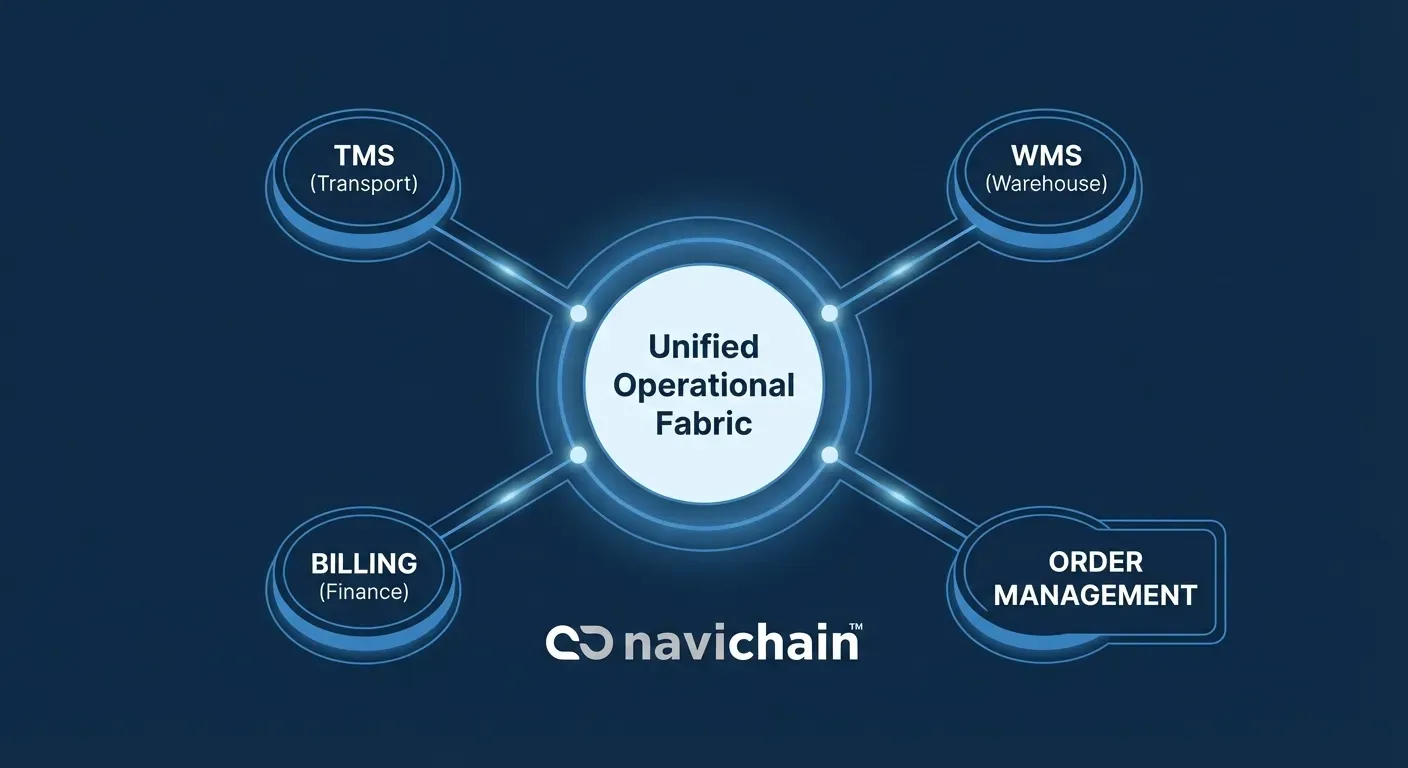
You must move from data silos to a single, integrated system. Think of this as the 'central nervous system' for your entire operation. Your Transport Management (TMS), Warehouse Management (WMS), Billing, and Order Management must not be separate, loosely coupled applications. They must be embedded modules in a single, unified operating system. When a change is made in one place – an order is updated, a truck is delayed, a pallet is scanned in the warehouse – the information must be immediately and automatically reflected everywhere else. This is the only way to create a single source of truth, the absolute prerequisite for calculating the true ROI metrics we have discussed.
Principle 2: Sovereign Data Architecture
For every European SME, this is non-negotiable. True operational resilience requires data sovereignty. Your operational data, your customer lists, your pricing, and your driver information must be stored and processed exclusively within your own legal jurisdiction (e.g., within the EU or, even better, within Sweden). Your chosen platform partner must guarantee, contractually, that your data is hosted on infrastructure that is 100% compliant with GDPR and, crucially, 100% protected from extraterritorial laws like the US CLOUD Act. This is not just a 'compliance function'; it is a cornerstone of trust, security, and competitive risk management.
Principle 3: Embedded Analytical Intelligence
With a unified fabric (Principle 1) and a secure, sovereign foundation (Principle 2), you can finally unlock the power of data. But this intelligence should not be a separate, complex 'big data' project. It must be an embedded layer that works seamlessly within your operating system. This AI should run on the same secure, sovereign infrastructure and analyze your unified data in real time. Its purpose is to automatically surface the insights you need: to reveal your 'Profit per Kilometer', to flag hotspots for 'Downtime Waste', to identify your most and least profitable customers, and to suggest route optimizations that maximize profit, not just fill rate.
Section 5: References/Sources
- International Road Transport Union (IRU). (2024). European Road Freight Market Report. https://www.iru.org/resources/iru-library
- Transport Intelligence (Ti Insight). (2024). European Road Freight 2024 Market Sizing and Forecasts. https://www.ti-insight.com/
- European Data Protection Board (EDPB). (2024). Annual Report on GDPR Enforcement. https://edpb.europa.eu/
- EUR-Lex. (2018). Regulation (EU) 2018/1807 on a framework for the free flow of non-personal data in the European Union. https://eur-lex.europa.eu/
- US Department of Justice. Clarifying Lawful Overseas Use of Data (CLOUD) Act. https://www.justice.gov/opa/page/file/1044431/download
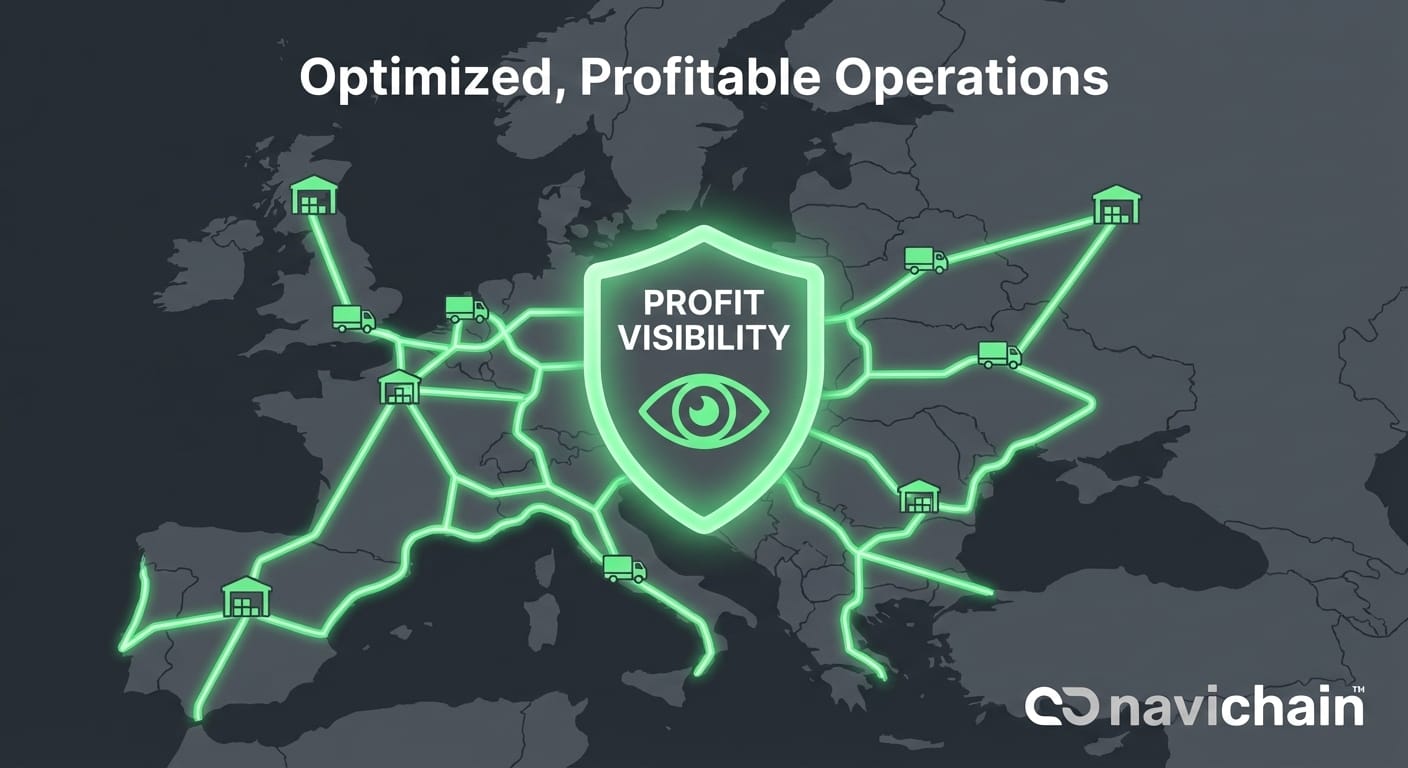
Shows how increased profit visibility can lead to improved strategic outcomes for haulage companies.
Section 6: Enabling the Blueprint: Navichain SaaS Unified Logistics Platform
This white paper has sketched a strategic blueprint for SME haulage companies to move from the 'Paradox of Full Trucks' to a new model of 'Profit Visibility'.
Visual representation of the strategic benefits of profit visibility.
We have defined the three essential principles: a unified operational fabric, a sovereign data architecture, and embedded analytical intelligence.
Navichain SaaS Unified Logistics Platform.
Our mission is to democratize logistics technology, giving SMEs the ability to increase efficiency, reduce costs, and deliver exceptional service. We believe that the path to resilience is not just about filling trucks, but about building a secure, intelligent, and unified business.
Navichain: a unified platform for logistics that provides increased visibility and efficiency, enabling more profitable decisions.
Navichain's unified logistics platform enables increased visibility and efficiency across the entire supply chain.
Want to see how profitable your business can be with Navichain?
References
- European Commission (2020). Green Paper on Freight Transport. https://ec.europa.eu/transport/themes/strategies/2011_white_paper_en
- International Road Transport Union (IRU) (2023). The Future of Road Transport. https://www.iru.org/future-road-transport
- McKinsey & Company (2024). The next frontier in logistics: From lean to intelligent. https://www.mckinsey.com/industries/travel-logistics-and-infrastructure/our-insights/the-next-frontier-in-logistics-from-lean-to-intelligent
- Gartner (2023). Supply Chain Technology. https://www.gartner.com/en/supply-chain/trends/supply-chain-technology