Calculate what it costs. Not in money – but in time. An average transport booking contains sender address, recipient address, cargo type, weight, number of packages, desired delivery date, and any special instructions. Keying that in takes perhaps three minutes. If you do that twenty times a day, five days a week, it's a full-time job of about three hours every week. And that's in the best case – without typos, without having to call back for a missing postal code, without double entry when the same job needs to go into the invoicing system.
That is exactly the everyday reality that Navichain is now erasing with a feature that is as easy to explain as it is hard to believe until you see it in action: Drop & Go.
What is Drop & Go?
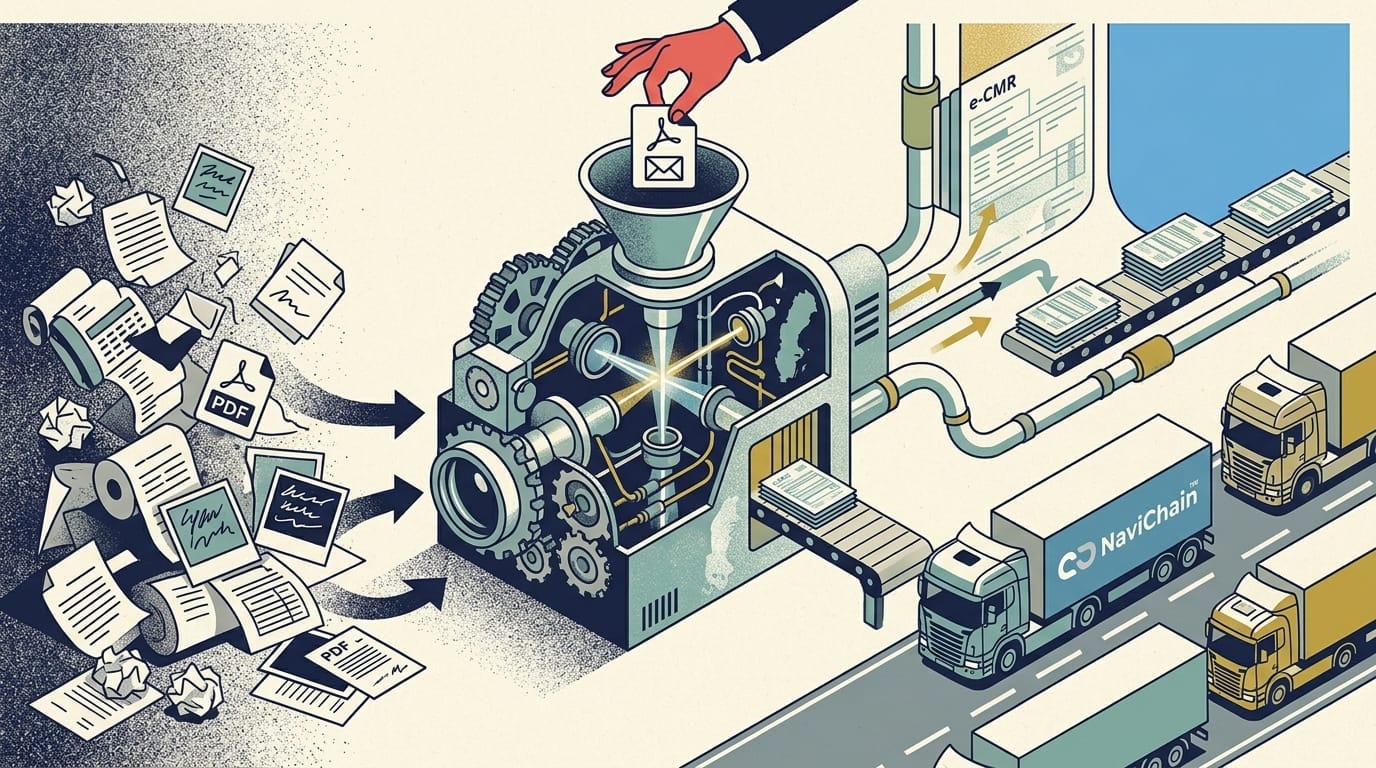
Drop & Go is Navichain's AI-driven booking import. The concept is so simple that it almost seems ridiculous: you drag and drop a document – an email, a PDF, an image – and Navichain's AI reads the content, identifies all relevant booking information, and creates a complete, structured booking directly in the system. No forms. No copying and pasting. No manual work.
It doesn't matter if the customer has sent a professional order confirmation in a well-structured PDF format, a hastily written email with the address in the middle of the text, or a photo taken of a waybill with a dirty mobile camera. The AI handles it anyway.
Three minutes per booking. Twenty bookings a day. That's three hours a week that disappear – until now.
From chaotic document to ready booking – in seconds
Drag and drop any file into Navichain – a PDF, an image, a forwarded email. No preparation required.
Navichain's sovereign AI – running on Swedish servers – analyzes the document and extracts all booking-relevant information.
A complete, structured booking is now in the system. Ready for assignment, route planning, and invoicing.
Any format – the AI handles it
The hidden cost of manual data entry
The freight industry is used to calculating fuel, wages, and mileage reimbursement. But it is rarely calculated on administration – and that is a mistake. Every time a document passes a human on the way from the customer's inbox to the system, there is a risk of errors. A transposed postal code. A missed instruction that the goods are fragile. An address that was misinterpreted.
The consequences are well known: wrong runs, delays, dissatisfied customers, credit notes. And behind every such incident is a moment of human fatigue or ambiguity that a well-trained AI system never suffers from.
Navichain also solves another problem that is rarely discussed openly: spot bookings. The ad hoc jobs that are crucial for revenue but administrative nightmares. A customer calls, emails three unstructured lines, and expects confirmation within five minutes. Previously, this meant that the transport manager had to interrupt what he was doing, manually key in the job, and hope that nothing went wrong. With Drop & Go, you forward the email to Navichain and you're done.
All data processing takes place on Swedish servers
Navichain's AI is self-hosted – meaning it runs on Navichain's own servers in Sweden, not on American cloud services like AWS or Azure. This means that none of your customers' booking information, addresses, or business data leaves Sweden.
It is not a small detail. It is the difference between the US CLOUD Act being able to force access to your data – and it not being able to. For those who run transport jobs for sensitive operations, handle trade secrets, or simply want control, it is a fundamental protection.
And it's actually free to get started
The perhaps most astonishing thing about Drop & Go is that you can use the basic function without even creating an account. Visit Navichain, drag and drop a transport document, and see how the AI interprets it and generates an e-CMR waybill – completely free of charge, completely without giving away a single piece of personal data.
It is a way to prove the point without asking for trust in advance. Navichain knows that those who have seen it work once rarely want to go back to the old way.
If you then create a free account – up to two users and around fifty bookings per month cost nothing – the system also starts building up a history. Each Drop & Go import becomes not only a booking but an entry in a growing database: customers, addresses, route patterns. The system learns your business without you having to spend a single hour manually entering background data.
Try Drop & Go right now – no login required
You don't need an account to see the magic. Go to Navichain, drag in a transport document, and see what happens. It literally takes twenty seconds.
- Go to navichain.se – no account required to test
- Drag and drop an email, a PDF, or an image with booking information
- Watch the AI create a complete, structured booking in real time
- Create a free account to save the history and unlock the entire TMS
Free up to 2 users and ~50 bookings/month. No commitment. Want more? 199 SEK per user and month – and all data stays in Sweden.
It's not about technology. It's about time.
It's easy to get distracted by the technology behind Drop & Go – the sovereign AI, the OCR interpretation of handwritten notes' chicken scratches, the ability to find an address in the middle of an unstructured email. But that's not what makes the feature important.
What makes it important is that it gives back time. Time to talk to customers. Time to plan the next route optimization. Time to actually run a haulage company instead of administering it. And that's really what a good TMS has always been about – making the heavy lifting invisible, so that the transport manager can focus on the only thing that actually creates value: that the goods arrive.