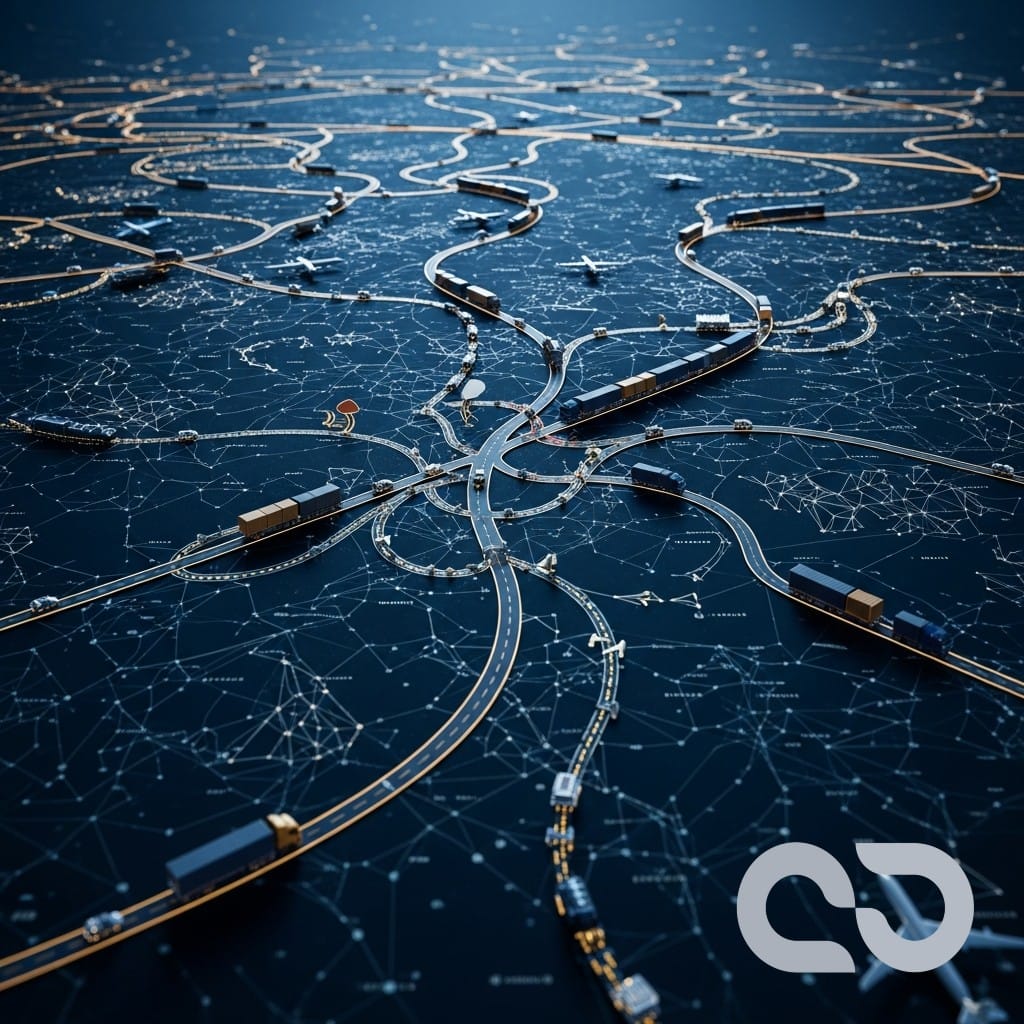
It's 06:47. Your planner has just finished planning for the day: twelve trucks, forty-three stops, route-optimized against traffic and time windows. It's good work. Professional. Thoughtful. And at 07:03 — sixteen minutes later — the northbound E4 is closed after an accident outside Rosersberg. Without a system that reacts in real-time, you're now living in an illusion of control while the ketchup effect builds up one delivery at a time.
The scenario above is not unusual. It's a completely ordinary Tuesday. And the difference between a haulage company that absorbs that disruption without customers noticing and one that spends three hours on frantic phone calls is not luck — it's infrastructure.
Dispatch sees the delay on the phone. Calls the driver. Calls the customer. Tries to recalculate in their head who is affected. Decides on a new order that seems reasonable. Hopes that the chain reaction is under control.
Meanwhile, three other trucks are heading towards stops that now have the wrong priority.
The system identifies the disruption via live traffic data. Recalculates arrival times for all vehicles. Generates a new optimal sequence that minimizes total delay. Notifies customers automatically with updated ETAs.
Dispatch sees the solution — not the problem.
The invisible that eats your margin
Dynamic route optimization is half about the obvious: traffic, deviations, roadworks. But the other half — the more expensive half — is about something more subtle. It's about all the decisions made too late, with incomplete information, by a human doing their best but lacking a computer brain.
Consider last-minute bookings. A new customer calls at 10 a.m. with an urgent job. Your planner has three options: say no, send an extra truck, or — with the right system — slot the job into the existing flow without disturbing a single existing customer. The third option is only possible if the system can answer the right questions in under a second.
Three questions an AI system answers in milliseconds: Who in the fleet is closest? Who has spare capacity without breaking driving time regulations? Who can add the stop without an existing customer missing their time window?
Scene: a disruption without drama
Let's make this concrete. Below is a completely ordinary sequence of events — played out in two very different ways depending on what infrastructure your haulage company has.
Why drivers sleep better
There is a persistent misconception that algorithmic control stresses field personnel. In practice, it's exactly the opposite. Pressure arises not from having a system that thinks for you — it arises from lacking a system for effective resource matching.
The driver who knows that the system automatically handles driving time regulations, adjusts stop order, and communicates with the customer is spared the hidden burden: the feeling of being personally responsible for the consequences of events beyond their control. That is the burden that drains energy during a long shift.
The difference between a good and a fantastic haulage company is not the absence of problems — it's their invisibility.
The principle behind operational resilienceQueues, roadworks, and deviations are continuously incorporated into the calculation — not just at the start of the day. The system reacts to the change, not to the report of it.
Last-minute jobs are analyzed against existing fleet capacity in real time. The system finds the optimal insertion point — or flags if a new vehicle is actually needed.
The customer is automatically informed of deviations — with updated ETA and a simple status update. No angry calls to the cab. No stressed planner juggling phones.
Avoiding queues and unnecessary detours reduces idling and fuel consumption