Cross the border
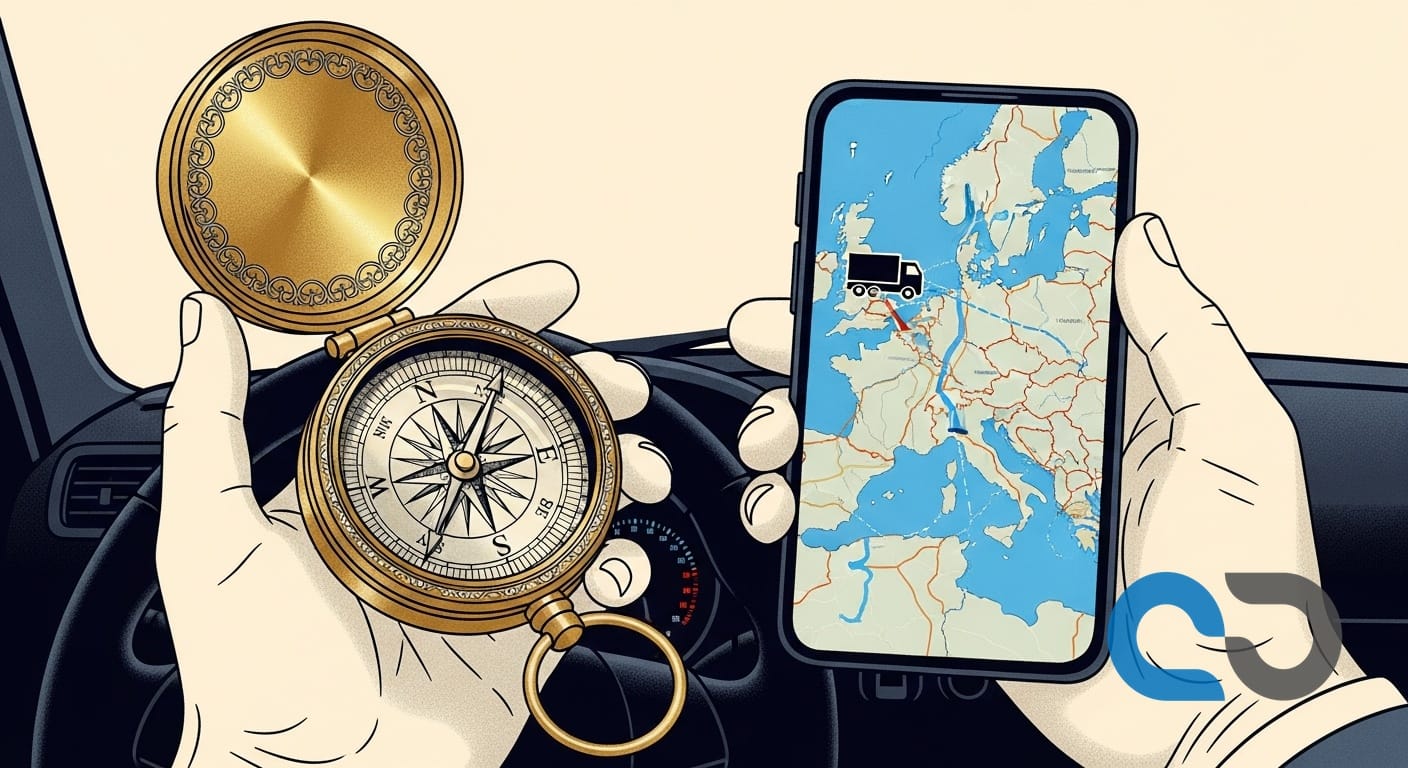
The digital waybill that opens up Europe – Navichainnavichain Transport Management System e-CMR & Digital Integration · Theme Week
Never stand still again
at a border that already knows
you're on your way
While other haulage companies queue at customs with stacks of paper under their arms, you've already moved on. That's what happens when your waybill stops being a document and starts being a digital key – open for all of Europe, in real time.
Navichain Editorial · International TMS Integration · Reading time approx. 5 min
There's a moment every experienced transport manager recognizes: the truck is loaded, the driver is ready, but the system is stuck. Someone needs to fax something. Someone needs to call customs. A customer is waiting for a status update that's still "unknown". It's not a logistics challenge – it's an infrastructure problem. And that's exactly the problem that e-CMR integration in Navichain is designed to eliminate.
We conclude our theme week on the digital freight document with what is essentially the end goal: a world where information moves faster than the wheels. Where your customers see delivery status in their own business system. Where customs authorities have approved your shipment before the truck reaches the border. Where your driver never has to dig out a piece of paper from a plastic pocket in the door panel.
The problem with paper friction time
In the logistics industry, we rarely talk about the time lost in information gaps. We calculate fuel, customs, and labor costs. But for every transport that crosses a national border, there's a hidden cost: waiting time at checkpoints, double data entry in the customer's system, the phone call about "where is the cargo really?"
According to international industry studies, European haulage companies spend an average of 47 minutes per border crossing on manual document handling. Multiply that by the number of border crossings per year in your fleet. The result isn't hours – it's weeks of production time that simply evaporates.
47 min Average per border crossing – manual < 4 min Average per passage – digitally pre-approved 91% Time savings with full e-CMR integration
That difference isn't marginal. It's structural. And it determines which haulage companies will grow in 2026 and which will stagnate.
The three-dimensional data sharing
An e-CMR in Navichain isn't a digitized copy of a paper document. It's a dynamic data package structured according to the UN's UN/CEFACT standard – a global common "grammar" that international customs systems and logistics hubs already speak fluently. This means that a single document can be fed to three critical parties simultaneously, without anyone needing to lift a finger after the transport is created.
One truth. Three recipients. Zero friction.
The same validated data is delivered in real time to the entire chain
🏢
The consignor
Sees exactly when the goods have passed each checkpoint – directly in their ERP, without status inquiries to your office. This is integration that builds loyalty.
🛡️
Customs & Authorities
Receives digital freight and customs manifests in advance. The result: green light and pre-approval at the border, before the truck is even in sight.
🚛
The haulage company
The driver avoids conflicting instructions and manual customs documents. Everything is updated dynamically in the driver app. He drives – you control.
That's what Navichain means by acting as a digital bridge. Not software that streamlines your existing process – but an architecture that replaces it with something fundamentally better.
Why standards are your competitive weapon
Many transport companies underestimate the value of working with open, standardized interfaces. It sounds technical and dry. But the consequence is concrete: if your TMS speaks UN/CEFACT, you can immediately integrate with a new major customer's ERP without a month-long IT project. You can send pre-manifests to the Customs Administration digitally. You can connect to European logistics hubs like Duisburg, Rotterdam, or Hamburg without intermediaries.
Sharing data isn't giving away your business secrets. It's building a digital infrastructure where friction is eliminated – and where you become the indispensable link in your customers' global success.
Navichain · Integration Strategy 2026
The haulage companies that understand this aren't just building efficiency. They're building lock-in – the positive kind. When your customer sees you in their delivery view, their invoicing, and their planning process, you stop being a subcontractor. You become part of their infrastructure.
Three strategies to achieve full integration
The path from local digital waybills to full-scale international supply chain integration is shorter than most people think. It's about prioritizing correctly:
01 Standardized API connections
Ensure that your TMS uses open, standardized interfaces. In Navichain, this is built-in from the ground up – you can connect new customers regardless of which business system they use, without custom projects every time. A new customer is a connection, not an installation.
02 Proactive customs sync
Take full advantage of digital pre-notifications. By sending e-CMR data to customs portals before the truck even leaves the warehouse, you can reduce border waiting times from hours to minutes. This isn't a futuristic possibility – it's a reality for haulage companies already working digitally in Navichain today.
03 Create shared ownership with your customers
Invite your key customers into a shared digital ecosystem where they can track and download signed e-CMRs in real time. This builds a partnership that's hard to end – not because it's expensive to switch, but because the collaboration has become part of how they run their business.
Next in the series
Next Monday, we start a new theme week: "The predictive vehicle fleet" – how AI and advanced telematics predict engine wear and plan maintenance before breakdowns can stop your trucks on the road. Subscribe to the blog to not miss it.
The conclusion is simple – even if the path hasn't always seemed that way
During this theme week, we've followed e-CMR from its basics, through cash flow gains, to full international integration. And if there's one common thread through it all, it's this: the paperless haulage company isn't a goal for the future. It's a business decision you can make this week.
The haulage companies that are still waiting for the "right time" to digitize their document handling are losing concrete minutes, hours, and customer relationships every day. While they wait, their competitors are building the infrastructure that customers will take for granted in three years – and demand as an entry ticket.
Navichain is built for that haulage company. The one that doesn't want to be the biggest, but always wants to be the best. That understands that data isn't an IT problem, but a business tool. That sees the border not as a barrier, but as proof that they're operating in a system that actually works.
Ready to let data
outperform paper?
Get started with Navichain today. Free up to 2 users – with full e-CMR functionality from day one. No binding periods. No installations.
Start for free today Book a demo
199 kr / user / month · Swedish servers · GDPR compliant · No binding period
NVC-ECMR-05 · blog.navichain.se · 2026 Part 5 of 5 · Theme Week: The Digital Freight Document