The dwell time that costs you money you don't know you're losing.
Downtime costing you
money you don't know you're losing.
Every time the driver waits to be unloaded, your haulage company pays with time, fuel, and capacity. It's called downtime. Most haulage companies never bill for it. Navichain tracks it automatically – and sends the invoice.
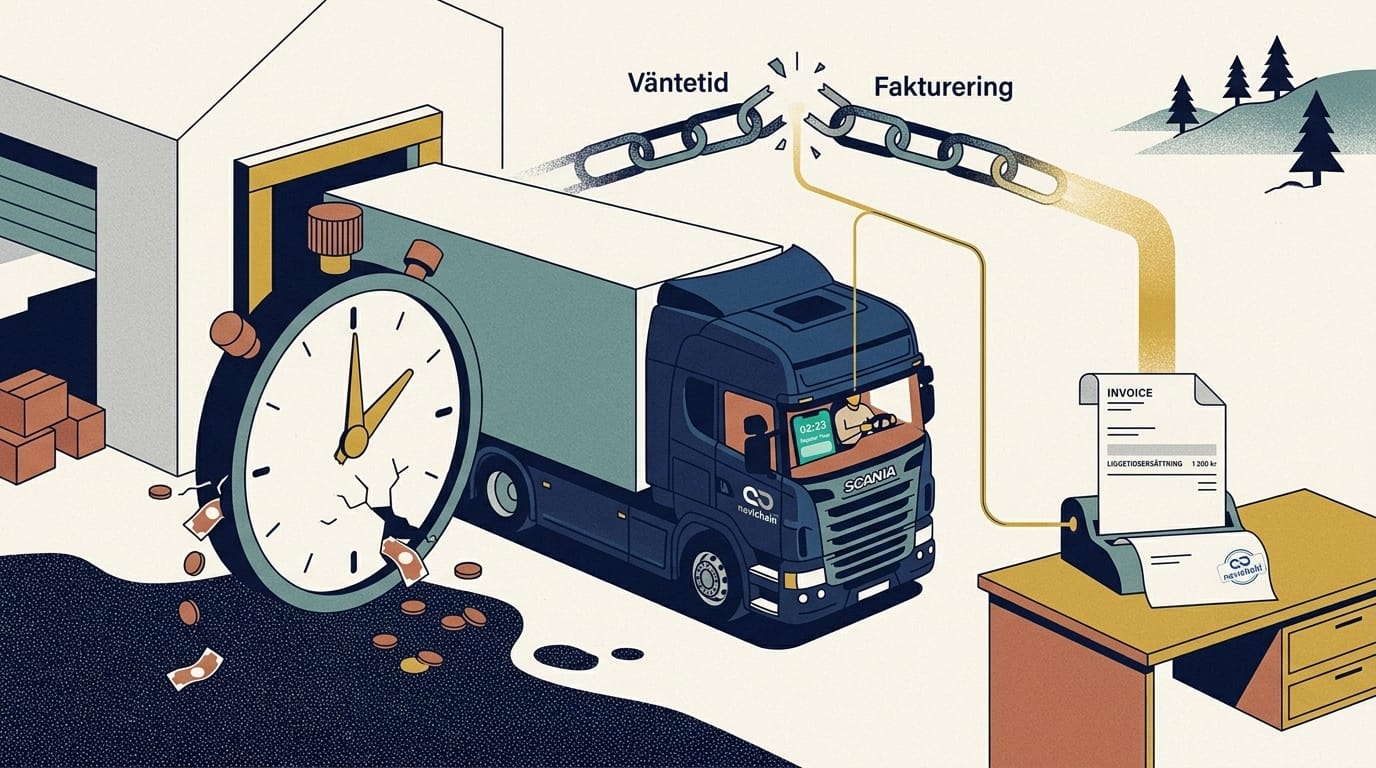
There is a category of costs in the freight industry that is almost invisible – not because it is small, but because the system is missing to capture it. The driver arrives at the unloading address at 08:00. He signs off at 10:23. Two hours and twenty-three minutes of paid working time, fuel in idle, and a tied-up truck have been spent waiting for a dock. The customer has a contract. The contract states that downtime exceeding 30 minutes is billed at 650 SEK per started hour. But no one knows it happened. No one has tracked it. No one has invoiced it. And if there is no system that captures the event in real-time – in the mobile app, linked to the correct order, matched against the customer contract – the 1,300 SEK is gone forever.
This is not an unusual scenario. It's a common Thursday.
What does downtime really cost?
Ask the dispatch manager at a medium-sized haulage company what downtime costs per year, and the answer is almost always the same: "We have no idea." Not because they don't care. But because no one has calculated it. The driver reports informally, the dispatcher notes it sometimes, and to the finance department, it never reaches with sufficient accuracy to be invoiced.
Multiply by 50 weeks. Multiply by ten vehicles. That's 900,000 SEK per year in revenue leaking out of the haulage company because no one has captured it. These are not extravagant profits – they are compensation for actual costs that you are contractually entitled to charge for. Navichain captures every event. Automatically.
Downtime is not a cost you can avoid. But it is revenue you can stop missing.
Why does this happen? The uncomfortable truth.
The problem with billing for downtime is not that haulage companies don't want to charge. It's that the information chain fails in three places at the same time.
First, the driver knows he is waiting but has no easy way to report it in a structured way and linked to the correct order. He might write a comment in the app or tell when he calls in, but it never reaches finance in the right format.
Second, the dispatcher knows that downtime costs, but has no tool that automatically checks the customer's contract to know if and how much can be billed. The result: you don't bill rather than risk a customer conflict if you bill incorrectly.
Third, the finance department has neither the data nor the mandate. The invoice is sent based on what is in the system – and if the downtime is not in the system, it is not invoiced.
Navichain closes all three gaps in one system.
Navichain's automated downtime management – step by step
Driver registers waiting time in the mobile app Real-time
In the Navichain 365 app, the driver marks "Waiting time starts" and "Waiting time ends" with a button press. The event is timestamped, GPS positioned, and immediately linked to the correct order and customer in the system – without the driver needing to know anything about the customer contract.
System automatically checks the customer contract Automatic
Navichain reads the specific customer contract: How much free time applies? What is the billing rate? Is downtime billable at all for this customer? The answer is generated automatically without anyone needing to look up a contract paper or call the dispatcher.
Finance sees the event in real-time Immediate
The dispatcher and finance department immediately see that waiting time has been registered against the customer order, which contract applies, and which amount is billable. No detective work. No phone round. Correct basis in the system directly.
Invoice includes downtime automatically Automatic
When the delivery is signed and the automatic invoice is generated, the downtime compensation is included as a correct additional line item – in accordance with the customer contract, without manual handling and without the risk of it being forgotten.
Contrast: with and without Navichain
- Driver reports waiting time verbally or via email – no structured registration
- Dispatcher doesn't know which contract applies to this customer
- Finance never gets the information in billable format
- Downtime is billed sporadically if at all – based on memory, not data
- Customer conflicts arise because billing cannot be proven
- Thousands of SEK per week disappear without being seen anywhere
- Driver registers waiting time with a button press in the app – timestamped and GPS positioned
- System automatically checks the customer contract and calculates billable amount
- Finance sees the event in real-time linked to the correct order
- Downtime is automatically included in the invoice upon delivery
- Digital chain of evidence makes every billing dispute-free
- Every billable minute is captured – every time
The role of the customer contract: the right decision every time
The system knows what you are entitled to charge – and when you are not
One of the most common reasons why downtime is not billed is not that it is forgotten – it is that it is not known if the contract allows it. With ten or twenty customers with different contracts, it is impossible for a dispatcher to keep all the terms in mind.
Navichain links each order to the customer contract. When waiting time is registered, the system immediately flags: "This customer contract allows billing" or "This customer contract does not include downtime." It is not only an easy way to bill correctly – it is a protection against billing incorrectly and creating unnecessary customer conflicts.
As Navichain's blog illustrates: the finance department can now have strategic discussions – "We should renegotiate the contract with Customer X to include downtime billing" – instead of chasing information about what actually happened at the loading dock on Wednesday.
Six features that make downtime billable
The driver starts and stops the waiting time measurement with a button press. Timestamp and GPS position are logged automatically and linked to the correct order.
The system checks the specific customer contract and calculates the billable amount according to the agreed free time and rate – without manual handling.
Dispatchers and finance see the event in real-time. No phone round. Correct basis, correct system, directly.
Downtime compensation is automatically added as a line on the invoice upon delivery completion. Nothing is forgotten.
Timestamp, GPS position, order reference, and driver's signature create an irrefutable basis for each billing. The customer cannot dispute it.
AI analysis shows which customers systematically cause downtime, at what times, and on which routes. Basis for contract renegotiation based on facts.
Downtime data as a strategic weapon
When downtime is systematically captured in a TMS, something more happens than that the invoices become correct. A data pattern is built up that is invaluable for business development. Which customers cause the most downtime? Is it always the same terminal that slows things down? Is there a specific time window that consistently results in waiting time?
Navichain AI analysis can identify these patterns and give the dispatcher concrete action suggestions: book the delivery 45 minutes earlier to Customer X on Fridays, renegotiate the service agreement with Customer Y who costs more in downtime than they contribute in turnover, or adjust route planning to avoid the terminal that systematically results in an hour's wait.
This is the difference between seeing downtime as an unavoidable cost and seeing it as a control signal. With Navichain, the data is automatically collected. The only thing required is to look at it.
Start capturing downtime. Free. From day one.
Navichain is free up to two users and approximately fifty bookings per month. The downtime functionality is included – register your first waiting time, see how the system checks the customer contract, and experience how the invoice is generated with the correct additional line automatically.
- Create a free account on navichain.se – in under two minutes, no credit card
- Register your customer contracts with downtime rates and free time per customer
- Run a delivery with the driver's app – register waiting time with a button press
- See how the system automatically calculates the billable amount and adds it to the invoice
- Calculate what a year of correct downtime billing is worth for your haulage company – and decide
Free up to 2 users · ~50 bookings/month · 199 SEK/user/month for full functionality · Downtime registration & automatic billing included · Customer contract matching · AI analysis per customer · All data on Swedish servers · No commitment period
The money has always been there. Now it's finally visible.
Downtime is not a new problem, and it is not an unusual problem. It is a problem that the industry has accepted as part of reality because the systems to capture it have not been available at the price point that a small or medium-sized haulage company can afford. Navichain changes that calculation. For 199 SEK per user and month, every minute of billable waiting time is captured, matched against the correct customer contract, and automatically ends up on the invoice. It is not an extra system. It is part of the TMS you need anyway. And the money you recover covers the subscription several times over – probably on the first Wednesday.
Read more on Navichain
- Why haulage companies choose Navichain
- Missed delivery window at ICA costs more than a full day – Navichain time windows & goods locking
- Navichain ERP: Power without enterprise budget – the transformer of business support
- Google Maps doesn't know the bridge is 3.6 meters – Navichain x HERE Maps truck navigation