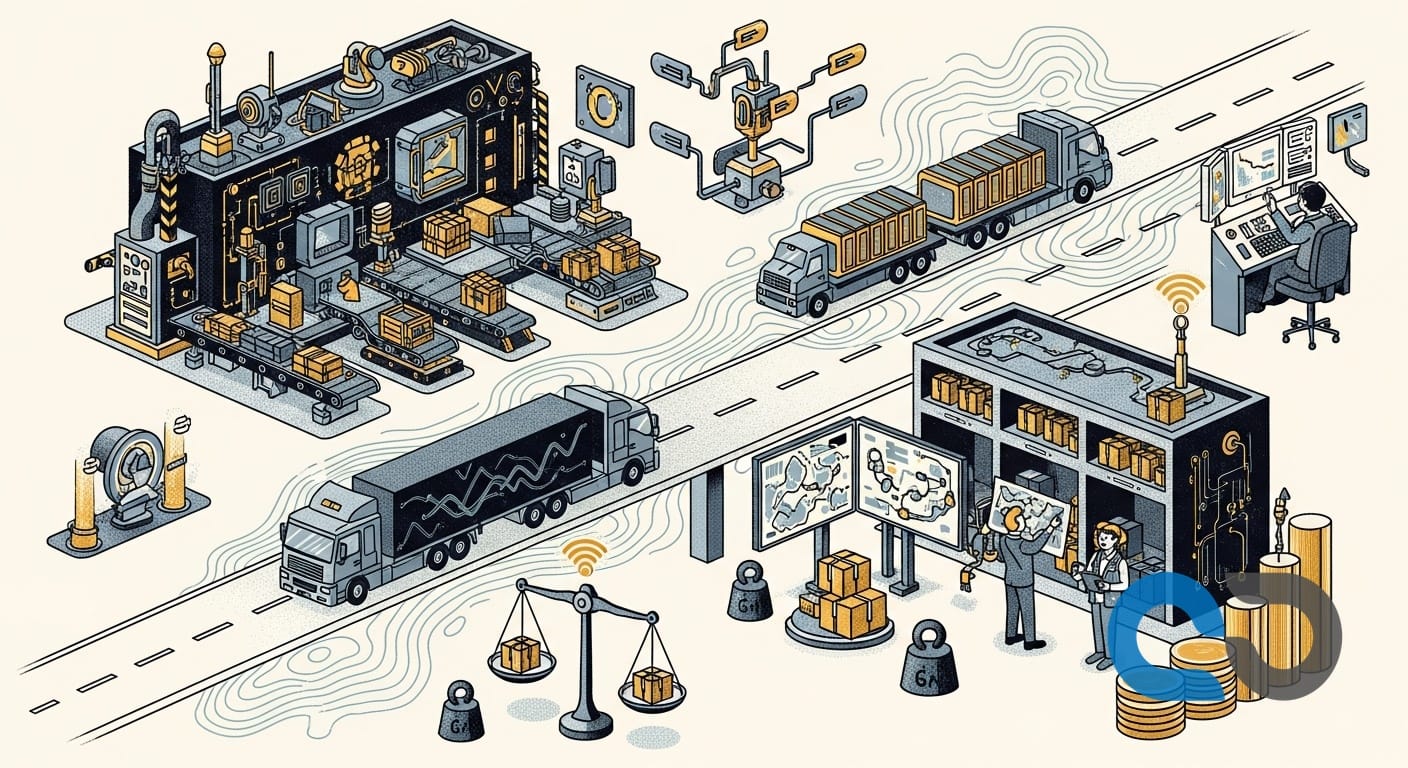
When we talk about self-driving trucks, it's easy to get stuck in complicated scenarios with pedestrians and challenging urban environments. But that's not where the revolution is happening. In 2026, it's on the predictable, boring, and long highway stretches between major logistics terminals that autonomous technology is gaining ground.
This is called hub-to-hub logistics, and it's transforming the industry's profitability at its core. The model is as elegant as it is pragmatic: identify the segment of the supply chain where autonomy is mature, deploy there — and let human expertise take over in environments where it's still indispensable.
The highway — the vehicle's domain
Self-driving heavy electric trucks roll continuously 24/7 between fixed highway hubs. They only stop to charge or swap trailers. No rest time, maximum utilization of infrastructure.
The city center — the driver's domain
At the hub, human drivers take over. They drive the trailer the last mile into city centers, handle the complex unloading, and build the personal customer relationship that no algorithm can replace.
Why does the model work in 2026?
Hub-to-hub is not a new concept — but in 2026, three factors align in a way that makes the model commercially viable at scale. The technology for vehicle control in controlled highway environments has reached sufficient maturity. Regulatory frameworks in Sweden, Germany, and France now allow rolling commercial operation without safety drivers on board on approved routes. And the energy cost of diesel operation makes the profitability calculation for electric autonomous vehicles hard to beat.
The result is a logistics flow where the cost structure of remote transport changes fundamentally — not marginally. It creates opportunities for haulage companies that understand how to position themselves in the new division of labor.
When software becomes the captain
In an autonomous supply chain, the human driver who can make decisions in the event of an unexpected incident along the way is missing. This fundamentally changes what is required of the transport management system. The TMS platform can no longer be a passive booking system — it must take on the role of the vehicle's operational captain.
"Automation is not about eliminating humans, but about moving our expertise to the places where it does the most good: in the complex last mile."
Navichain Logistics Analysis 2026Four operational capabilities that TMS must have
A cloud-based TMS platform like Navichain must have total control when the vehicle's captain is a system, not a person. This requires four concrete capabilities:
Direct communication with the vehicle's autopilot stack via standardized API — not a batch update, but a live command interface.
Automatic booking and confirmation of check-in times at terminal gates with millimeter precision requirements — without human coordination.
Immediate route change if a charging station along the route reports downtime, roadworks are activated, or a time slot is canceled.
Automatic status transfer to the human driver at the hub: load, next destination, customer-specific instructions for the last mile.
Three actions to prepare your haulage company
You don't need to buy a fleet of self-driving vehicles today. But you must prepare your digital infrastructure — otherwise, you risk being left out of the network ecosystem that is being built right now.
-
Standardize your APIs Ensure that your TMS can exchange data in real-time with external autonomous networks and vehicle platforms. Data sharing is the ticket to the ecosystem. Start mapping out which API standards the autonomous operators in your corridors require.
-
Optimize your terminal flows with digital Yard Management An autonomous truck requires millimeter precision when backing up to the gate and fully digitized check-in processes. Start implementing digital Yard Management now — not because autonomous vehicles are arriving tomorrow, but because your terminal needs to be ready the day they do.
-
Build expertise in the last mile Position your haulage company as the expert in local, complex distribution. That's where human drivers will be indispensable for the foreseeable future — and that's where the margins for competent operators will strengthen as the cost structure of remote transport normalizes.
An opportunity, not a threat
The autonomous horizon is not a threat to today's transport companies — it's a huge opportunity to cut lead times and reduce costs for remote transports, while at the same time refining and enhancing the value of human expertise.
By understanding how hub-to-hub flows work, you can proactively adapt your business model and secure your place in the future supply chain. The haulage companies that start the digital preparation now — API standardization, digital Yard Management, positioning for the last mile — are the ones that will be able to participate in the new collaboration agreements with autonomous operators as they are rolled out along the European motorway corridors.
Cloud-based transport management system with open APIs, digital Yard Management, and real-time integration — built for full scalability from day one.