From administrative burden to strategic asset: How to turn data into your profit machine
🇬🇧 Read this article in English
Many haulage companies view data collection as a necessary evil for invoicing. They are wrong. In an era of thin margins, your operational data is the key to profitability. Learn how to turn administration into strategic business value.
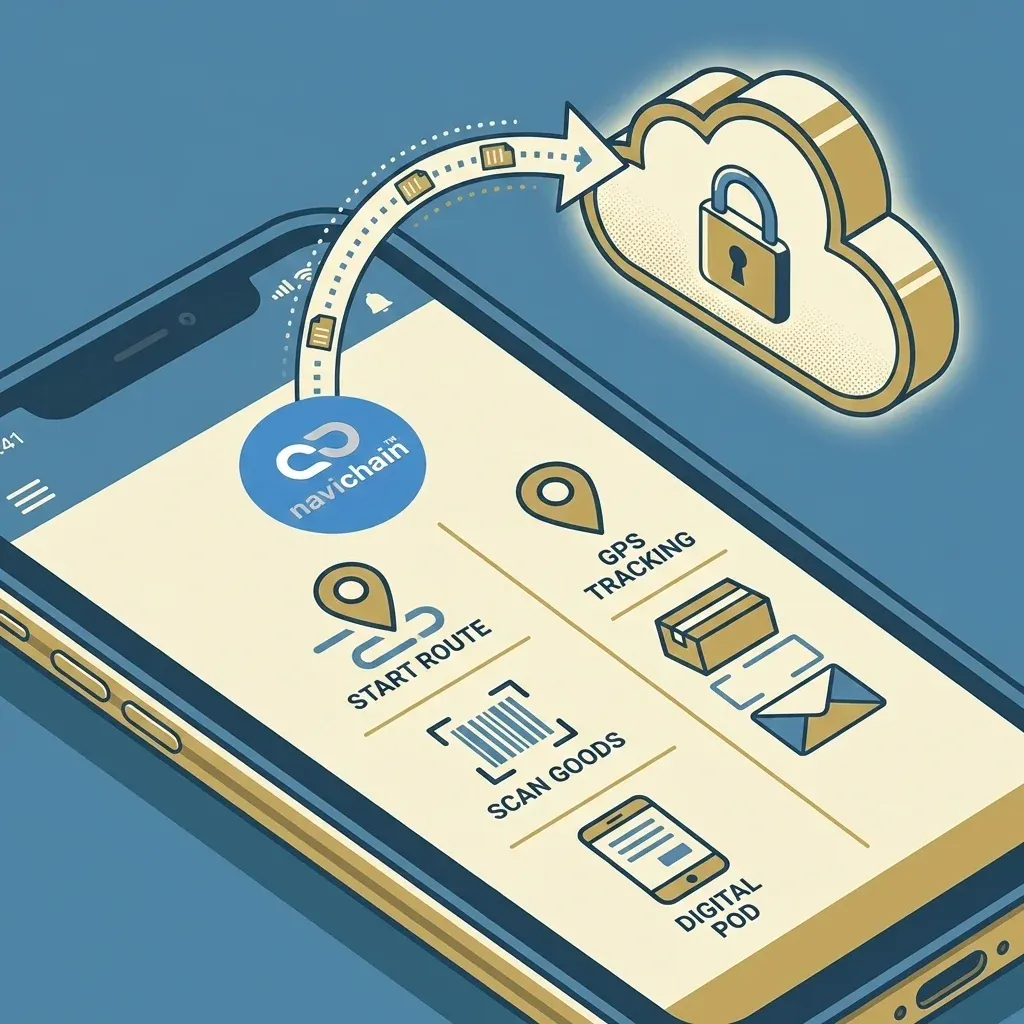
For owners and managers of medium-sized haulage companies, the discussion about "digitalization" has often been about costs and requirements. Customers demand integrations. Authorities demand reports. Drivers demand simple apps. Amidst this noise, it's easy to see data collection as just another administrative burden – a cost item to be minimized.
This perspective is a strategic trap.
The truth is that in an industry where margins often hover in the single digits, your operational data is the only lever you have left to radically improve profitability. It's not about collecting data to "be digital." It's about collecting data to make money.
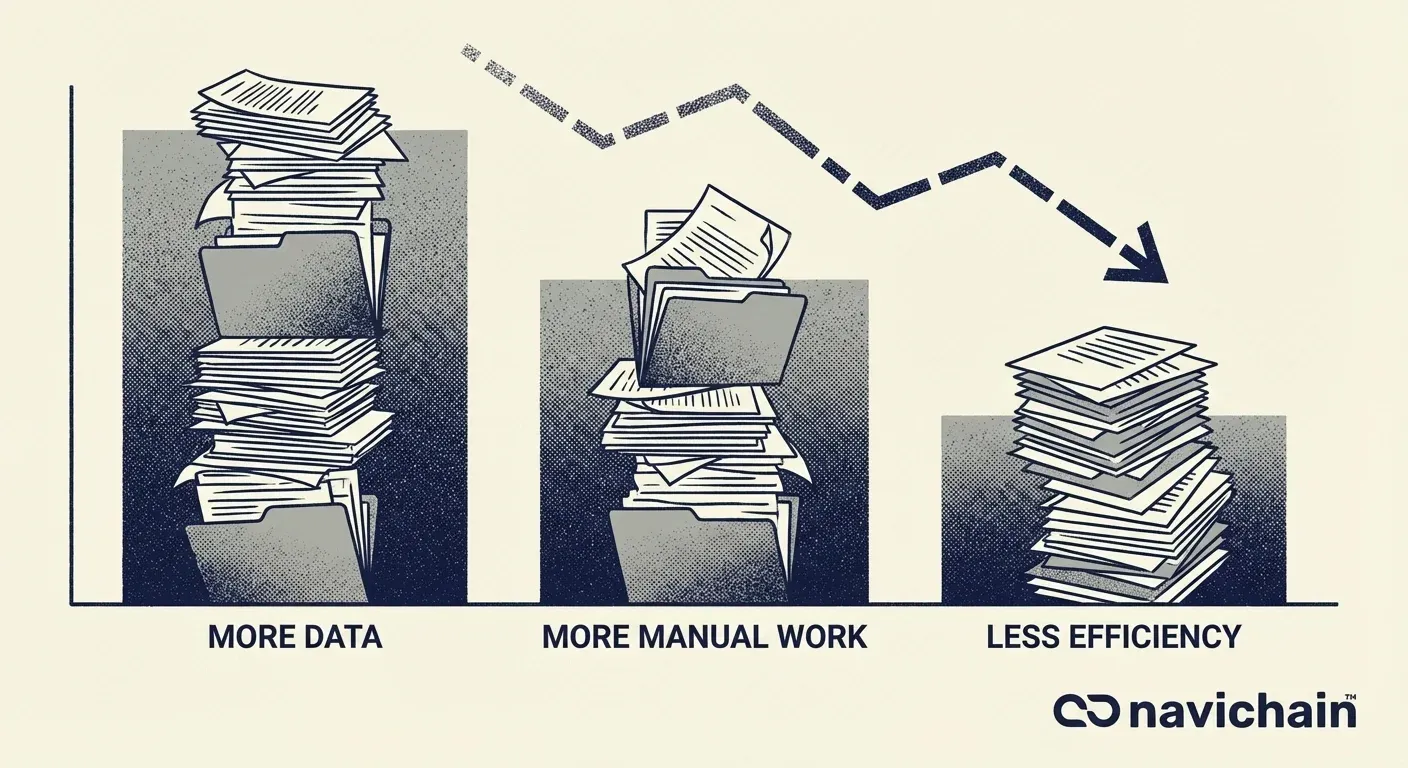
Fig 1: The gap between having data and using it to increase profit.
The operational gain: Stop the money leak

Fig 2: Many haulage companies have large amounts of data but lack the tools and knowledge to convert it into concrete savings and increased profitability.
The first, and most immediate, gain from modern data collection is purely operational. Manual processes are not only slow; they are costly and error-prone.
The hidden costs: A deep dive into "Micro-losses"
Many haulage company owners look at the income statement and see the big items: fuel, wages, vehicles. But profitability rarely dies from a single large expense; it dies from "a thousand cuts." These cuts are what we call micro-losses – small, invisible inefficiencies that occur hundreds of times a day.
Let's break down a classic example: Invoice basis. In an analog or semi-digital haulage company, a traffic manager or accounting assistant often has to manually verify that a trip is complete, collect a signed consignment note (which may be in a truck cabin or have been texted as an image), and then match this against the order before an invoice can be created. If this process takes 15 minutes per order – a conservative estimate when accounting for chasing documents – and you handle 20 orders a day, we're talking about 5 hours of non-billable time every day. Over a year, that's over 1,200 hours. With an internal cost of 500 SEK/hour, this "invisible" administration costs you 600,000 SEK directly on the bottom line.
But the cost doesn't stop there. * Liquidity effect: Every day an invoice is delayed due to incomplete documentation is a day you act as a bank for your customers. * Credit losses: A handwritten change on a consignment note that is missed during invoicing means you might not get paid for waiting time or toll fees. That's revenue slipping right through your fingers.
Automated data collection eliminates these micro-losses. When the system automatically matches GPS position, timestamp, and digital signature against the order, the invoice can be generated the second the goods are delivered. The 600,000 SEK in administrative costs is directly transformed into profit margin or investment space.
Automation beats administration
Consider how many hours your staff spends chasing information. * Traffic managers calling drivers to ask, "Where are you?" * Accounting assistants chasing signed consignment notes to be able to invoice. * Drivers filling out time sheets on paper that then have to be interpreted and manually entered.
With a modern platform, all of this happens automatically. Positions are logged via GPS. Times are automatically stamped upon arrival and departure (Geofencing). Signatures are made on the glass and are visible immediately in the office. The gain is immediate: Reduced overhead costs. When administration decreases, the same team can handle more trucks and larger volumes without needing to hire new staff.
Fig 2: Comparison of administrative time per order: Manual vs. Automated.
Case study: A day in the life of two haulage companies
To truly understand the difference, let's compare a typical Wednesday morning for two different haulage companies: Analog Haulage and Digital Haulage.
07:30 – The deviation
A truck gets stuck in an unexpected traffic accident and is 45 minutes late for the first loading.
- At Analog Haulage: The driver tries to call the traffic management but it's busy. He sends an SMS. The traffic manager, who is busy planning the afternoon, doesn't see the SMS for 30 minutes. The customer, who is waiting for the goods, calls angrily and asks where the truck is. The traffic manager has to call around, apologize, and try to put out fires. Stress levels rise, and trust is chipped away.
- At Digital Haulage: The system automatically detects that the vehicle is stationary and calculates a new estimated time of arrival (ETA). An automated notice is sent directly to the traffic manager's screen and via a customer portal to the goods receiver: "The truck is delayed due to traffic. New arrival time: 08:15." The customer can reschedule their staff. No one needs to call. The traffic manager can calmly focus on optimizing the next trip instead of acting as a switchboard.
13:00 – The unplanned waiting time
Upon unloading, the driver has to wait for 40 minutes because the receiver has lunch closed.
- At Analog Haulage: The driver swears about the wait but forgets to note it on the crumpled consignment note. When the invoice is sent the following week, the customer is only billed for the transport. The haulage company has just given away 40 minutes of working time and vehicle rental for free.
- At Digital Haulage: Geofencing technology records exactly when the truck arrived (13:00) and when it left (14:00). The system automatically flags 40 minutes of "Deviating waiting time" against the contract. When the invoice is created, an extra charge for waiting time is included as an automatic line item, complete with timestamps as proof. The haulage company gets paid for every minute they deliver value (or are forced to wait).
A comparison of the data flow and information exchange between a traditional (analog) and a digitalized haulage company, illustrating the difference in transparency and efficiency.
The difference is not just technology; it's the difference between being a passive supplier and a proactive, professional partner.
The strategic gain: Insight that creates margin
But while the operational gain is about saving money, the strategic gain is about earning it. This is where the difference between winners and losers is decided.
Who is your most profitable customer?
Most haulage companies know which turnover a customer generates. Few know the exact margin. Without detailed data, you roughly estimate costs. You know what the average truck costs per mile, but you don't see the variations. With automated data collection, you get an exact post-calculation on each individual job. * You see that Customer A causes 40 minutes more waiting time per unloading than Customer B. * You see that Route X consumes 15% more fuel due to traffic jams at a certain time.
Data-driven pricing
With this insight, you stop guessing when setting prices. You can go to Customer A and present facts: "Our trucks are stationary for 3 hours a week at your gates. We need to adjust the price or change the booking window." Data gives you the power to sort out unprofitable jobs and double down on those that actually ring the cash register. It transforms your haulage company from being a volume-chasing transporter to a margin-focused logistics partner.
Fig 3: From raw data to strategic decision – the value chain for information.
The technology under the hood: Passive data collection
Many haulage companies have tried to digitalize by forcing their drivers to use complex apps where they have to "input" everything they do. This almost always fails. Drivers should drive, not be data registrars. The solution, and the core of strategic data collection, is passivity.
Passive data collection means that the system collects the information without the human needing to act. 1. Telematics & GPS: The vehicle reports where it is, how fast it's going, and how much fuel it's consuming. 2. Geofencing: Virtual fences around customers' warehouses and terminals create automatic "clock-ins" for arrival and departure. 3. Status triggers: When a driver scans a pallet code, the status of the order changes throughout the system – from warehouse, to transport, to accounting.
This data is superior to manual data because it is objective. A driver might "round off" their arrival time to look good on paper. A GPS doesn't lie. This truthful data is the foundation for making the strategic analyses required to increase profitability.
Data sovereignty: The insurance for your future
When you start collecting this deep operational data – about your customers, your prices, your routes, and your efficiency shortcomings – you create the company's most valuable asset. This raises a critical question: Who really owns this information?
In a world dominated by global tech giants, this is not a theoretical question. Most cloud services for logistics are operated on servers owned by American companies (AWS, Google, Microsoft). This means that your data, even if physically stored in Europe, is subject to American legislation, specifically the US CLOUD Act. This law gives American authorities the right to request data from American companies, regardless of where in the world the data is located, often without you as the data owner being informed.
For a Swedish haulage company, this is a huge, often unspoken risk. Imagine the scenario where your customer list or your price calculations are exposed. Or where an international competitor gains insight into your flows through a "Big Data" analysis sold by the platform provider.
Strategic data collection requires data sovereignty. This means that your data must be stored and managed on infrastructure that is subject to Swedish and European law, completely decoupled from foreign involvement. It's about owning your own truth. When you choose a platform, the question "Where does the data reside?" is as important as "How much does the system cost?".
A schematic overview illustrating the importance of data sovereignty to protect corporate information from external influence and ensure competitive advantages.
Enabling the blueprint: Navichain SaaS unified logistics platform
The strategic blueprint described in this White Paper – a unified, sovereign, and intelligent platform – is the exact model that Navichain SaaS is built on. We designed our platform from the ground up to solve the specific challenges that medium-sized haulage companies face.
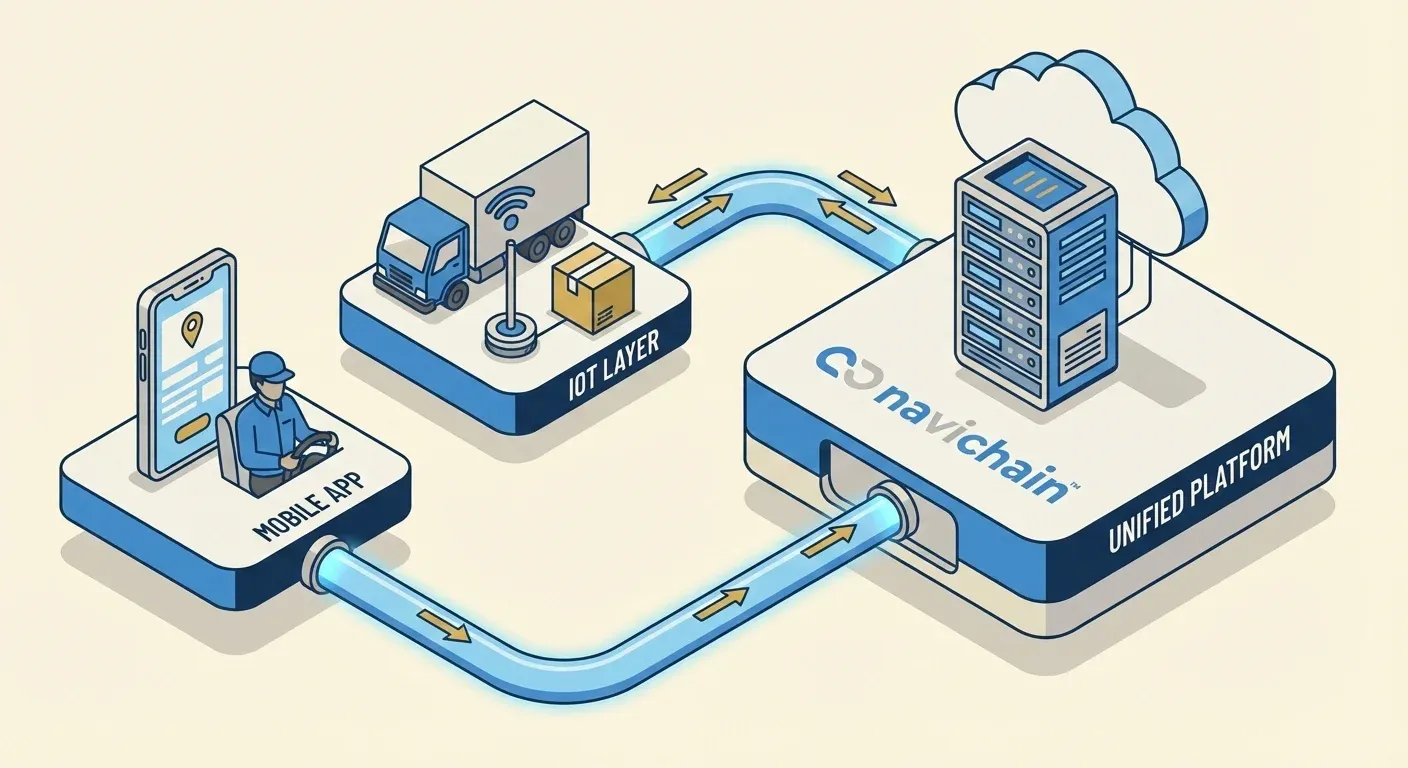
- For "A Unified Operational Fabric": Navichain SaaS is not a collection of modules, but a single, unified logistics operating system. Our platform seamlessly integrates Transport Management (TMS), Warehouse Management (WMS), Resource Management, Invoicing, and Order Management. The data collected in our mobile app by the driver is immediately available to the traffic manager and accounting assistant. No double work, no data silos.
- For "A Sovereign Data Architecture": This is our core differentiation. The entire Navichain SaaS platform is operated on our own independent infrastructure in Sweden. Your data stays in Sweden, under Swedish jurisdiction. This guarantees full GDPR compliance and makes you immune to foreign legislation such as the US CLOUD Act. Your operational data remains 100% yours.
- For "Built-in Analytical Intelligence": Our platform is enhanced with an integrated AI that runs on the same secure, Swedish infrastructure. Because your data is already unified and stored sovereignly, our AI can perform deep, secure analyses on your operational data to unlock unique efficiency gains and provide you with the fact-based decisions that this White Paper describes.
Our mission is to democratize logistics technology and give SME haulage companies the tools they need not just to survive, but to thrive. We have eliminated the administrative burden so you can focus on what's important: building a profitable and resilient business.
Implementation: A step-by-step guide
Moving from analog chaos to data-driven precision can feel overwhelming. But the journey doesn't have to be made in one giant leap. We recommend a phased process:
- Phase 1: Digitalize the Order Flow (Month 1)
- Stop receiving orders by phone and post-it notes. Implement a customer portal or EDI connection.
- Goal: 100% of incoming jobs should be digital from the start.
- Phase 2: Passive Data Collection (Month 2)
- Roll out the driver app for positioning and status updates. Focus on getting geofencing to work for automatic time reporting.
- Goal: Eliminate the paper consignment note and manual driving logs.
- Phase 3: Automated Invoicing (Month 3)
- Link the collected data to the invoicing module. Let the "Delivered" status automatically trigger a draft invoice.
- Goal: Reduce the time from delivery to invoice to less than 24 hours.
- Phase 4: Strategic Analysis (Month 6+)
- Now you have data. Start analyzing profitability per customer and vehicle. Use the insights for upcoming contract negotiations.
- Goal: Increase the average margin by 3-5% by weeding out or renegotiating unprofitable jobs.
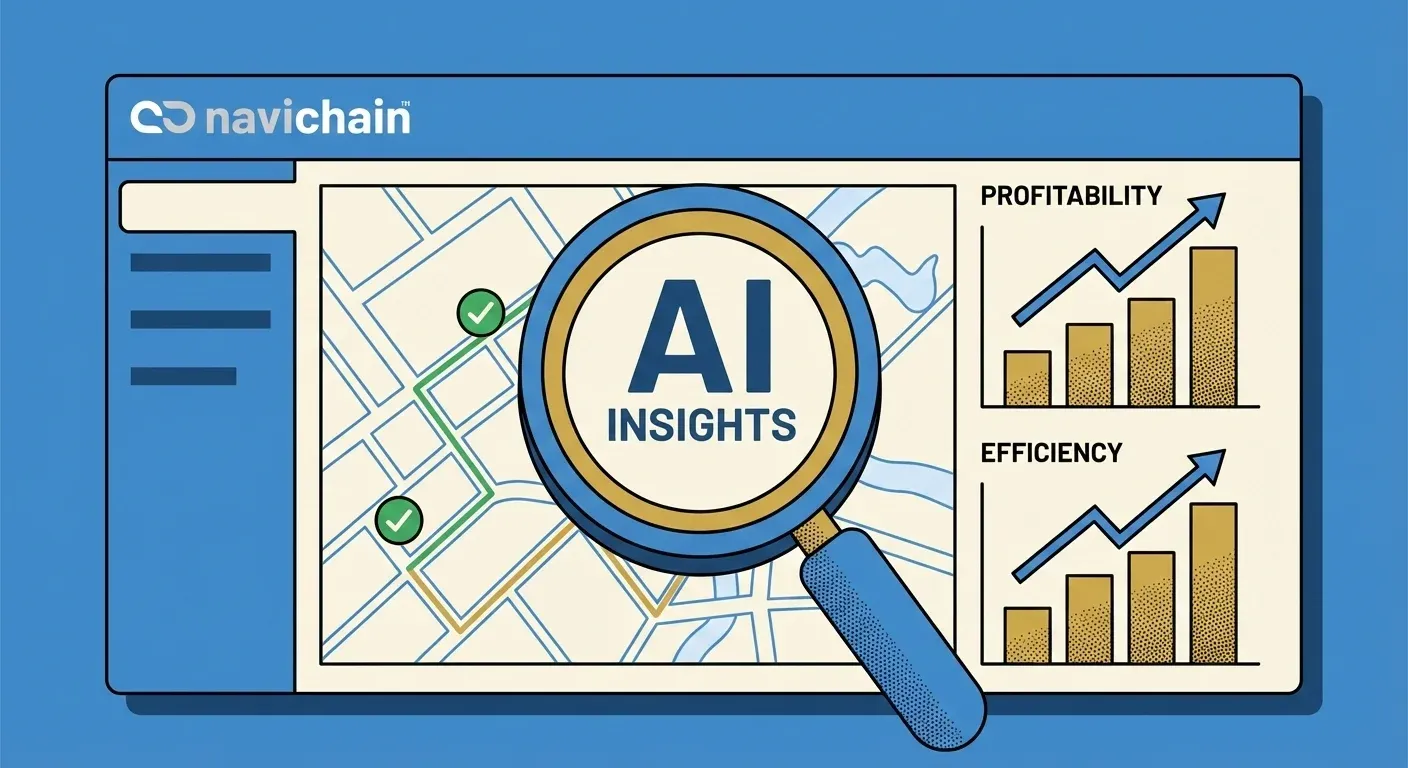
From administrative burden to strategic asset: data analysis enables improved margins and smarter decisions in haulage operations.
References/sources
- Transport Intelligence (Ti) Insight: "European Road Freight Market 2024 Report". Data on cost pressure and market trends. https://ti-insight.com
- Trafikanalys (Sweden): "Development of the Haulage Industry". Official statistics on costs and profitability. https://www.trafa.se
- International Road Transport Union (IRU): "European Road Freight Rates". Reports on price development in Europe. https://www.iru.org
- Integritetsskyddsmyndigheten (IMY): Guidance on third-country transfers and GDPR. https://www.imy.se
Navichain: Your partner for profitable and secure logistics.
Navichain offers a comprehensive solution for secure and profitable logistics management. Discover how the platform can optimize your operations.
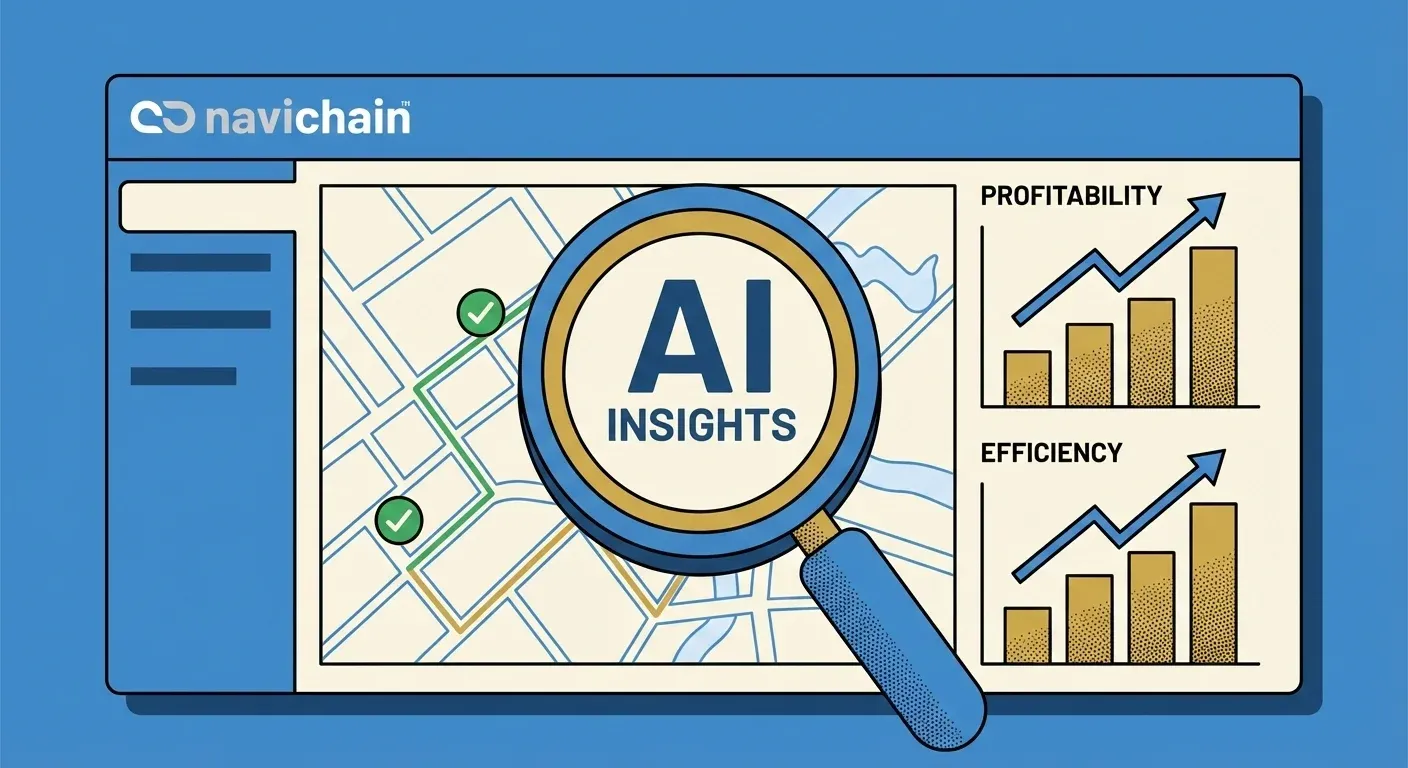
The Navichain platform visualizes the data flow for more efficient and secure logistics management.