The e-CMR paradox: Is your digital waybill creating a new data silo?
🇬🇧 Read this article in English
For decades, paper CMR has dominated European logistics, but now the end is near. With the EU's upcoming requirements for electronic freight transport information (FTI), e-CMR is no longer optional but a necessity. Discover why e-CMR is a strategic opportunity and how you can prepare for 2026.
For decades, the paper consignment note (CMR) has been a simple, tangible, albeit inefficient, part of European logistics. Its digital successor, e-CMR, along with the broader EU regulation on electronic freight transport information (FTI), is now moving from a niche topic to a non-negotiable operational reality. In 2026, all relevant public authorities within the EU will be obliged to accept transport data in digital format, making the transition inevitable.
The ticking clock: Why e-CMR is a strategic focus point, not just a compliance headache
For decades, the paper consignment note (CMR) has been a simple, tangible, albeit inefficient, part of European logistics. Its digital successor, e-CMR, along with the broader EU regulation on electronic freight transport information (FTI), is now moving from a niche topic to a non-negotiable operational reality. In 2026, all relevant public authorities within the EU will be obliged to accept transport data in digital format, making the transition inevitable. For the large multinational carriers, this transition is a simple, albeit expensive, system upgrade. But for the small and medium-sized enterprises (SMEs) that form the backbone of the Scandinavian and European transport industry, it feels different. It feels like yet another layer of costs, yet another complex technology, and yet another regulatory burden in an industry already squeezed by minimal margins, driver shortages, and rising operating costs. The temptation is simple and immediate: find the cheapest, fastest e-CMR app, get it on the drivers' phones, and check off the compliance box. This report argues that this seemingly pragmatic approach is a strategic mistake. * Problems with fragmented e-CMR solutions.
Problems with fragmented e-CMR solutions.
It is a decision that, instead of solving a problem, creates a new, more insidious one: the digital data silo.
Deconstructing the paradox: How a 'solution' creates more problems
Your business is not driven by consignment notes. It is driven by the data they contain. Who is the sender? What is the cargo? Where is it going? Most importantly: has it been delivered? The moment of delivery is the moment of truth – it triggers the invoice, proves compliance with service level agreements (SLAs), and starts the clock for your payment cycle.

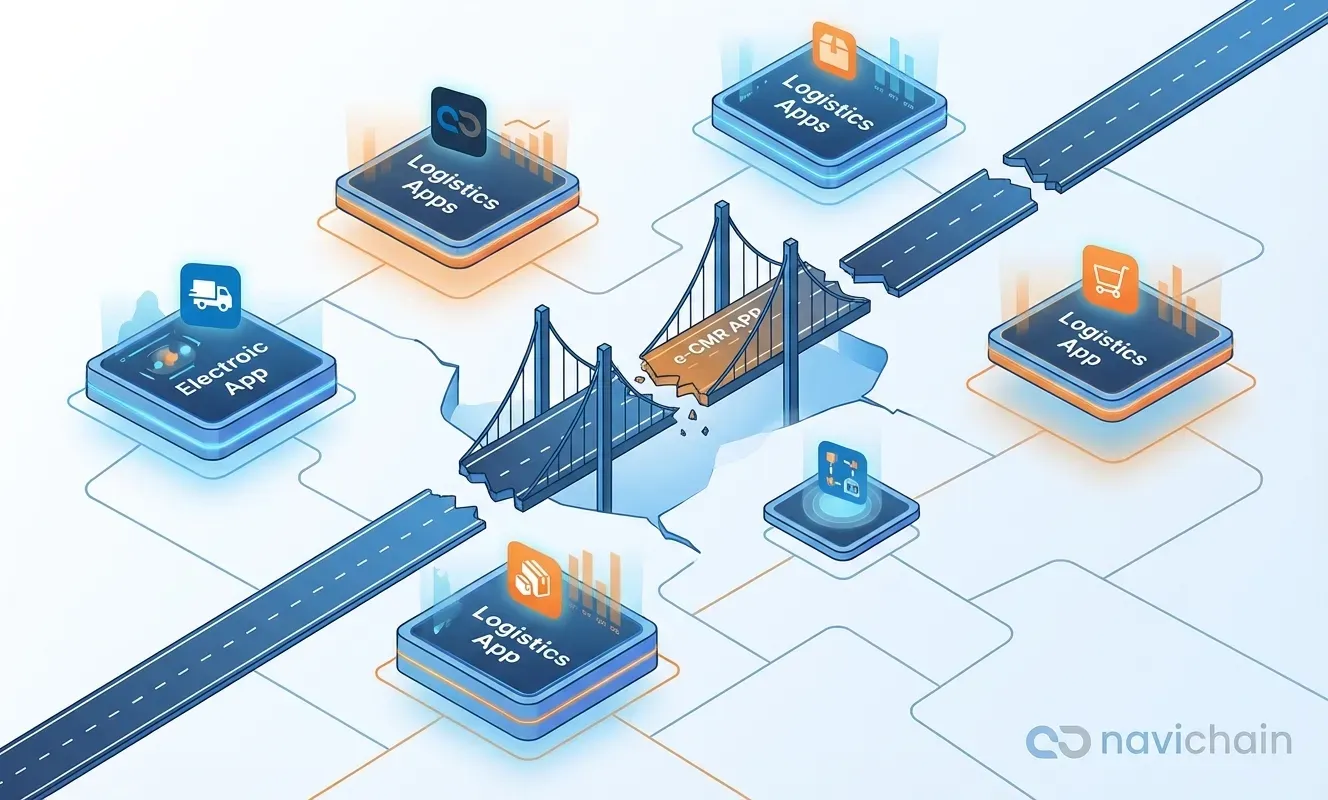
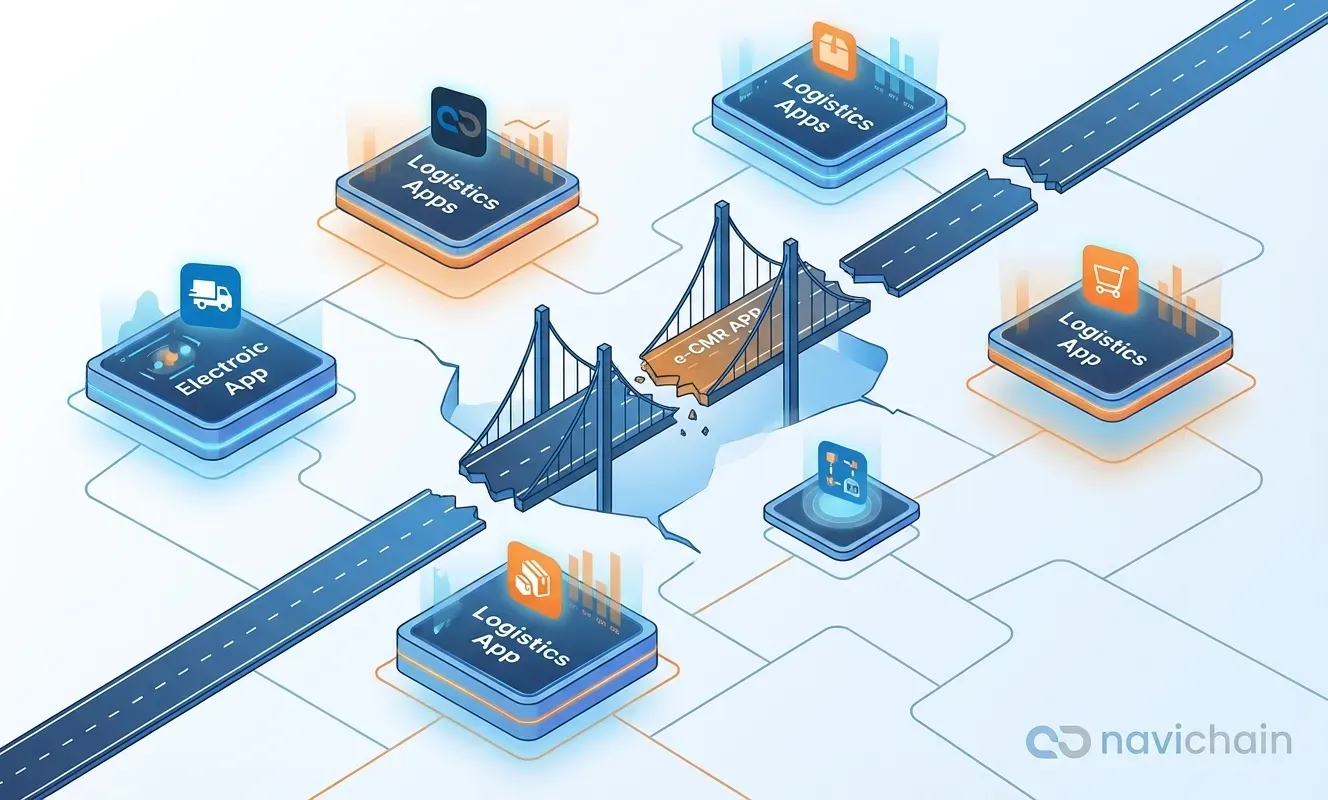
Illustration of how isolated e-CMR solutions create data silos, hindering information flow and increasing administrative burden.
The trap with the 'all-in-one app'
The typical SME logistics business is already fragmented. You have a Transport Management System (TMS) for planning, perhaps a Warehouse Management System (WMS) for storage, an accounting package for invoicing, and a vehicle management tool for tracking. These systems rarely communicate well, if at all. Now you add a standalone e-CMR app. This app successfully captures a digital signature and a proof of delivery (POD). But where is that data? It is in the e-CMR app. This creates a critical disconnect. Your operations manager, sitting in the office, now has to manually log into a separate system to verify delivery before they can enter the accounting system to create an invoice. The data must be re-entered, checked, and reconciled. Every manual step is a potential error, a delay, and a cost. You have not streamlined your business; you have merely moved the bottleneck and given it a digital interface.
The hidden costs of a new data silo
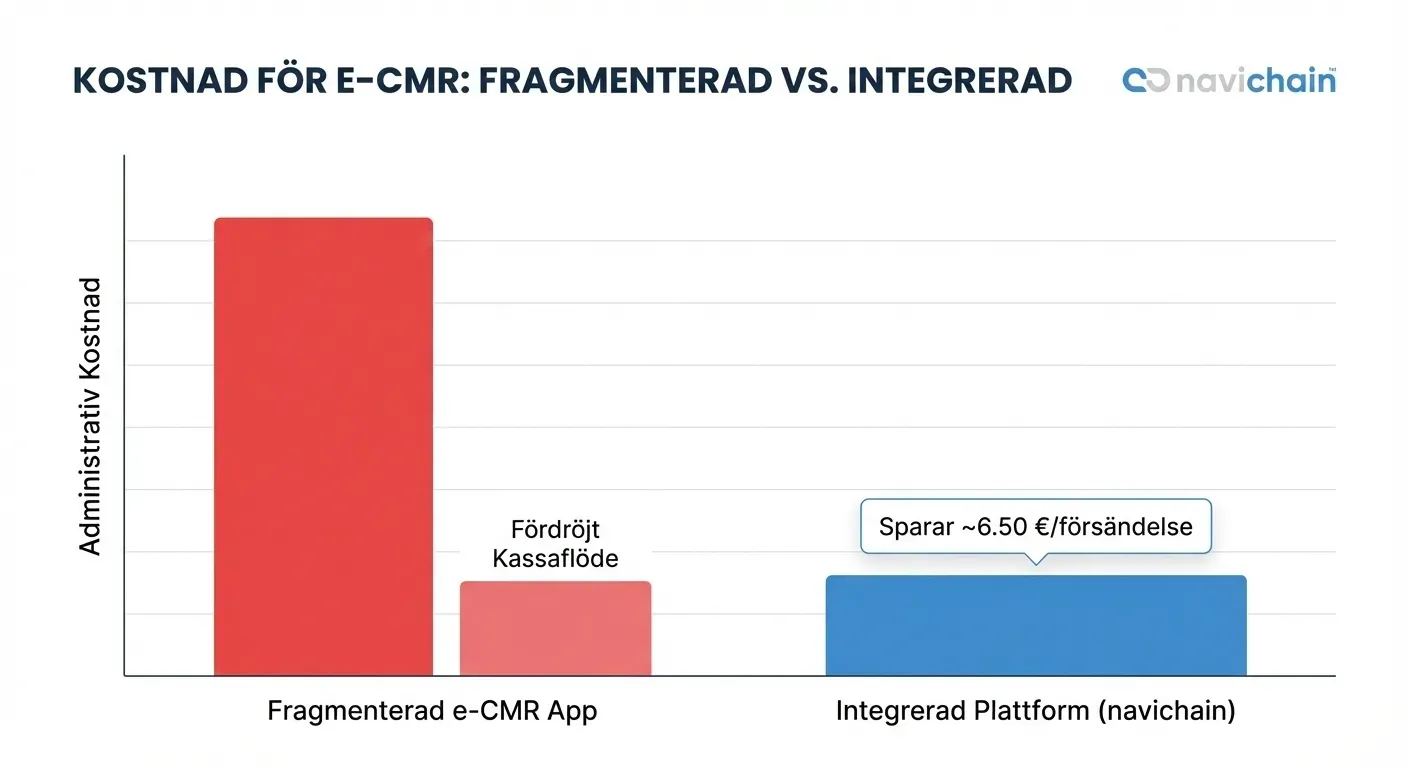
This fragmented approach, stemming from a compliance-focused mindset, incurs significant hidden costs and risks: * Increased administrative overhead: Your team now spends time moving data between disconnected systems. A process that should be immediate – from delivery to invoice – remains a multi-day, manual affair. Studies by industry organizations such as IRU have shown that while e-CMR can save up to €6.50 per shipment, these savings are only realized if the data flows automatically.
* Cost comparison: Manual vs. Automated e-CMR data handling.
Cost comparison: Manual vs. Automated e-CMR data handling.
Manual re-entry negates the entire benefit.
- Delayed cash flow: The single most important benefit of digital PODs is the ability to accelerate the order-to-cash cycle. If your e-CMR data does not immediately and automatically trigger an invoice in your invoicing system, you are losing revenue and damaging your cash flow.
- Compromised data integrity and compliance: When data is copied manually, it is corrupted. How can you prove to an auditor, or a customer disputing a charge, that the data from the e-CMR app perfectly matches the data in your TMS and the final invoice? This data fragmentation is a compliance risk, not a solution.
- Inability to analyze: You cannot optimize what you cannot see. With your operational data split between a TMS, a WMS, and an e-CMR app, you have no single source of truth. You cannot ask simple, powerful questions like "What is our average dwell time at this specific customer's dock, confirmed by e-CMR data?" Your data is trapped.
The way forward: The framework 'compliance as a catalyst'
The e-CMR mandate should not be seen as a burden. It should be seen as the catalyst for the strategic unity your business has needed for years. Instead of asking "How do we add e-CMR?" the strategic question is "How do we absorb e-CMR into a single, unified operational system?" This framework rephrases the challenge around three core pillars. 1. Unified Core (TMS + WMS + Invoicing): The foundation is not e-CMR itself, but a unified operational system where transport, warehouse, and invoicing management are one. Data from an order should flow seamlessly from creation to planning (TMS), to picking (WMS), to in transit (Asset Management), to delivery (e-CMR), and finally to invoicing (Invoicing) without a single manual keystroke. 2. Embed compliance as a built-in feature: In a unified system, e-CMR is not an 'app' or an 'integration'; it is a built-in feature. The driver's mobile interface is simply a window into the central system. When the delivery is marked as complete, the data is not sent to the invoicing module; the invoicing module already has it. It is the same data, in the same system, in real-time. This is true, automated compliance. 3. Secure the data flow: This newly unified, real-time data flow is now your most valuable asset. It contains all your operational, client, and financial data. Protecting it is not optional. This is where data legislation and infrastructure become critical. For a European SME, relying on cloud platforms outside the EU represents a massive compliance risk (e.g., CLOUD Act, GDPR complexity). Your data flow must be as secure and legally correct as your cargo. Adopting this framework transforms e-CMR from a costly inconvenience to the final piece of the puzzle, the triggering factor that automates your entire order-to-cash cycle and provides a single source of truth for your entire business.
The diagram illustrates how a framework with compliance as a catalyst can streamline the order-to-cash cycle and create a unified data source.
From diagnosis to design: The blueprint for a resilient logistics operational system
To move from fragmented, friction-filled processes to a streamlined, resilient business, Scandinavian SMEs must demand a new standard from their technology. All modern logistics platforms must be built on three non-negotiable principles.
Principle 1 - unified operational fabric
Stop buying 'modules'. Start demanding a 'fabric'. A modern logistics system must be a single, integrated platform – a central nervous system for your business. Transport Management (TMS), Warehouse Management (WMS), Invoicing, and Asset Management must not be separate systems that are 'tied together'. They must be built-in components of a system, sharing a database and a single source of truth. When a change is made in one place (e.g., an e-CMR is signed), it is immediately and universally available everywhere. This is the only way to eliminate data re-entry, reduce errors, and build automated workflows.
Principle 2 - secure data architecture and control
For European SMEs, data is not an abstract concept; it is a core asset governed by strict law. True operational resilience requires full control over your data environment. This means your data must be stored and processed under your region's legal jurisdiction – specifically within the EU/Sweden – on secure, high-performance infrastructure. This 'self-hosted' or 'sovereign' approach ensures simple, provable GDPR compliance. It eliminates exposure to the complexity and risks of international data transfers, giving you and your customers absolute confidence in your data's security and integrity.
Principle 3 - embedded analytical intelligence
With a unified fabric (Principle 1) and a secure data architecture (Principle 2), you finally have what drives true efficiency: a clean, complete, and secure data set.
Schematic overview of a unified logistics platform.
The final principle is to put this data to work.
An embedded intelligence or integrated AI layer is no longer a luxury; it is a necessity. This AI must run within your secure environment and analyze your unified data in real-time. It can then unlock unique efficiencies: proactively flag problematic shipments before they become issues, optimize routes based on actual delivery times, and identify your most (and least) profitable customers with an accuracy impossible in a siloed world.
References/sources
- European Commission: Regulation (EU) 2020/1056 on electronic freight transport information (FTI). https://transport.ec.europa.eu/transport-themes/logistics-and-multimodal-transport/electronic-freight-transport-information-fti_en
- International Road Transport Union (IRU): Benefits of e-CMR. https://www.iru.org/what-we-do/innovate-and-lead/e-cmr
- Transport Intelligence (Ti): Report on the digitalization of road freight in Europe. https://www.ti-insight.com/briefs/the-digitalisation-of-road-freight-in-europe/
- CLECAT (European Association for Forwarding, Transport, Logistics and Customs Services): Position on the FTI regulation. https://clecat.org/
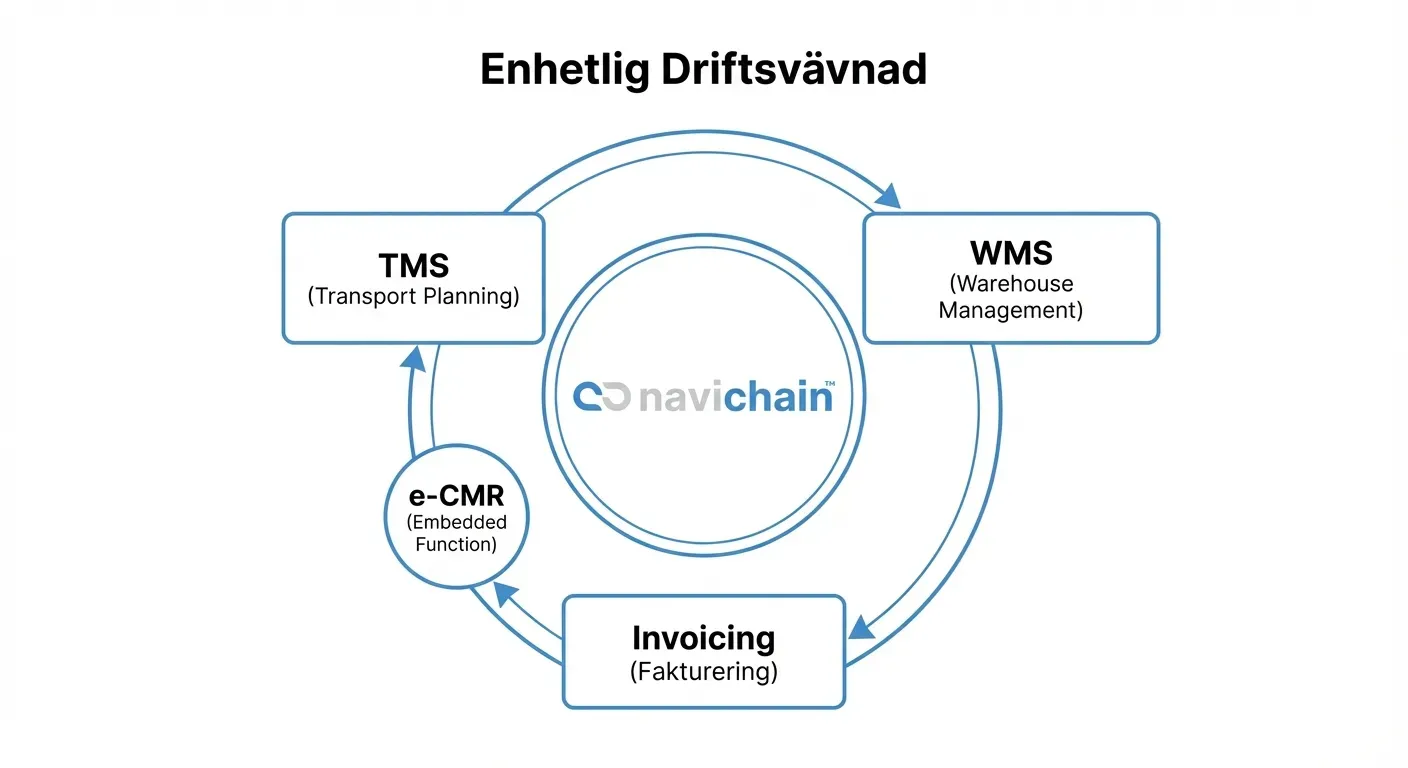
Schematic overview of how a unified logistics platform, such as Navichain SaaS, enables data-driven optimization and reduces data silos.
Enable the blueprint: Navichain SaaS unified logistics platform
This white paper has sketched a strategic blueprint for transforming the e-CMR mandate from a compliance burden to a catalyst for operational excellence. The principles of a Unified Operational Fabric, Secure Data Architecture and Control, and Embedded Analytical Intelligence are not theoretical – they are the foundation of the Navichain SaaS platform.
We designed Navichain SaaS specifically to address the fragmentation plaguing SME logistics.
- Embodiment of Principle 1 (Unified Fabric): Our platform is not a collection of modules. It is a single, unified operational system where Transport Management (TMS), Warehouse Management (WMS), Asset Management, Invoicing Management, and Order Management work as one. The e-CMR function is a built-in part of this flow, not an add-on, enabling you to achieve a zero-touch, automated order-to-cash cycle.
- Delivers Principle 2 (Secure Data Control): As our most important differentiator, the entire Navichain SaaS platform is hosted on our own secure infrastructure (Self-hosted) in Sweden. This guarantees that your data, your customers' data, and all e-CMR information remain strictly within Swedish/EU jurisdiction. This ensures maximum data security, control, and the most straightforward path to GDPR compliance in the industry.
- Activates Principle 3 (Embedded Intelligence): Because all your data resides in a unified, secure system, our new integrated AI can deliver deep insights. Running securely on our Swedish infrastructure, our AI analyzes your operational data to identify bottlenecks, optimize planning, and unlock efficiencies that are impossible to find when your data is trapped in silos. Our mission is to democratize logistics technology and offer a seamless, secure, and intelligent solution that enables Scandinavian SMEs to thrive. Stop managing apps and start building a unified, resilient business.
The result of unified logistics: Efficiency and resilience.
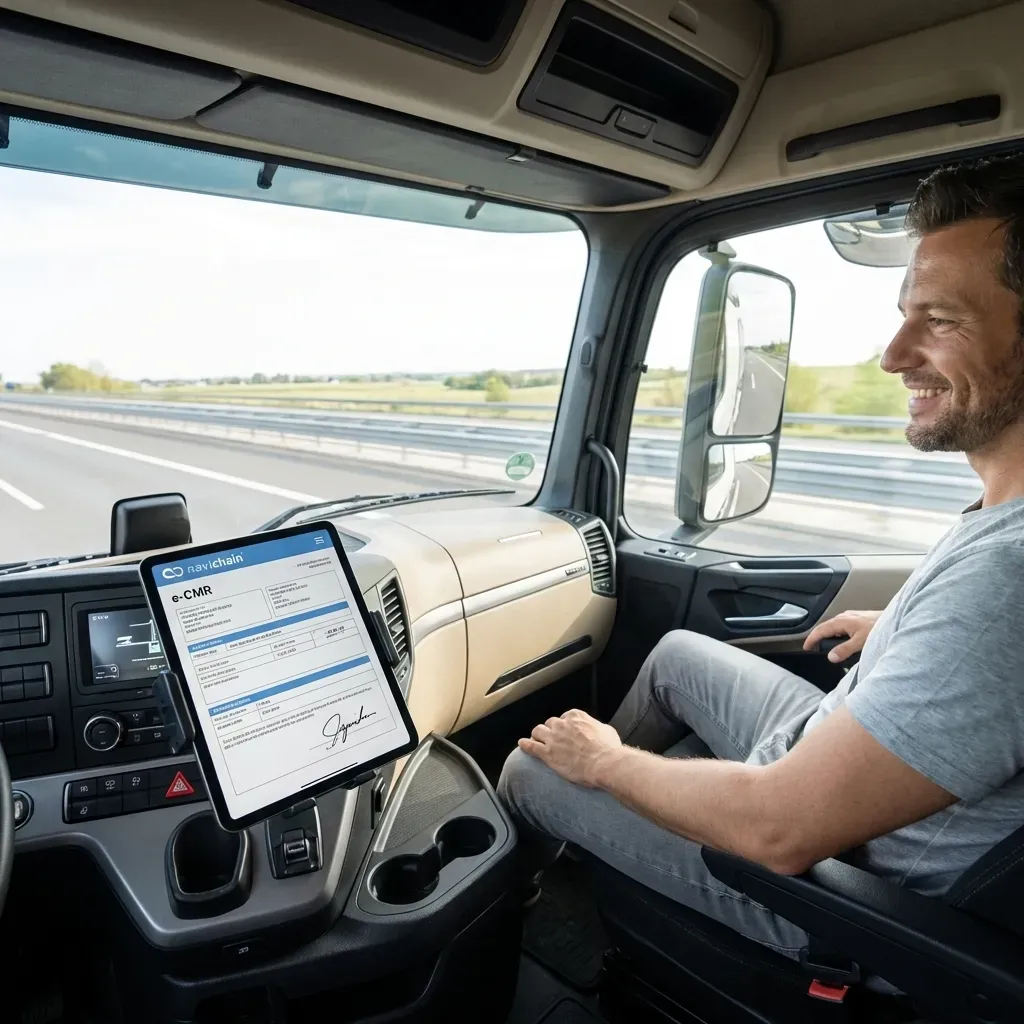
Navichain SaaS: A unified platform resulting in improved efficiency and resilience in logistics operations.
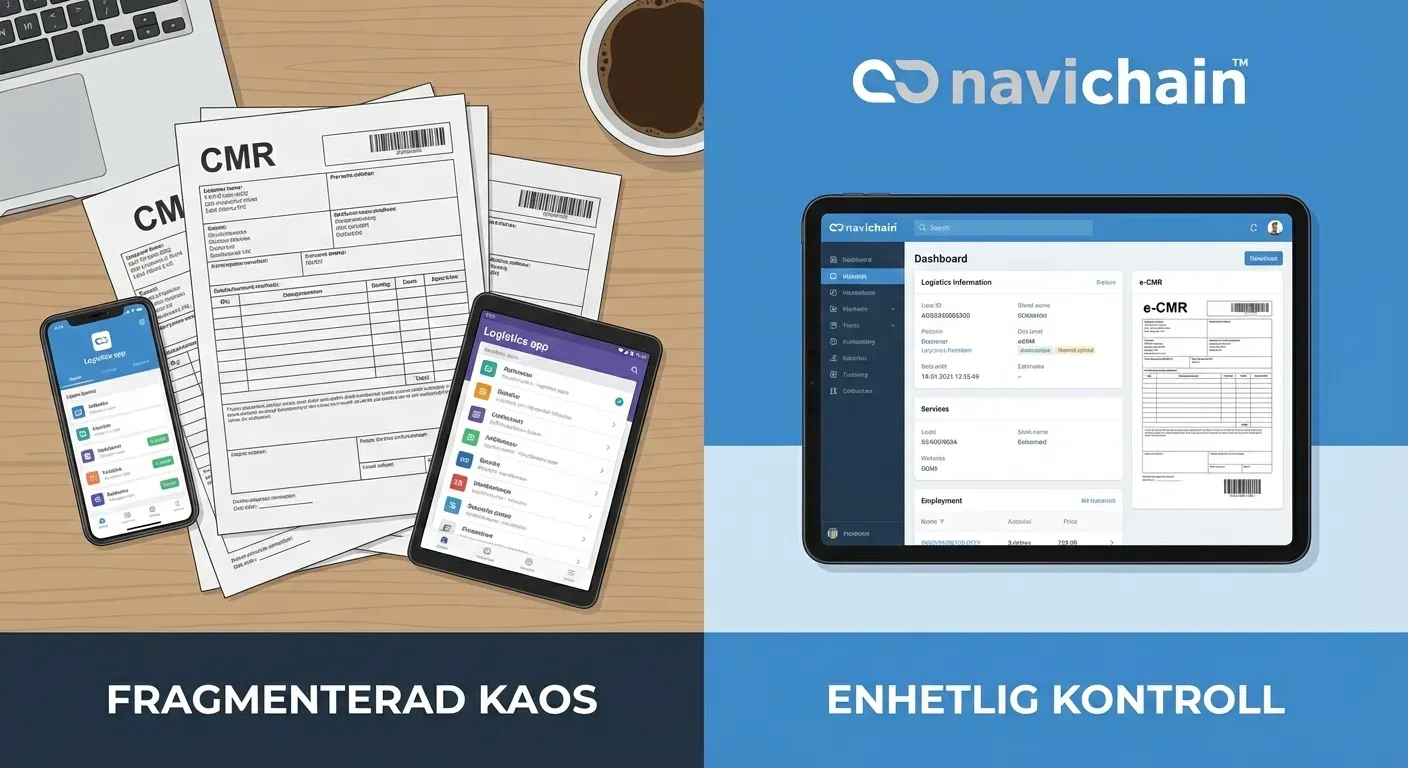
Navichain provides real-time insight into the entire supply chain, enabling proactive management and optimization.