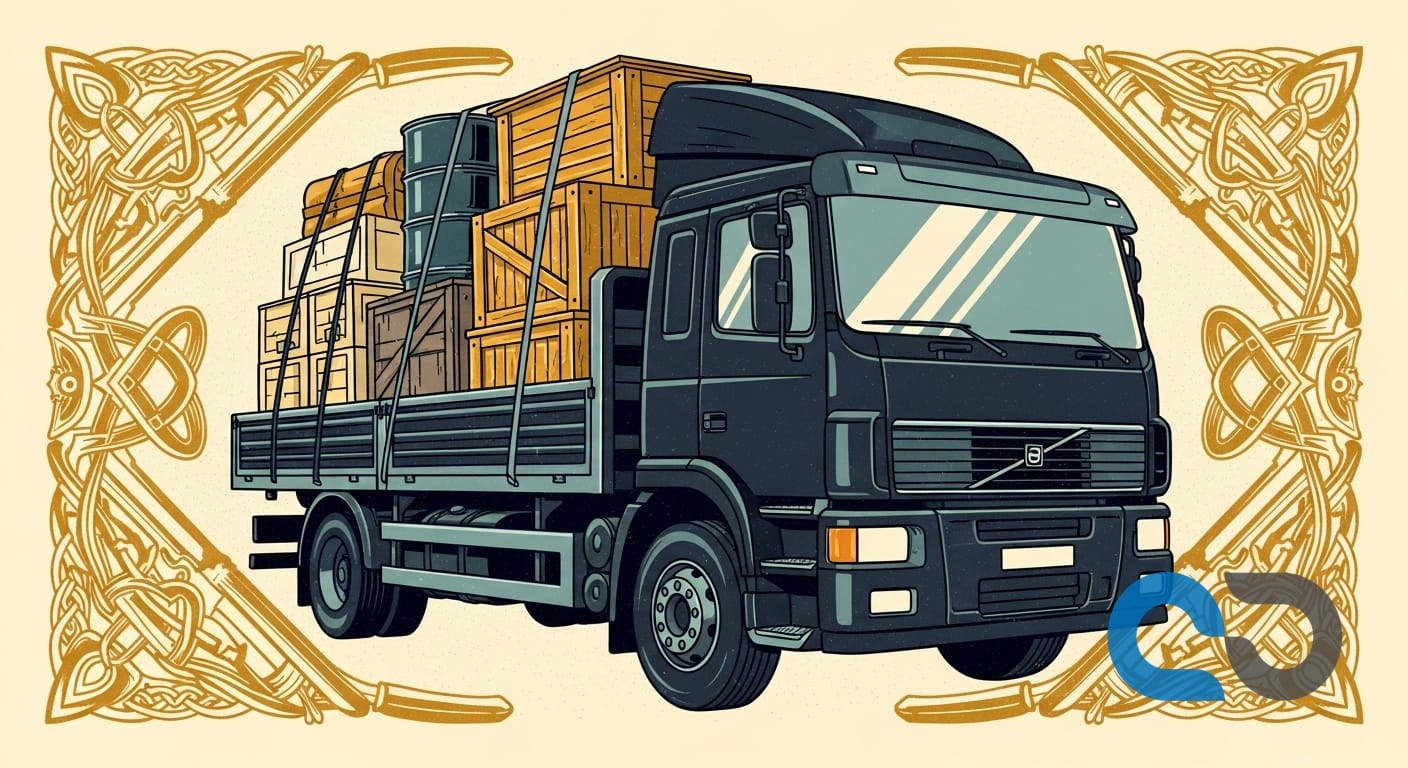
Imagine your best-performing driver. He delivers goods to an industrial customer in Strängnäs, signs the delivery at 09:47, and then turns onto the E20 with an empty flatbed heading back to the warehouse. Thirty-six miles. Approximately 850 SEK in fuel, road tolls, and wear — and zero revenue. This is called a return trip, and for an average haulage company with ten vehicles, it happens up to four times per vehicle and day. This is not a logistics detail. It's a leak at the bottom of your cash box.
The old linear model — pick up goods, deliver goods, drive home — worked when margins were thick and competition was asleep. Today, it's a luxury problem you can't afford. The global movement towards a circular economy changes not only what is transported but how transport assignments are defined, priced, and planned. For you as a haulage company, the question is no longer whether you should adapt — but how quickly.
What is circular logistics? It is an operational paradigm where return flows — empty packaging, used products, residual materials — are planned as separate business assignments rather than necessary costs. Instead of seeing home trips as "empty runs," they are treated as a commercializable transport assignment in the opposite direction.
Why the Circular Economy Changes Your Mission
The circular shift is driven not by goodwill but by hard economic pressure. Goods owners like IKEA, Axfood, and Volvo have already committed to halving their Scope 3 emissions — that is, emissions throughout the entire value chain, including transportation — by 2030. They choose suppliers who can demonstrate their environmental impact with actual data, not guesses.
In parallel, EU legislation is introducing requirements for producers to be responsible for the entire lifecycle of their products. Batteries must be retrieved. Packaging must be sorted and returned. Textiles must be collected at the end of their lifespan. All of this requires systematic, documented, digitally tracked return flows. And who transports the return flows? You.
The haulage company that can offer a closed-loop solution — deliver out and take back on the same trip with full digital traceability — is no longer a subcontractor. He is a strategic partner.
Navichain Insight · Circular Logistics 2026Three Business Models for Return Flows
There is no universal model. Successful haulage companies typically combine two or three of the following:
-
1Closed-loop Packaging Management
You deliver goods in the customer's own pallets, crates, or containers and pick them up on the return trip. The customer pays for the circulation, not just the transportation. Navichain tracks each unit with an asset ID so that no packaging is lost — and you can invoice based on actual circulation time, not estimates.
-
2Optimized Return Freight on Existing Routes
Navichain's AI engine automatically matches your delivery point with collection assignments nearby. The driver delivers a load, confirms the delivery in the app, and immediately gets the next assignment — a pick-up assignment 2.4 km away — read on his screen. This requires no new vehicles, no new personnel. Just smarter planning.
-
3Environmental Reporting as a Service
Goods owners need to be able to report their Scope 3 in their sustainability reports. You have the data: number of kilometers driven, load, vehicle, fuel type. Navichain packages this data in an export format that can be directly used in the customer's ESG report. What was previously a requirement for you becomes a premium offering you get paid for.
How Navichain Makes It Possible in Practice
It's not enough to have a good idea. Circular logistics requires a system that keeps all the moving parts together — and that doesn't require you to hire a data analyst to use it.
Dual Assignment Pool
Plan outbound and return assignments on the same trip. The AI engine optimizes order, time consumption, and fuel cost per loop.
Asset Tracking Built-in
Track pallets, crates, and containers with unique asset IDs. See where each unit is in real-time and set automatic reminders for returns.
Automatic Environmental Report
Export CO₂ data per assignment, customer, or vehicle. Your customers get the basis for their Scope 3 reports — directly from Navichain.
chain
What You Need to Do Now
There are three practical steps that any haulage company can take immediately — regardless of the size of the fleet:
Identify your empty runs. Navichain automatically gives you an empty run report per vehicle and day. For most haulage companies, this is the eye-opening insight: the volume is much larger than you think, and concentrated on a few routes.
Talk to your three largest customers about packaging. Ask directly: do you handle return packaging today? Do you pay for it? How do you want to report your Scope 3? You'll be surprised how often the answer is "we handle it poorly and want help."
Activate the return assignment module in Navichain. It takes 20 minutes to set up and requires no system changes. Navichain integrates with Fortnox, Visma, and Hogia — so your invoicing and accounting follow automatically.
Navichain does not replace your existing stack — it complements it. Do you already have an accounting system you like? Great. Navichain connects to it. Do you have a planning routine that works? Keep it. You choose what you replace and what you keep. That's what sovereign independence means in practice.

The Conclusion That Changes the Calculations
You already own the capacity. You already drive the routes. You already have customer relationships. The only thing missing is a system that makes it profitable to use all of this in both directions.
Circular logistics is not a niche for large players with dedicated sustainability departments. It is a business model for every haulage company that is tired of driving home with empty flatbeds and wondering where the margin went. The answer is already driving on your truck — you just need the right system to capture it.
Navichain is built for exactly that situation. Not to replace how you work, but to make every kilometer you already drive more valuable.