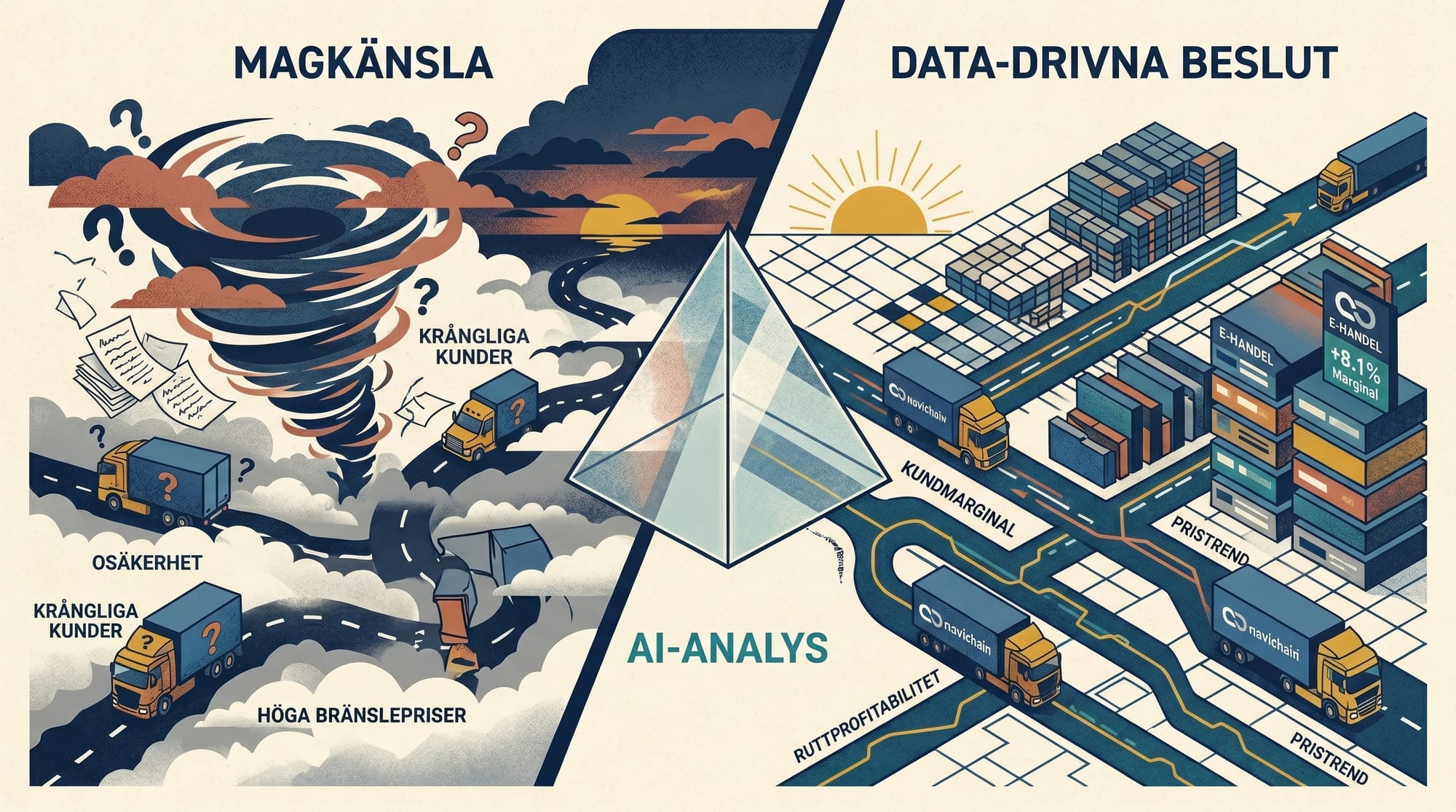
Ask most freight company owners how things are going and the answer is roughly the same: pretty good, I think. Fuel prices are high. One customer is a bit troublesome. One route seems to take longer than it should. But exactly how profitable the Gothenburg–Malmö route is compared to Gothenburg–Stockholm? What price per kilogram should the goods have to cover costs with a three percent margin? If you increased the price by five percent for your three least profitable customers – how much of that revenue is realistically retained? These are questions most cannot answer. Not because they don't want to, but because the data isn't collected in one place – and no one has had time to analyze it.
Navichain has built a solution to this problem: a superior AI analysis engine that works directly with the actual traffic data in the system, in real time, without a single line leaving Sweden.
What does "sovereign AI" mean in practice?
The term AI is currently being thrown around like confetti in marketing, and it's reasonable to be skeptical. Navichain's AI is not a third-party service that processes your shipments on American servers. It is an open-source language model that runs on Navichain's own servers in Sweden – isolated, controlled, and inaccessible to foreign legislation. This means that your prices, your customer agreements, your route patterns, and your margins never exist outside your control.
It's not a marginal issue. It's the difference between having a trade secret and having a secret that is potentially available to U.S. authorities via the U.S. CLOUD Act – a real legal scenario that more and more European companies are starting to take seriously.
Most haulage companies have a rough idea of how things are going. Navichain's AI knows exactly – down to route, customer, and consignment.
What does the AI actually see?
Navichain continuously collects data from every booking, every drive, every signed delivery, and every issued invoice. This is raw material that was previously hidden in the system without anyone having the capacity to analyze it. The AI engine transforms it into concrete decision support.
Illustrative example view. Your actual data looks different – and that's exactly the point.
The type of view shown above is not available in an Excel spreadsheet. It requires that bookings, invoices, driving times, and customer agreements are linked in a single system – and that someone or something constantly analyzes the movement in the data. That's what Navichain does, automatically, in the background, every day.
Prices, trends, and benchmarking
One of the most powerful – and least discussed – features of Navichain's analysis engine is price trend analysis. The system tracks how your prices develop over time per customer category, per route zone, and per type of goods, and compares them with the actual cost development in operations. This means you see in real time whether your pricing follows fuel price developments, or if you are gradually eroding your margin without noticing it.
The benchmarking layer is equally concrete: Navichain can compare your average payment time, your price per mile, and your margin figures with anonymized aggregates from comparable haulage companies in the system. This is the type of industry comparison that has so far only been available to the large players with money for expensive management consulting.
Is your price keeping pace with your costs?
The AI tracks deviations between your contract price and your actual cost development and flags when the margin shrinks – before it shows up in the account.
Which customers cost more than they bring in?
Not all revenue is equally valuable. The system calculates profitability per customer including driving time, administrative burden, and payment time – not just the invoiced amount.
Which routes are really profitable?
Gross revenue per route often hides inefficiency. The AI calculates net after fuel, time, and empty running – and ranks your routes by real return.
How do you perform against the industry?
Compare your payment time, your price per mile, and your margins with anonymized aggregates from comparable haulage companies in the Navichain network.
The flight simulator for your haulage company
Navichain describes its analysis engine as a "flight simulator for logistics" – and the analogy is apt. A pilot does not fly a real plane to test what happens if the engine fails. A freight company owner should not have to risk their business to find out what happens if fuel prices rise by another ten percent, or if the big customer negotiates a price reduction of eight percent.
With Navichain's analysis engine, you can simulate these scenarios against your actual operational data and see the consequences in advance. This is strategic planning of the kind that has so far required a consulting fee – now built into a system that costs 199 kronor per user per month.
Do you have years of data in folders and old emails? It's a goldmine.
AI analysis requires no long startup period. If you already have historical transport data – old waybills, booking confirmations, Excel lists, scanned PDFs – you can feed them directly with Navichain's Magic Drop function.
The AI reads the documents, extracts the booking information, and automatically builds a historical database. This means you can have a complete analysis basis from day one – not after a year of continuous data collection. An evening with old folders can give you a two-year view of your business, structured and analyzed without a single manual keystroke.
This is retroactive digitization that actually works – and gives the AI the context it needs to provide meaningful trend analyses from the very first week.
From gut feeling to decisions in seconds
It's not about replacing the experience of a dispatch manager who knows their routes and customers inside out. It's about giving that experience a basis. The gut feeling that a certain customer is difficult to work with is confirmed – or dismissed – by actual profitability data. The feeling that a route zone has become worse is seen in the trend curve. The suspicion that competitors are pressing prices in your segment is confirmed by benchmarking data.
It's not magic. It's what happens when the right data is in the right place, analyzed by an AI that runs around the clock on Swedish servers and doesn't charge for overtime.
See your business as it really is – from day one
Navichain is free up to two users and approximately fifty bookings per month. If you want full AI analysis, price trend, and benchmarking, it costs 199 kr per user per month – and you can get started in ten minutes.
- Create a free account at navichain.se – takes less than two minutes
- Use Magic Drop to upload historical bookings, old waybills, or emails – the AI builds your database automatically
- See the AI analysis activated against your actual operational data – prices, margins, customer profitability, and trends
- Make better decisions – about pricing, routes, and customers – based on data, not guesses
Intelligence where it was needed most
The large haulage companies have long had access to the type of decision support that Navichain now offers small businesses. Not because they are smarter – but because they have been able to afford the systems and consultants that produce it. This injustice now has a counterpart. And it costs less than lunch at a truck stop.