You ordered the transport. But do you know what happens next?
You ordered the transport.
But do you know what happens next?
Thousands of Swedish companies procure transports every day and then hope for the best. Navichain gives the merchandise owner, the construction company, the wholesaler, and the growing freight broker the same real-time overview as the haulage company they hire – for 199 SEK per month.
There are three types of actors who all share the same fundamental problem with transports they do not themselves drive. The local building supplier who delivers gypsum boards to three construction sites every day and does not know if the delivery arrived on time. The wholesaler with thirty delivery addresses per week who has to call around on Friday afternoon to check. And the medium-sized logistics company that would like to offer its customers a comprehensive Supply Chain setup but lacks the digital tools required to actually orchestrate a network of haulage companies without drowning in administration. Navichain is built for all three – and costs for all three a fraction of the alternatives.
The construction company, the wholesaler, the reseller
Procures transports but lacks real-time information about where the goods are, if they were delivered, and if the recipient actually signed.
The intermediary who wants to see more
Coordinates several haulage companies but lacks a common system. Handles everything via email and phone and cannot show the customer where the goods are.
The haulage company that wants to be more
Wants to grow from driving trucks to controlling entire supply chains – but lacks a platform that is powerful enough and cheap enough.
The problem no one talks about: the black box
When a company procures a transport, approximately the following happens: the booking confirmation is sent, the loading list leaves the terminal, and then – nothing. The merchandise owner does not know if the transport went as planned until either the delivery is confirmed by the recipient via phone, or something went wrong and the customer calls and complains. It is a "black box" – goods that disappear into a system you do not have access to and hopefully reappear at the right place and at the right time.
For the haulage company, the information is available. The driver knows where he is. The dispatch manager has the system open. But for the one who ordered the transport – the merchandise owner, the purchasing manager, the logistics manager – that information does not exist. The only alternative is to call the haulage company, which puts them on hold, which calls the driver, who reports back. It is an information flow from 1987 that lives on into 2026.
- ✗Where is the cargo exactly? You know it left the terminal this morning. More than that you don't know without calling.
- ✗Did it arrive? The delivery should be completed by noon. It is a quarter to one. You don't know.
- ✗Was it signed? The recipient at the construction site claims they did not receive all the packages. The haulage company says everything was delivered. Who is right?
- ✗Is the documentation available? The waybill? Somewhere in an archive at the haulage company's office, if you ask for it and wait.
- ✗Is the schedule being kept? The next delivery depends on this one being completed. You are planning blindly.
- ✗What does it actually cost? The invoice arrives in three weeks with additional charges you did not pre-approve.
- ✗How is the haulage company performing? Are the same routes always late? You have no data. You have a gut feeling.
Procuring a transport without real-time insight is like booking a flight and then turning off your phone. Hope it lands.
Navichain solves it – for all three actors at the same time
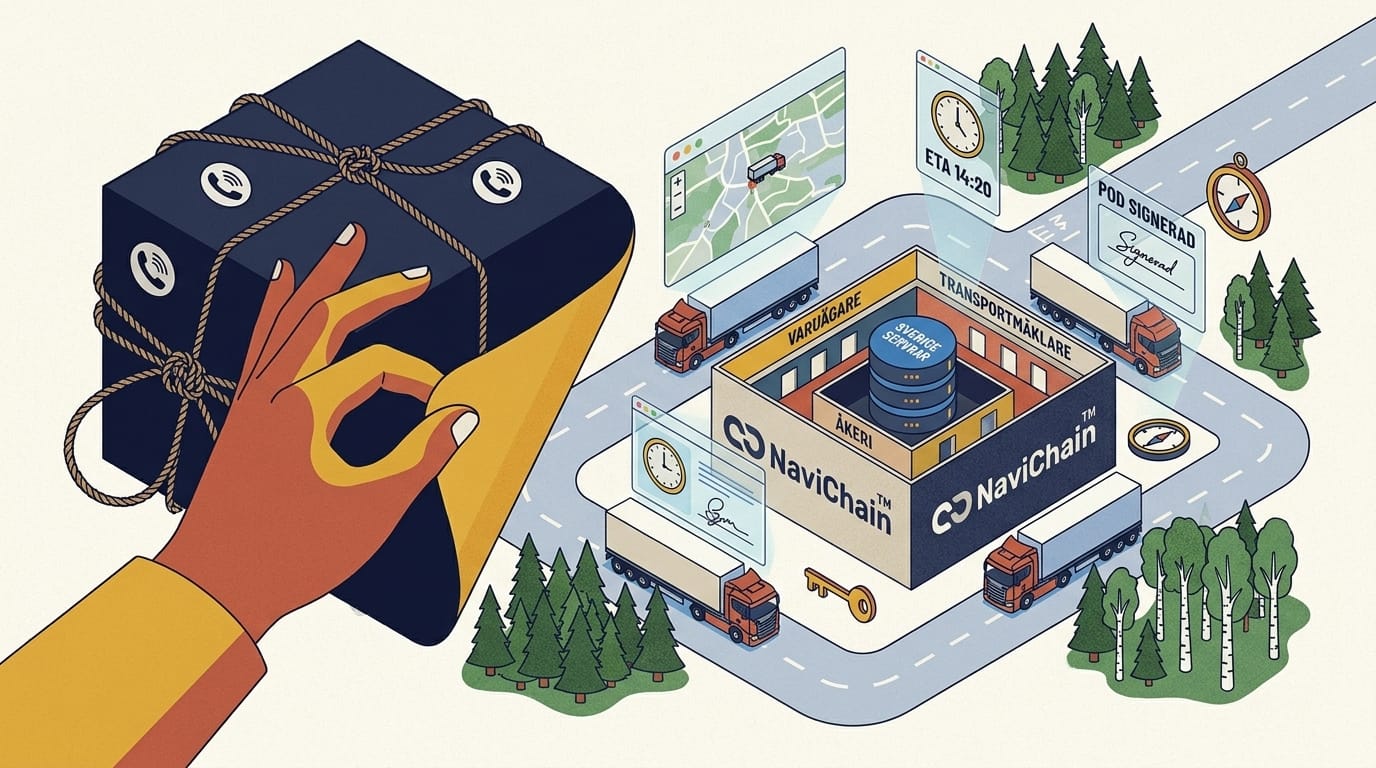
What makes Navichain's architecture unusual is that it is not built for a single actor. It is a multi-tenant system with separate, isolated data environments – which means that the haulage company, the merchandise owner, and possibly a 4PL coordinator can be in the same ecosystem, each with their own view, their own permissions, and their own data, but all looking at the same transport in real time.
For the haulage company, this means a complete TMS. For the merchandise owner, it means a customer portal with live tracking, digital delivery confirmation, and access to all documentation. For the 4PL actor, it means a control tower that can see, control, and report on an entire network of haulage companies – without having to integrate three separate systems or pay for an enterprise contract.
Customer portal – the merchandise owner's window Real-time
The merchandise owner logs into a branded customer portal and sees their transports live. GPS position, order status, ETA, and delivery confirmation with signature – without calling the haulage company. Everything available directly, around the clock, on computer and mobile.
Booking portal – the merchandise owner books directly Automatic
The merchandise owner can enter transports directly via their portal. Booking information flows automatically to the haulage company's TMS without a single phone call or email. AI assistance handles unstructured formats – the customer does not need to learn a new system.
Documentation & POD – always available Legally valid
Delivery receipt, e-CMR, signatures, and photos are available in the portal immediately after delivery. No binders, no scanning, no waiting. The merchandise owner can show their customer the delivery receipt within seconds of it happening.
Performance data & supplier evaluation AI analysis
Navichain continuously collects data on punctuality, delivery accuracy, and deviations per haulage company and per route. The merchandise owner gets a factual basis for evaluating their transport suppliers – not based on gut feeling, but on actual history.
Customer portal in practice – what the merchandise owner actually sees
Everything you see above is updated in real time, without you asking the haulage company for anything. Every status change is triggered by the driver's app – automatically, without manual reporting.
And for those who want to be more: the path to 4PL
There is a strategic shift in the freight industry that Navichain's blog describes accurately: haulage companies with thin margins see the 4PL model – to control and coordinate a network of carriers rather than just driving trucks – as the only way to sustainable profitability. The problem has always been that 4PL requires enterprise technology that costs enterprise money.
Navichain changes that calculation. The multi-tenant architecture means that a haulage company can handle jobs on behalf of their customers, give each customer their own isolated portal, coordinate subcontractors, and show a complete end-to-end supply chain – all within the same system, without having to buy an SAP contract.
You drive your own goods with your own vehicles
Navichain handles route planning, driver app, and e-CMR. Your customers see the deliveries in real time via the customer portal.
You drive on behalf of others – and want to be able to show it
Each client gets their own customer portal with their data isolated. You deliver transparency as a selling point – not just a service.
You orchestrate a network – and own the information flow
You coordinate several haulage companies, show your customer an overview of their entire supply chain, and build loyalty on data – not on price. It is a business model. Navichain is the infrastructure.
Data sovereignty is not a technical argument. It is a business argument.
A 4PL actor who handles their customers' supply chain data on a US-dominated cloud platform risks exposing their customers' most sensitive business information – routes, suppliers, pricing – to foreign jurisdiction via the US CLOUD Act. It is a trust issue that can cost an entire customer relationship.
Navichain runs on Swedish servers. All data stays in Sweden, under Swedish law and GDPR. For the 4PL actor who wants to build deep, long-term relationships with their customers, it is not a small technical reservation – it is a fundamental quality guarantee.
Why now? And why Navichain?
The systems that solve these problems have been around for a long time. SAP, Oracle Transportation Management, Blue Yonder – all can offer the type of insight and control described above. The price: hundreds of thousands of SEK in implementation, multi-year contracts, and an IT department to keep it running. It is not an alternative for a medium-sized construction company, a regionally active wholesaler, or a ten-truck haulage company with 4PL ambitions.
Navichain is the same functionality for 199 SEK per user per month. No implementation. No consulting fees. No binding period. And a free tier for up to two users and fifty bookings per month – enough to test the entire ecosystem for real, with real transports, before you decide.
Two ways to get started. Zero reasons to wait.
Navichain works just as well for the merchandise owner who wants insight, and for the haulage company that wants to offer that insight. Start for free today – no credit cards, no binding period.
If you order transports
- Create a free account on navichain.se
- Invite your haulage company as a supplier in the system
- See your transports in real time via the customer portal
- Retrieve delivery receipt and POD directly – without calling
If you drive or coordinate transports
- Create a free account on navichain.se
- Give your customers a branded portal with real-time insight
- Coordinate subcontractors in the same system
- Build the 4PL offering on a sovereign platform
Free up to 2 users · ~50 bookings/month · 199 SEK/user/month for full functionality · Customer portal included · Multi-tenant architecture · All data on Swedish servers · No binding period
The information exists. It's just not with you.
That is the core of the problem – and the core of Navichain's answer. The driver knows where the goods are. The haulage company knows when it was delivered. The recipient knows if everything was correct. But you, who paid for the transport and whose business depends on it going right, know nothing until someone tells you. Navichain closes that gap. Not with an expensive integration or a one-year implementation project. With an account, a customer portal, and ten minutes of your day.