Driver Assignment & Resource Planning: The Bridge Between HR and Operations
🇬🇧 Read this article in English
Navichain Driver Allocation: Where compliance meets execution.
Summary
In many logistics companies, there is a dangerous "air gap" between the HR department and the dispatch/transport management. HR maintains legality (driver's licenses, contracts, policy acknowledgments), while dispatch/transport management focuses solely on execution (getting the truck rolling). This lack of connection often leads to Compliance Drift: drivers operating vehicles without reading the latest safety message, or assignments clashing with mandatory rest periods.
Navichain closes this gap with its unified Driver Allocation Model. By treating "Driver Eligibility" as a hard constraint for operational planning, we create Digital Compliance Gates. The system literally prevents an assignment from starting if HR requirements—specifically Policy Acknowledgment and Driver's License Validity—are not green-lit in real-time.
The Gap: Why Spreadsheets Fail
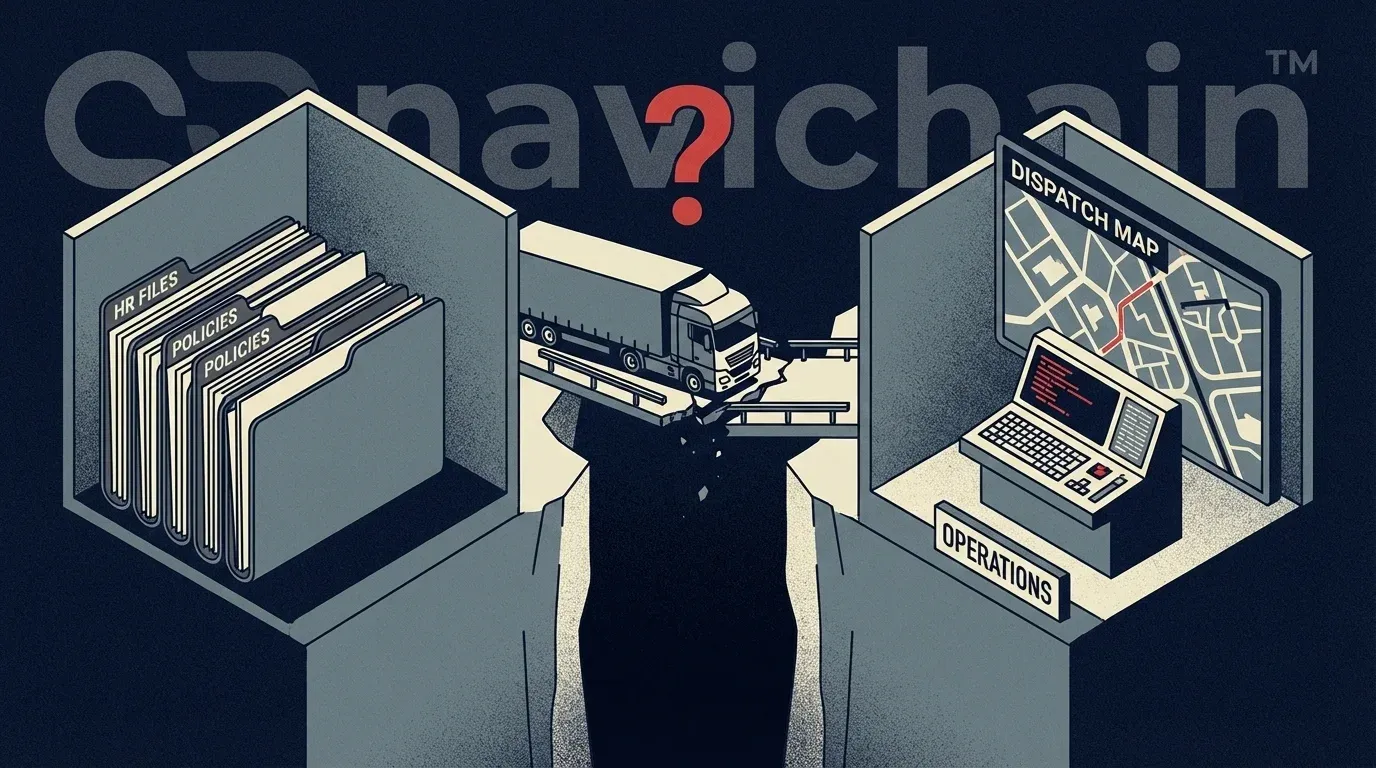
The traditional model: HR and Operations working in silos creates blind spots for compliance.
In a traditional setup, dispatchers assign "Driver Johan" to "Truck 42" based on availability. They assume Johan is approved. Meanwhile, HR sent out a critical "Winter Safety Policy Update" yesterday that Johan hasn't read.
If Johan happens to have an accident on an icy road, the company is not only liable for the crash but for Negligence. The prosecutor will ask: "Did you ensure the driver was aware of the new safety protocols?" Without a digital audit trail, the answer is "We hoped so."
The Solution: Allocations as "Digital Contracts"
Navichain redefines the concept of an "Allocation". It is not just a calendar entry; it is a Digital Contract between the Driver, the Vehicle, and the Company.
1. The Pre-Trip Compliance Gate
Before a driver can accept an assignment in the Navichain app, the system runs a Policy Check.
- Scenario: HR publishes a new document: Ref: docs/safety-guidelines-2026.
- Guard: When the dispatcher assigns a job to Driver A, the endpoint
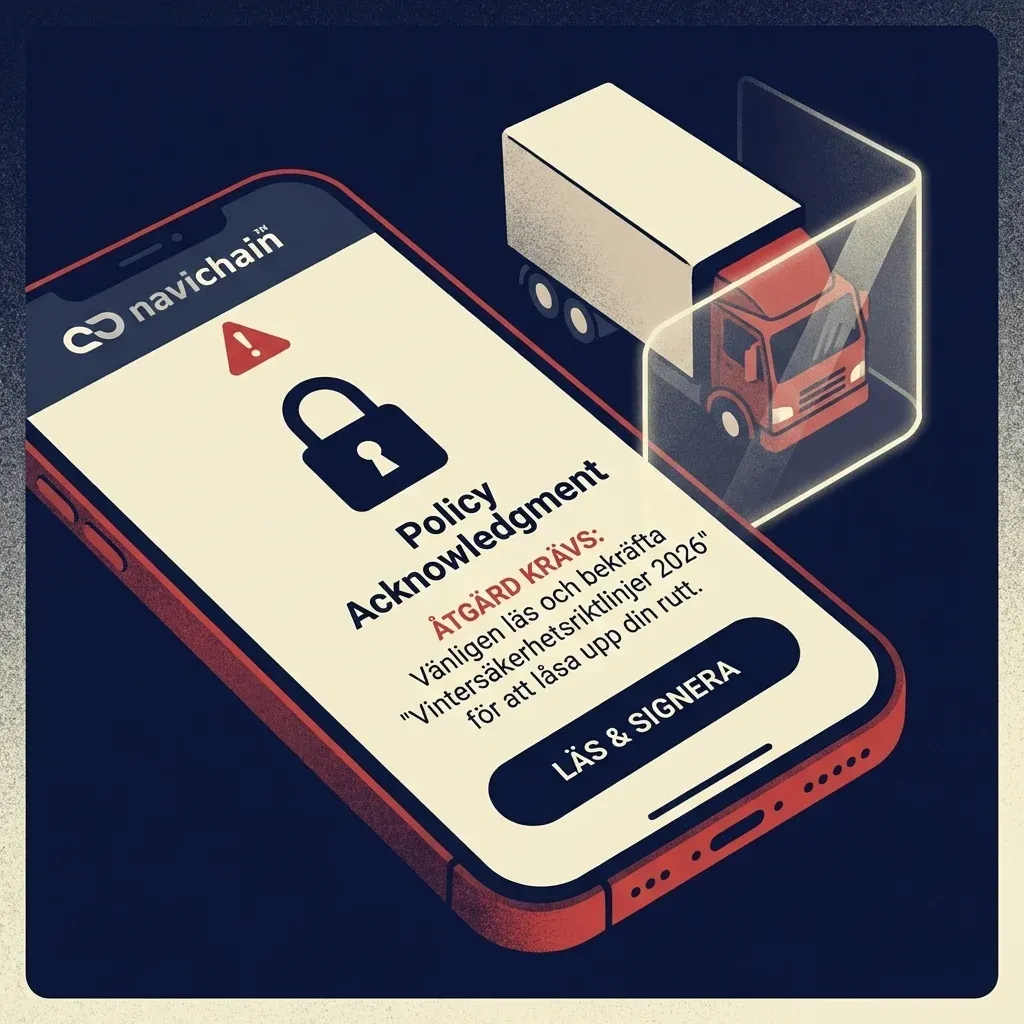
Allocations/{guid}checks the driver'sAcknowledgmentRecord. - Action: If the policy hasn't been signed, Locks the app from the assignment. The driver sees a prompt: "Action Required: Please read and acknowledge 'Winter Safety Guidelines 2026' to unlock your route."
This ensures 100% Policy Distribution. No driver can be "on the road" without being "on the same page" as HR.

Digital Compliance Gate: Safety first, operations second.
2. The Sovereign Audit Trail (RavenDB)
We harness the power of RavenDB to store immutable records of these interactions. We don't just store "Yes, he signed." We store High-Fidelity Context:
- Timestamp: Precise UTC time of the digital signature.
- Device Fingerprint: Proves which specific mobile device was used.
- Location: Where the driver was when they signed (e.g., "Depot's Break Room").
This creates a Sovereign Evidence Archive. In case of an audit or legal inquiry, you can produce a tamper-proof log showing exactly when compliance was achieved.
3. Real-Time vs. Planned (Feedback Loop)
Resource planning is often a guessing game. Dispatchers estimate "4 hours", but reality takes 6. Navichain bridges this by linking the Allocation Plan directly to the FMC650 Tacho Flow.
- Planned Start: 08:00 (Dispatcher's Wish).
- Actual Start: 08:14 (When the Tacho card was inserted).
- Deviation: +14 min.
This data is fed back to the Resource Planner, automatically updating future availability and allowing HR to monitor punctuality trends without manual time reports.

Reality Loop: Tacho data automatically updates resource availability.
Strategic Resource Planning
Beyond daily compliance, this model enables long-term planning. By having a unified view of Driver Certifications (ADR, Truck License, Eco-Driving), the system can proactively warn dispatchers:
- "Warning: Driver B’s ADR certification expires in 14 days. Do not assign hazardous goods assignments after Feb 20th."
This shifts the organization from Reactive Compliance (fixing expired licenses) to Proactive Resource Management.
Conclusion
Your drivers are your most valuable—and your most regulated—assets. Stop managing them with static spreadsheets.
Navichain's Driver Allocation & Resource Planning module builds a digital bridge between HR's requirements and Operations' reality. By enforcing compliance at the point of allocation, you reduce your liability, raise your safety standards, and let your dispatchers focus on efficiency, knowing that strict legality is built into the system.

Navichain: Connecting HR policy to the open road.
References
- European Commission (2025). Digitalization of Transport Compliance Documents.
- Navichain Developer Docs (2026). The Driver Allocation Schema & Policy Guard.
- ISO 39001. Road Traffic Safety (RTS) Management Systems.
- RavenDB (2025). Audit Logs and Immutability features.