Your office is leaking money. Every day. — Navichain
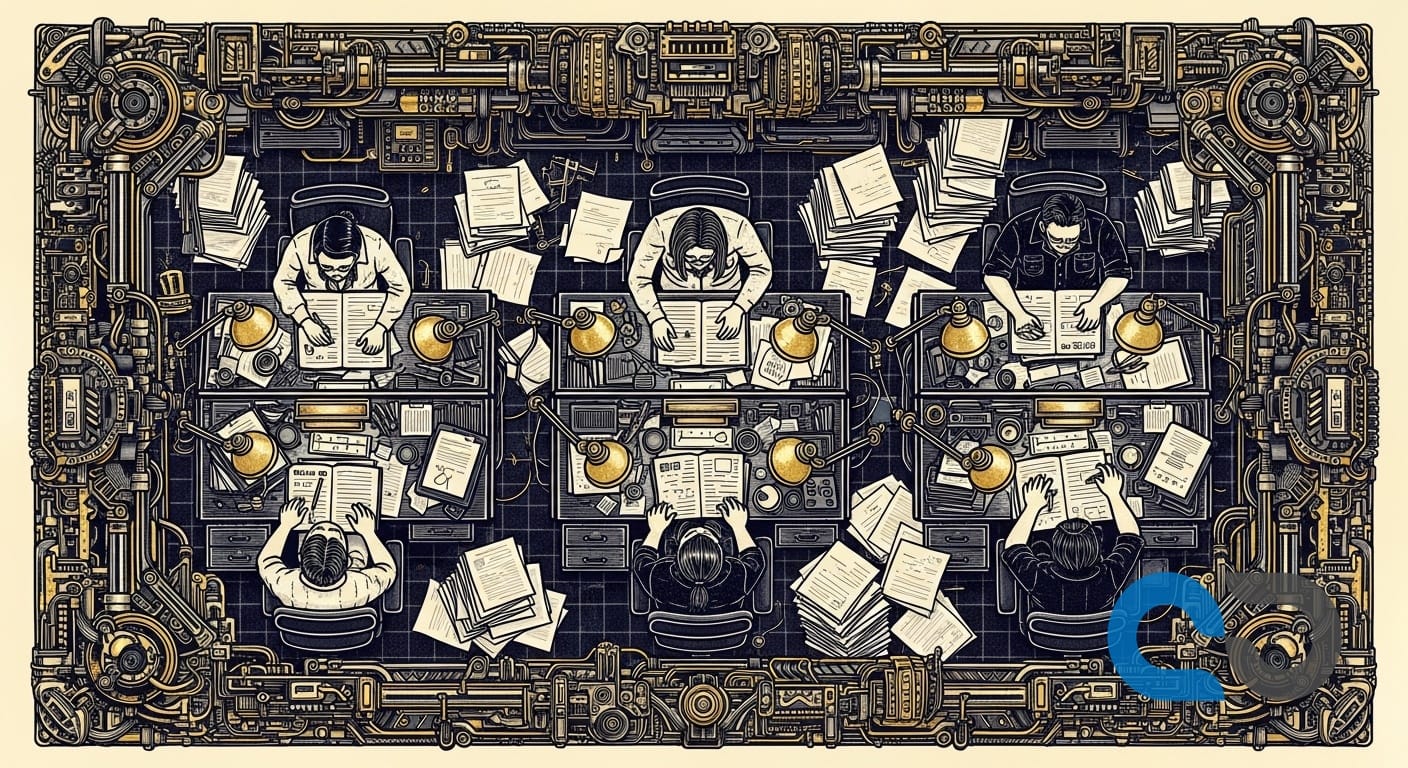
Your Office Is Leaking Money.
Every Day.
You have optimized routes, squeezed fuel, negotiated tires. But what does it actually cost you to transport a piece of paper from driver to invoice?
A transport takes four hours to complete. Seven days to invoice. If you can look at yourself in the mirror and feel fine about that – don’t read on. But if that number made something click in your gut, welcome. We’re going to talk about the waste no industry calculation accounts for.
In the logistics industry, people talk about Lean as if it were a manufacturing question: warehouses, trucks, routes. That’s wrong. Or rather – it’s half right. The real productivity gap for most Swedish small haulage companies isn’t on the road. It’s in the office.
In every email inbox that serves as an order book. In every Excel file that’s duplicated three times and still contains errors. In every invoice waiting for a driver to email back a scanned document with handwriting that’s illegible. It’s your office that’s bleeding, quietly and methodically, every workday.
The Japanese Called It Muda
Toyota had a word for it: muda. Waste. Anything that consumes resources without creating value for the customer. Toyota’s engineers identified seven types. In a modern haulage company in 2026, they’re reduced to five administrative sins – as recognizable as they are profitable to address.
5 Types of Administrative Waste
The costs that never show up on a logbookWaiting
Dispatch waiting for a driver to send a signed waybill via WhatsApp. Every hour spent waiting is an hour you can’t close the month.
Double Handling
Orders entered into one system, copied to another, and then manually written into the invoicing documentation. Three times – the same data. Three opportunities to make mistakes.
Motion
Digital motion: six open tabs, three programs, and a spreadsheet to complete a single booking. Every click outside your primary system is a process drop.
Defects
Incorrect invoices. Wrong reference numbers. Wrong customer. Every defect costs at least double: once to produce the error, once to correct it. And once in the form of delayed payment.
Overprocessing
Manual review of data that the system has already verified. Double-checking that’s already been double-checked. It’s not thoroughness – it’s a sign that you don’t trust your own flow.
What It Actually Costs
Let’s do a thought experiment. You have a haulage company with ten vehicles. The dispatch manager spends on average one hour per day on tasks that could be automated – double entry, status updates, invoice correction. That’s five hours per week. Twenty hours per month.
At a labor cost of 450 SEK per hour – including social fees – we’re talking about 9,000 SEK per month in pure administrative waste. That’s 108,000 SEK per year. Not in fuel. Not in tires. In keystrokes that shouldn’t need to be made.
"The most effective way to handle a piece of paper is to ensure it never needs to exist in the first place."
Lean principle, applied to transport 2026One-Piece Flow – A Principle That Changes Everything
In classic Lean, they talk about one-piece flow: the idea that each unit should move continuously through the process without stacking, waiting, or being handled again. Apply that to your order handling and the picture is clear.
An order should never be "parked". Never wait for the next person in the chain. Never be manually copied to a new system. The ideal administrative flow is a single, continuous conveyor belt – from the customer's booking to paid invoice – without a single human intermediate step that’s only there to move data from one box to another.
Customer Books
Via portal, email, or EDI import
AI Extracts
Data is automatically read without a keyboard
Driver Receives
Digital eCMR in the app – no paper
Invoice Sent
Automatically to Fortnox, Visma, or Wint
Note: no one in the office "handled" the order in that flow. It moved. That’s the difference between a haulage company and a Lean haulage company.
The Three Tools That Make the Difference
-
Standardized Work Procedures Chaos can’t be automated. Before you go live with any system, map out how orders are actually handled today – not how you think they’re handled. The difference is often revealing. Standardize the process. Then automate.
-
Visual Management with Real-Time Data You should never have to call a driver to find out where an order is. You should see it. A live dashboard with order status, logbooks, and deviations replaces ten emails and three phone calls per day.
-
Kaizen – The Monthly Improvement Question Ask your team once a month: "Which administrative moment annoys you the most?" Write down the answer. Eliminate it. That’s Kaizen in practice: not one big revolution, but a long series of small removals of friction.
The Frictionless Office Isn’t a Utopia
The words "paperless haulage company" have been around for decades. Most people mean that you stopped printing waybills. That’s not frictionless. That’s just paper-light.
Frictionless means that data flows without human intervention from customer order to bank receipt. It means that your dispatch manager spends their time planning and building customer relationships – not chasing signed documents and correcting misspelled reference numbers.
It means a TMS that isn’t one system among five, but the hub of an ecosystem. Where Fortnox knows what Navichain knows. Where the driver’s app is the same truth as the office’s dashboard. Where the AI has read the order before you even opened the email.
It’s not the future. It’s what Navichain haulage companies are running with now.
Stop leaking. Start flowing.
See how much your office
actually costs you
Start Navichain for free and run your first 50 bookings in a frictionless flow. No binding periods. No IT department. Just a haulage company that works.
Try Navichain for FreeFree tier: up to 2 users · ~50 bookings/month · Swedish servers