Your electric truck is losing money every day if the math doesn't add up
Future route optimization
Your electric truck loses money every day — unless the math is right
The electrification of heavy transport is not a question of technology. It's a question of the logistics brain behind it. Without the right system, every kilowatt-hour becomes a debt you don't see.
Imagine that you have invested three million Swedish kronor in a heavy electric truck. The driver is in the cab. The order is placed. It's six in the morning. And then — an orange warning light. The battery isn't enough. The task must be redistributed, the customer notified, the margin eaten up. Not due to mechanical failures. Not due to bad drivers. But due to the absence of a single system that calculated correctly.
This is not a hypothetical scenario. It's the reality for hundreds of Swedish haulage companies that in 2025–2026 roll out electric vehicles without modernizing the logistics that should handle them. A diesel truck is fault-tolerant — you refuel when it runs out. An electric truck is not fault-tolerant. It requires planning with a precision that human spreadsheets can never deliver.
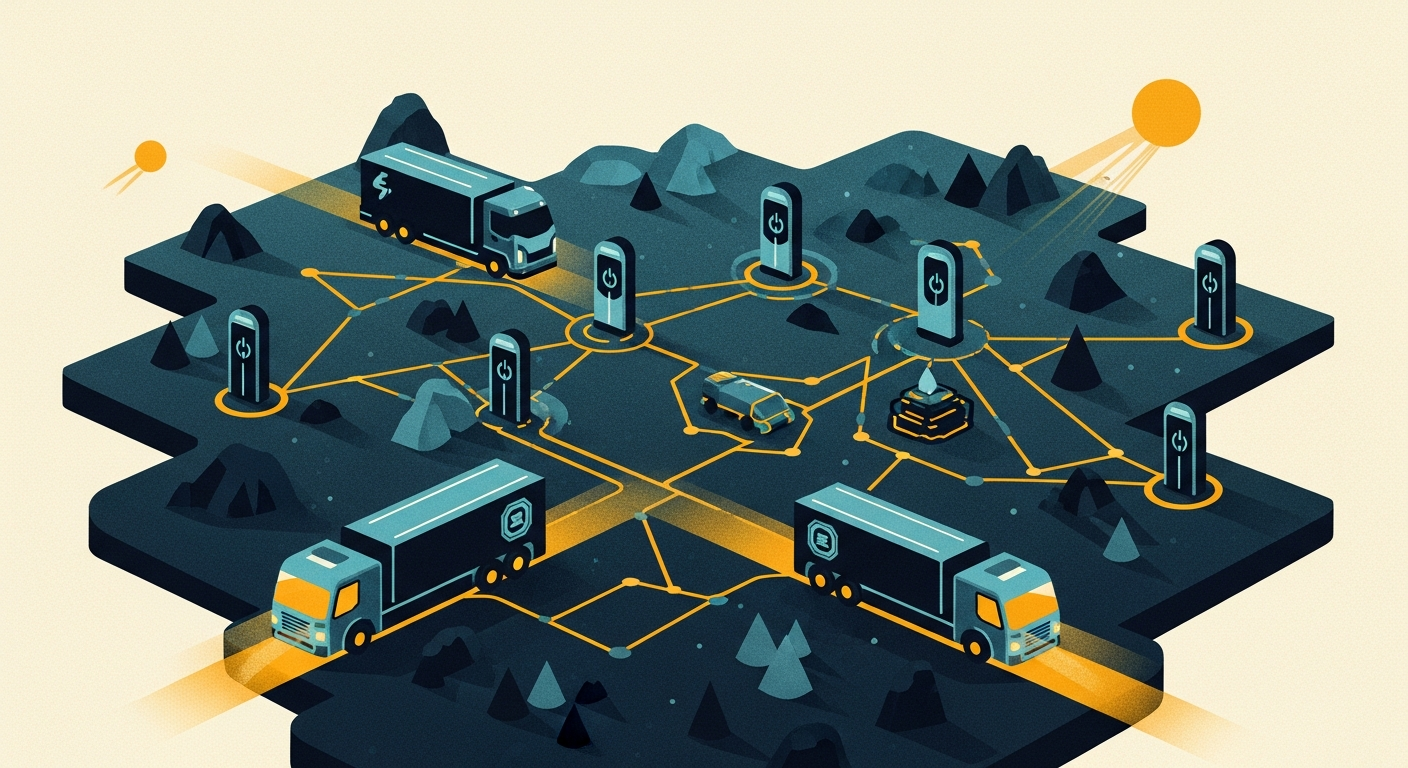
The new route puzzle: A diesel truck can be refueled almost anywhere in a few minutes. For a heavy electric truck, reality is different. Intelligent route planning must integrate charging breaks, battery status, and dynamic infrastructure — without compromising a single delivery promise.
The profitability of electrification does not depend on battery sizes or charging speeds. It depends on how quickly and accurately your system can answer a simple question: Can this truck handle this job — and what does it cost otherwise?
Three variables that change everything
Route planning for electric vehicles is not route planning with an extra step. It's a fundamentally different calculation, with three moving parts that must be handled simultaneously:
A steep hill drains the battery differently than flat ground — and a full load makes it worse. A charger that is "available" on the map can be occupied, broken down, or take 80 minutes longer than planned. And the driver's rights and rest times are not negotiable with the customer. All three variables must coexist in every route decision, in real-time, all day long.
Charging a truck should never be an interruption in logistics. It should be a scheduled, optimized part of the flow — as natural as a delivery point.
Why separate systems always fail
Many haulage companies try to solve the complexity of electric vehicles with a patchwork of tools: a TMS for orders and route planning, an app for battery status, a spreadsheet for charging schedules, and another system for driver administration. It looks like a system. It is not a system.
Without vs. with Navichain
Without integrated TMS
- Dispatcher calls the driver to check battery status
- New order does not match SoC — misses range
- Charging break collides with driving license rules
- Customer receives late delivery without warning
- Battery is charged to 100% unnecessarily — battery life decreases
With Navichain
- SoC displayed live in dispatch
- New order immediately calculates range margin
- Charging break synchronized with driver's mandatory break
- ETA updated automatically and customer notified
- AI controls charging for optimal battery health
Navichain is designed from the ground up as an integrated platform — not a collection of modules that communicate with each other via email. This means that the battery's State of Charge is a live data point in the same system that handles your orders, your drivers, and your customers. No manual sync. No information delay. No person in the middle trying to keep the picture together.
Four rules for profitable electric logistics
-
1
Charge during unloading
Install destination chargers at fixed customer hubs. The truck delivers and refuels at the same time — without a single extra stop in the schedule.
-
2
Avoid depot charging during daytime
Driving back to base just to charge is a productivity hole. Plan routes along the public green corridors — the system finds them for you.
-
3
Optimize the charging curve, not the charge level
Charging from 10% to 80% twice is often faster and cheaper than charging to 100% once. The charging curve flattens out — and the cost per kWh increases.
-
4
Protect battery health with AI
Every time you fast-charge unnecessarily, it costs battery life. Navichain lets AI control charging strategies so that your investment lasts longer — and depreciates more slowly.
It's not about range. It's about trust.
Range anxiety for electric trucks is real. But it's not cured with a larger battery — it's cured with a better system. When your dispatcher knows exactly where each truck is, how much energy it has left, what the next order requires, and where the next charging opportunity is — the anxiety disappears. What remains is a quiet, extremely cost-effective production unit that delivers on time, every day.
The profitable haulage company in 2026 is not the one with the most expensive trucks. It's the one with the smartest system behind them.
Navichain — Dispatch for the modern fleetNavichain is already in operation with haulage companies ranging from single vehicles to complex multi-carrier operations with hundreds of trucks. The platform is cloud-based, operated on Swedish servers outside the reach of the US CLOUD Act, and integrates with Fortnox, Visma, Wint, and Hogia — without forcing you to change the systems you already trust.
You start for free. You pay 199 SEK per user per month when you grow. And if you want to put Teltonika hardware in the fleet and run vehicle tracking, e-CMR, and digital driver logbooks as a combined investment — the HaaS model is available at 199 SEK per vehicle per month.
Try Navichain for free
Your first electric truck deserves a system that can handle it
Start with a free demo and see how Navichain calculates correctly — for your fleet, your routes, and your customers. No binding periods. No implementation consultant. Just a system that works from day one.
Read more on Navichain
- Visual route planning with drag-and-drop: Plan with your eyes
- Navichain ERP: Power without enterprise budget – The transformer of business support
- Digital Transformation: How to succeed with the digital transition in the transport industry
- Integrate Navichain with Fortnox & Visma