Your data is leaking money
Your data is leaking money – NavichainNavichain · Integrations · Theme Week
Your data is entered three times.
You pay for it every day.
The same order. Three systems. None of them talk to each other. It's not an IT problem – it's a business model working against you that requires a digital transformation.
6 minutes reading · Part 1 of 5
Every time one of your employees opens a spreadsheet to copy numbers from one system to another, your company bleeds. Not dramatically. Not visibly. But constantly – and with compound interest.
It starts with an order from the customer. It is entered into the booking system. Then into route planning. Then into the accounting system. Along the way, a comma is misplaced, a date changes order, an address is shortened. You notice it three weeks later when the invoice is disputed.
There is a term for this: decoupling. And it is the most expensive state a modern haulage company can be in.
◆
What does a spreadsheet really cost?
Don't ask what the program costs – it's free. Ask instead what the work costs, and how it affects your total price. A dispatch manager who spends 90 minutes a day manually synchronizing data contributes 7.5 hours of administrative work per week. Multiply by your hourly labor cost. Multiply by the number of years you have operated in this way.
4.1 h Manual data sync per day in a medium-sized haulage company23 % Of invoices with errors are due to double data entry11 days Average additional delay in final payment with manual process
The figures above are not worst case. They are industry average. And they don't even account for the silent cost: decision-making based on old data. When your dispatch manager plans tomorrow's routes based on yesterday's figures, she makes the right decisions – for a situation that no longer exists. Effective resource management requires current data.
Integrations are not an IT project. They are a decision about how quickly the truth should move through your organization.
The API – the digital interpreter you didn't know you needed
API is an abbreviation for Application Programming Interface. But the only thing you really need to understand is what it does: it allows two systems to talk to each other in real-time, without a human having to stand in the middle and translate.
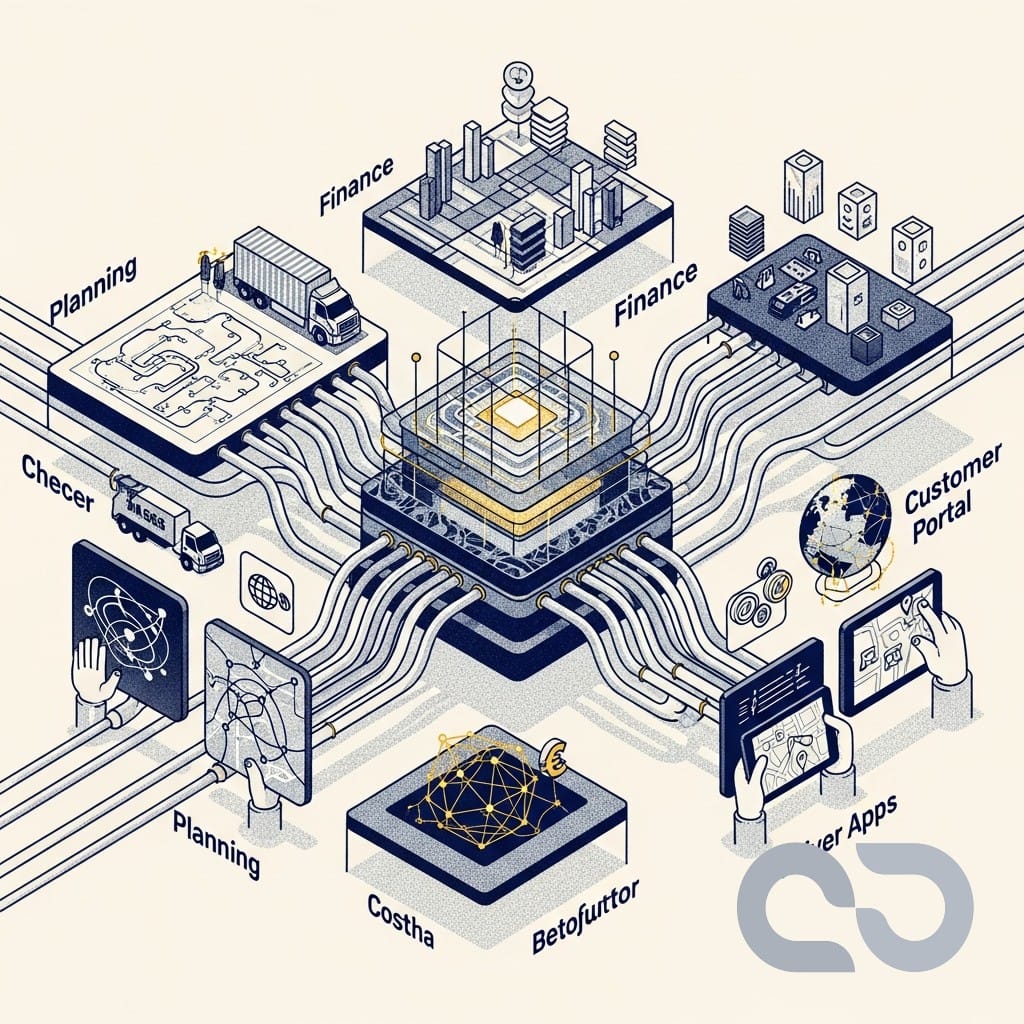
When you work with an open platform like Navichain, every integration is a direct channel between your operational reality and the systems surrounding you. The customer's order in SAP appears automatically, and with a connection to WMS warehouse the flow is handled seamlessly. The vehicle's position syncs without the driver lifting the phone. The invoice is generated in Fortnox without anyone manually opening the accounting system.
Navichain's integration ecosystemnavichain · TMS
Economy
Fortnox, Visma, Wint – invoicing and accounting sync automatically
Telematics
Teltonika FMC650 – position, temperature, and fuel in real-time, connected to your vehicle hardware
ERP & Customer
SAP, Dynamics – the customer's order lands directly in planning
Payment
Stripe – automated invoicing without manual handling
Freight forwarder & 4PL
Share capacity and load with trusted partners in the network
eCMR & Authority
Digital consignment note and automatic environmental reporting
The important thing to understand: Navichain does not force you to replace anything you are satisfied with, which gives you independence in your system choice. Do you want to keep Visma? Keep it. Do you want to continue with your existing telematics hardware? Continue. An integration means that you add a nervous system – not that you amputate what you have built up.
Navichain can fully replace your existing systems – but doesn't have to. The platform is built to integrate side by side with the tools you already trust. You choose the depth of the change.
◆
Three scenarios you recognize
- 01The customer wants real-time status on their deliveryToday they call you. You call the driver. The driver guesses. With Why Navichain, the customer has direct access to live position via the portal integrated with your TMS – you never pick up the phone.
- 02An order changes at 16:43Without integration: you call the route planner, who manually changes, who forgets to update the invoice. With Navichain: the change is made once in the source system and cascades automatically through planning, eCMR, and invoice.
- 03Month-end reconciliation takes three daysThe CFO exports from TMS, imports to accounting, compares with driver logs. Errors are found, corrected, exported again. With a Fortnox integration, the invoicing basis is ready when the last trip is done.
A single source of truth
The concept that changes the perspective on integrations is single source of truth – one place where all information is correct and up-to-date, and from there flows out to all systems that need it.
In practice, this means that your dispatch manager sees exactly the same picture as your CFO, your customer, and your driver. Not three versions of the truth with a 47-minute delay between them. But one single, living, synchronized picture of your business.
It's not a technical ambition. It's the difference between leading a haulage company and reacting to it.
◆
Tomorrow in the series
We continue with "The Integrated Customer" – how you, with the right API connections, stop being a supplier and start becoming part of the customer's internal processes. A position that is almost impossible to get rid of.
Ready to stop bleeding data?
See how a connected haulage company actually looks
Book a 20-minute walkthrough with one of our transport specialists. No sales pitch. Just your business – and what an integration would concretely change.
Book a walkthrough → Explore the platformNext part The Integrated Customer – how you become part of their internal processes
Read more on Navichain
- Why Navichain: A Complete Overview
- Digital Transformation in the Logistics Industry
- Sunday evening with receipts is over: Integration with Fortnox & Visma
- Navichain ERP: Powerful Support Without Enterprise Budget