The missing link: Why legacy ERP systems fail your vehicle fleet
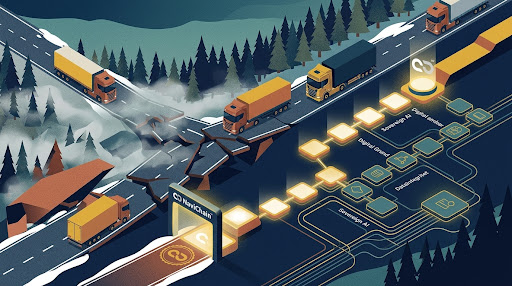
The missing sequence - patching up a fragmented road is not enough.
The missing sequence: Why old ERP systems fail your vehicle fleet (and how to fix it)
Many logistics companies make a critical mistake when implementing AI: they build advanced models on top of fragmented, paper-based, and isolated processes, which ultimately only accelerates the underlying chaos instead of solving it. By first establishing a modern digital foundation – with e-CMR, unified vehicle telematics, and a seamless platform from terminal to last mile – the data integrity required is created. Only then can powerful solutions like Sovereign AI function as a secure, automated engine, ensuring both operational efficiency and data sovereignty for future supply chains.
Key Insights (BLUF)
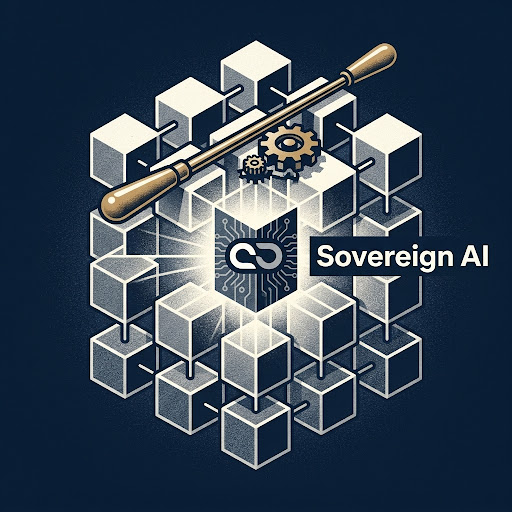
Data integrity is the key to a functioning, automated Sovereign AI engine.
- The sequence is everything: Applying AI to bad data and manual processes leads to failures. The right structure must come before scaling.
- Digitalize the entire foundation: Paper documents must be replaced with integrated solutions like e-CMR and Sign-on-glass directly in the driver's app.
- Secure a single source of truth: Telematics (e.g., FMC650) and live data from tachographs must be visualized in the same interface as your freight management.
- True AI requires control: For AI to generate real ROI in logistics, Sovereign AI built on entirely proprietary infrastructure is required.
Why does AI fail without a digital foundation?

Efficiency illusion: Relying on isolated, outdated systems leads to data loss.
Much is said about the revolution that artificial intelligence is supposed to bring to supply chains. But the problem that many transport companies and logistics managers face is that their "Master Data" is scattered. When drivers still handle paper waybills and dispatch managers have to switch between three different screens to see where the truck is, it doesn't matter how smart your AI is. The model simply has no clean data to analyze.
What is e-CMR? An electronic consignment note that digitalizes the entire chain of evidence for national and international road transport, eliminating paper handling and ensuring real-time traceability.
When the data fails, the systems draw the wrong conclusions. This is where "The missing sequence" comes into play: You cannot automate a process that you have not first structured and standardized.
How do real-world deviations affect your efficiency?
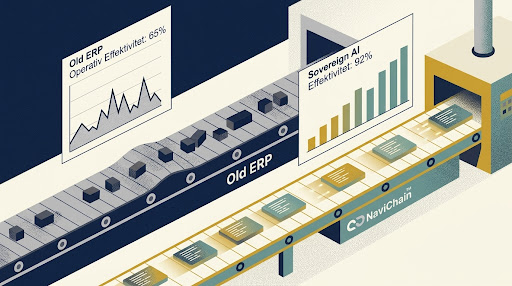
The smooth integration chain always wins over fragmented, slow data silos.
True efficiency is built on a deeper, almost philosophical insight: you must have an in-depth understanding of what each process is actually intended to achieve, and above all – how the result is affected when reality inevitably deviates from what was once planned.
It requires long experience and a genuine understanding of what can happen during the delivery, and how a single disruption propagates through the system's other parts. To counter this, you must capture all relevant data from the process and carefully package it in a way that enables continuous, data-driven decisions for optimal fulfillment.
This is where the magical possibilities arise. When all relevant information – from deep history to lightning-fast real-time data – is clean enough to be processed by an AI, entirely new dimensions of control are created. You gain access to extremely accurate forecasts, proactive planning, and outstanding quality of your final delivery.
How do you turn chaos into control with the right system?
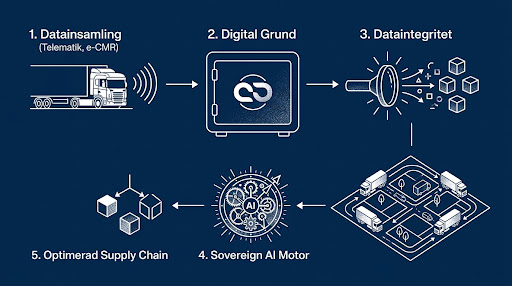
The "digital foundation" is built on a seamless flow of information.
To systematically eliminate chaos, old logistics silos must be broken down. Instead of patching and repairing heavy, difficult-to-integrate ERP systems (Enterprise Resource Planning), today's haulage companies need a flexible, cloud-based Software-as-a-Service (SaaS) ecosystem.
When you implement a platform like Navichain SaaS, the complete ecosystem is delivered first and foremost. This means that you immediately get 100 percent process discipline: from cross-docking at the terminal to traceability with last-mile subcontractors, and most importantly, integrated vehicle telematics.
Navichain's recipe: From inbox to automatic invoicing
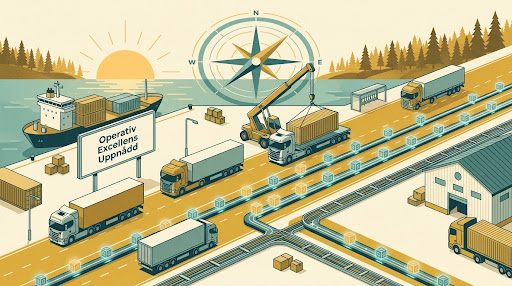
An optimized flow where order and tidiness have replaced manual paperwork.
To truly turn chaos into control, structure is required in every single link of your logistics. This is where Navichain has the right "recipe" for handling business-critical information. It's about capturing data and events in a consistent manner:
- Order management and validation: Structured and efficient interpretation of incoming order data with automated validation of, among other things, address information and references.
- Consistent pricing: Secure and consistent price and tariff handling regardless of how complex your customer agreement looks.
- Deep vehicle telematics: Live telematics (e.g., via FMC650) that captures all essential events, positions, and movement data from the vehicles.
- Drivers' best friend: A user-friendly mobile app designed to flawlessly handle the capture of pickups, deliveries, Proof-of-Delivery (POD), Sign-on-Glass, and photographs of goods. The system then automatically links these events exactly right in the respective fulfillment process.
- Seamless invoicing: Automatic invoicing entirely according to your desired rules – with advanced event triggers, co-invoicing, and much more.
When all these gears work together, you achieve Operational Excellence. The bottlenecks of the fragmented ERP system disappear, and your supply chain becomes as streamlined as a well-oiled machine.
What does Sovereign AI really mean for logistics?
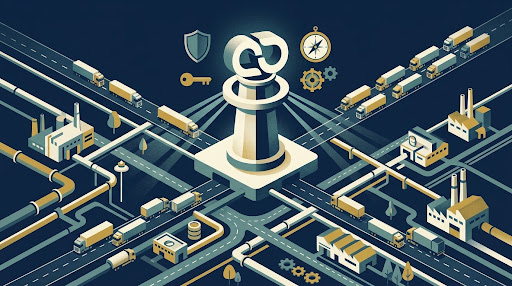
The Navichain philosophy is based on absolute Data Sovereignty and AI that frees up capacity.
When the foundation is laid and the data flows in clean and structured, it's time for the system to work for you. But in an industry where customer data, routes, and business-critical information are valuable, you cannot rely on black boxes or external public clouds.
What is Sovereign AI? An AI solution that strictly uses Open Source LLMs (large language models) operated on entirely proprietary infrastructure in combination with a proprietary RAG architecture (Retrieval-Augmented Generation), guaranteeing 100% data and operational sovereignty.
By using Sovereign AI, Navichain ensures that no part of your business information leaves the ecosystem. Instead, the clean data is used to securely automate heavy administration, optimize routes live, and guarantee that the investment quickly generates Return on Investment (ROI).
About the author
Håkan Lundmark, Founder of Navichain Håkan Lundmark is the founder of Navichain and is passionate about technological integration and data flow automation in the logistics sector. With deep expertise in system architecture, he ensures that transport companies can bridge the gap between older ERP systems and modern industry-specific SaaS platforms. Visit navichain.se to learn more about how we build the supply chains of the future.