Controlled editing ahead of data entry: The conversational AI tariff builder

🇬🇧 Read this article in English
Summary
A transport booking without a price is essentially just an unbilled cost. Yet, older transport management systems (TMS) force users to build complex pricing tariffs from scratch in empty, overwhelming spreadsheets. This inefficiency delays onboarding processes, frustrates dispatchers, and slows down cash flow. Navichain's conversational AI tariff builder eliminates this bottleneck. By replacing manual data entry with an intuitive, guided question-and-answer dialogue, European logistics companies can immediately generate accurate pricing matrices. The tool transforms days of system configuration into minutes of strategic fine-tuning, ensuring your business is ready to offer prices from day one – all with your business logic securely and self-hosted.
1. The Operational Challenge: Paralysis of Blank Spreadsheets
In the logistics industry, operational execution means nothing without commercial capture. A perfectly planned run, delivered on time by a highly skilled driver, is ultimately a burden on the business if the booking is not correctly priced. Revenue capture is the heartbeat of all transport companies.
Yet, dispatchers universally face the same archaic hurdle, the blank pricing matrix, when transitioning to new software or attempting to update annual customer contracts. Traditional software forces users to manually map complex variables, cross dozens of geographical zones with complicated weight classes and pallet spaces.

This manual data entry is an active operational bottleneck. Staring at a grid of 500 empty cells causes administrative paralysis, leading to massive drop-offs during software evaluations and significantly delaying companies' ability to realize value (time-to-value). In an era defined by severe labor shortages in the European supply chain, your dispatchers don't have time to function as human calculators. Every hour spent keying in base data is an hour lost for route optimization and strategic growth.
2. The Conceptual Shift: From Data Entry to Guided Editing
To solve this inefficiency, we must fundamentally change how people interact with system configuration. The traditional software method assumes the user must build the entire house from the ground up, providing only the raw bricks.
At Navichain, our Scandinavian design philosophy dictates that the software should work for the user. We needed a conceptual shift: we move from 'Data Entry' to 'Guided Editing'.
Psychological studies around user experience (UX) consistently show that people suffer from 'paralysis by blank canvas'. But if provided with a draft that is 90% correct, human operators are exceptionally quick to correct and refine it. Instead of asking you to build the foundation from zero, the system should erect the structure and merely ask you how you want to furnish it. You no longer input data; you simply refine the logic.
3. Introducing the Conversational AI Tariff Builder
The friction remover is here. Navichain is proud to introduce the Conversational AI Tariff Builder – an intelligent, chat-assisted guide designed to completely eliminate the manual setup of price lists and matrices.
By leveraging natural language processing (NLP) tailored for asset-heavy transport operations, the Tariff Builder acts as a dedicated pricing analyst. It interviews you about your basic business parameters, constructs an immediate complex, multi-dimensional pricing matrix (Zones vs. Goods Size), and then allows you to shape that matrix via simple, conversational commands. It's pricing at the speed of thought.
4. Technical Walkthrough: The Architecture Behind Guided Pricing
How does this conceptual shift translate into technical reality? We have abstracted the enormous mathematical complexity of logistics pricing into a clean, conversational interface requiring zero technical expertise.

Step 1: The Initial Interview When you open the Tariff Builder, you are greeted by an intuitive conversational interface. The AI asks 3 to 4 basic questions to understand the economic foundation of your business. For example: * "What is your absolute minimum cost per hour to operate a vehicle?" * "Where is your primary home base or depot?" * "What is your standard price for a single pallet for local delivery?"
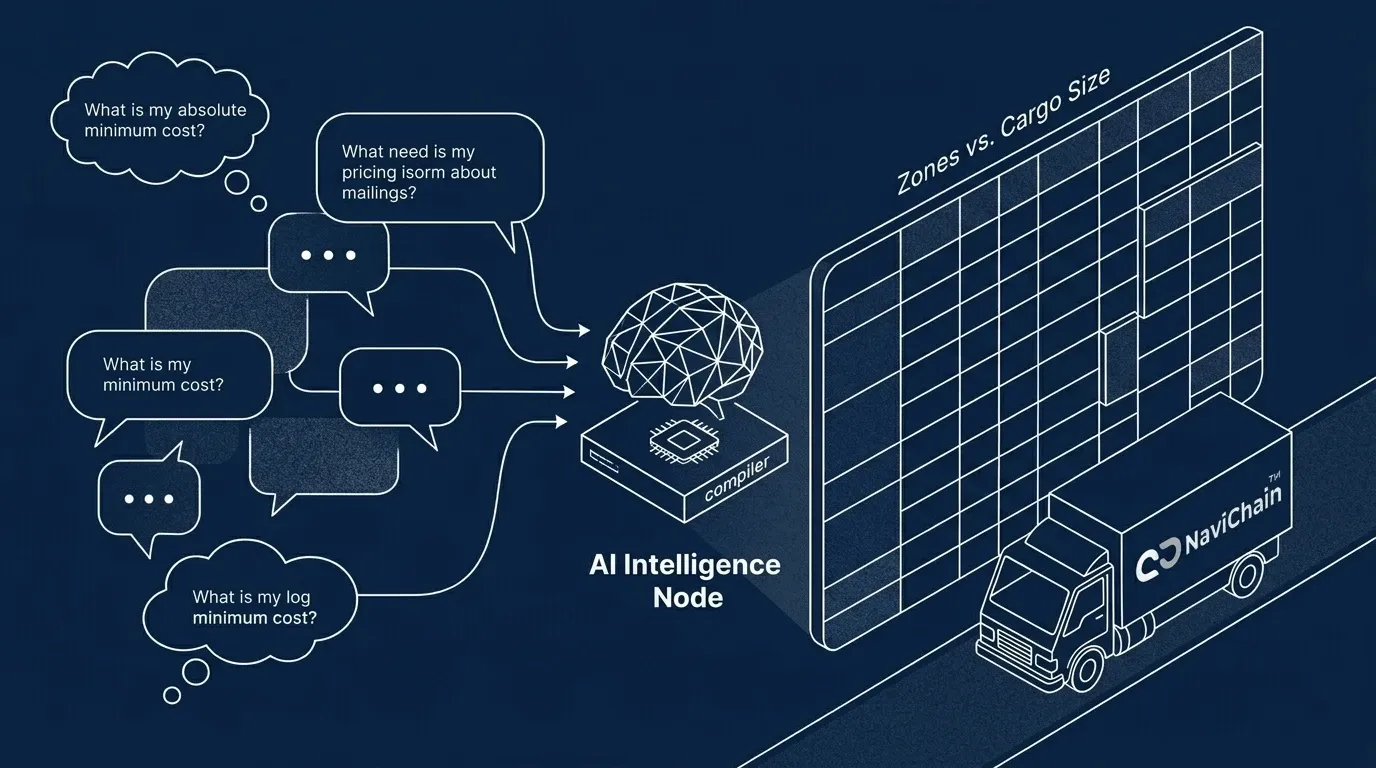
Step 2: Creating the Baseline Using proprietary algorithms, the AI processes these basic answers and immediately projects a fully populated price list on your screen. It automatically calculates the geographical zones radiating from your home base, extrudes standardized weight classes, and fills in the grid with logically scaled prices.
Step 3: Guided Refinement in Real-Time The true power of 'Guided Editing' emerges in the refinement phase. Instead of clicking individual cells to make blind changes, the UI prompts you to answer simple, strategic questions to fine-tune the matrix: * "I notice your short-distance prices are tight. Do you want to increase the minimum charge for inner-city zones?" * "Should we differentiate the top weight classes in single pallets, or group them by half loads?"
As you answer "Yes" or "No", or contribute alternative parameters, the pricing matrix updates visually in real-time. You see the numbers move and adjust immediately, ensuring your commercial strategy is perfectly represented without you ever touching a spreadsheet cell.
5. The Data Argument: Faster Time-to-Value
Operational excellence is measured in saved time and prevented errors. The commercial impact of this feature is immediate and highly measurable.
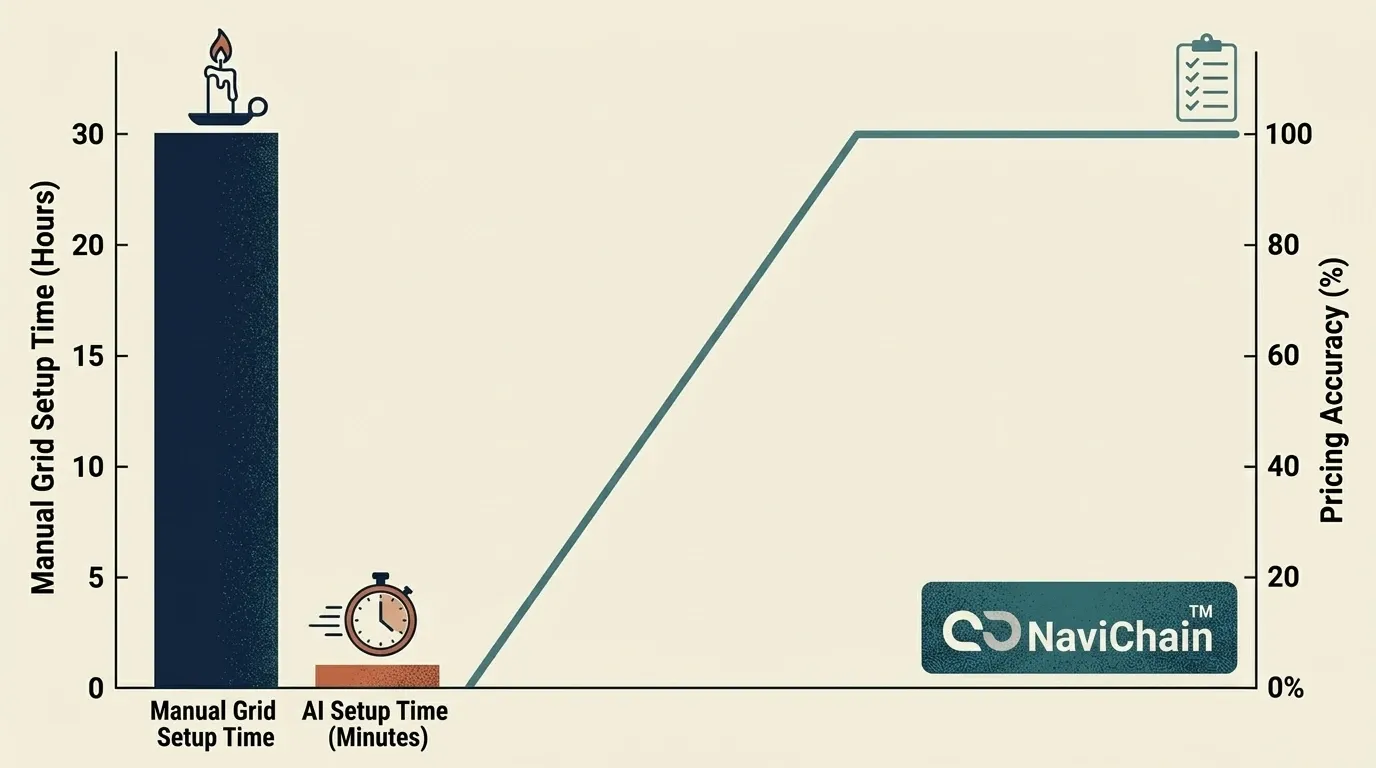
Building a comprehensive pricing matrix with 10 zones and 10 weight classes manually requires calculating and entering 100 individual data points. Historically, this takes an average of 4.5 hours per large customer tariff for a dispatcher to assess these points and correct inevitable typos.
With Navichain's conversational AI tariff builder, the same outcome is achieved in an average of 4 minutes.
This represents a transformative efficiency gain that significantly accelerates cash flow velocity. As the system is configured immediately, new bookings can be priced, executed, and invoiced the same day a new customer is won, eliminating the backlog of unbilled jobs. Additionally, automatic generation eliminates the "fat-finger" errors inherent in manual data registration, preventing catastrophic margin loss across hundreds of automated shipments.
6. The Difference with Navichain: Sovereign AI and Strategic Trust
Artificial intelligence is a powerful tool, but within the European corporate sector, it is of immense importance how this AI is used. Your pricing matrix is not just data; it constitutes your central commercial strategy and your ultimate competitive advantage.
European transport companies are rightly cautious about transferring their proprietary pricing logic into public AI models, which are often subject to US CLOUD Act and opaque data collection regulations.
Here, Navichain's commitment to Strategic Trust is crucial. Our conversational AI is entirely self-hosted within our secure, European infrastructure. When you input your minimum margins or base prices, this data never leaves the Navichain ecosystem. It is never used to train third-party models. You get the AI's groundbreaking operational excellence, fully protected by uncompromising GDPR compliance and European data security.
7. Strengthen the SME Ecosystem: Confident Execution
Small and medium-sized haulage companies do not have the luxury of dedicated IT implementation teams or weeks to waste on software onboarding. The software must work immediately, and it must adapt to the business's commercial reality.
The conversational AI tariff builder is far more than an installation guide; it is a manifesto. We have pledged to remove the administrative hurdles holding back European logistics companies. By transforming complex pricing into a quick, guided, and highly secure conversation, Navichain ensures your team can focus on what truly matters: moving goods efficiently, satisfying customers, and aggressively improving your margins.
Stop chasing empty cells. Let AI build the foundation, so you can build the business.
8. References
- Navichain Internal Telemetry: User metrics for onboarding with manual grid building vs. AI-assisted configuration (Q1 2026).
- European Logistics Association (ELA): Reports on administrative bottlenecks, labor shortages, and their impact on SME carriers' profitability.