Precision Planning: ROI for Context-Aware Smart Routing

🇬🇧 Read this article in English
Eliminate route errors, risks of non-compliance with ADR regulations, and wasted fuel. Discover how Navichain's Smart Routing automatically matches vehicle requirements with booking restrictions.
Summary
European transport SMEs face unparalleled margin pressure from volatile fuel prices, strict compliance requirements, and a chronic shortage of experienced dispatchers. Manual route planning with consumer maps is no longer commercially sustainable, exposing haulage companies to unnecessary risks such as catastrophic fines for non-compliance with ADR regulations or physical damage from environmental zones and bridge restrictions. Navichain's context-aware Smart Routing, powered by the industry-leading HERE API, addresses this vulnerability by allowing dispatchers to tag both vehicles and bookings with specific physical and legal parameters. This contextual intelligence automatically calculates the most profitable and compliant route, ensuring that every shipment is executed with flawless precision and maximum operational efficiency.
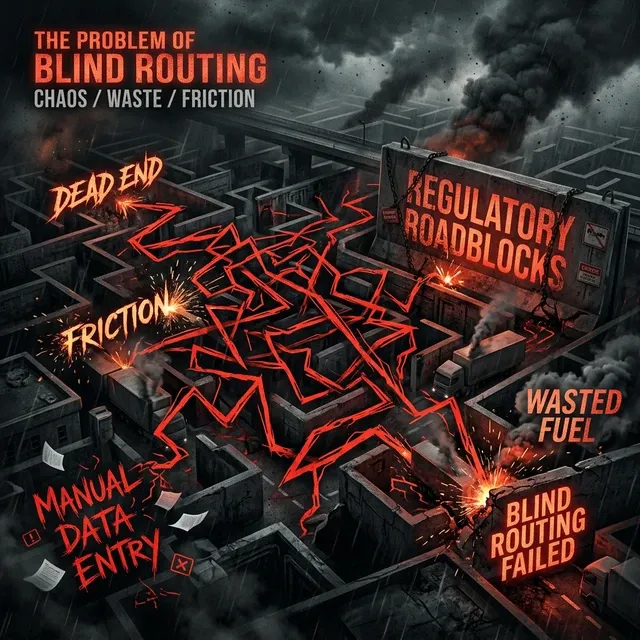
1. The Operational Challenge: The Hidden Costs of Blind Route Planning
For the modern European dispatcher, the map is no longer just a representation of distance; it is a minefield of variables. Environmental zones in major cities, strict weight limits on rural bridges, narrow delivery time windows, and strictly regulated ADR transport routes (hazardous goods) have made manual route planning a massive operational risk.
The traditional approach relies heavily on intuition and tacit knowledge – instinctively knowing that 'Truck A cannot take the southern tunnel because it carries Class 3 flammable goods' or that 'Trailer B is too high for the historic city center'. But with chronic labor shortages across Europe and high turnover in dispatcher roles, this institutional memory is increasingly fragile. When a new customer order comes in late and a dispatcher quickly adds it to an existing run, it is easy to overlook critical restrictions.
A truck sent on a route it cannot navigate either legally or physically results in immediate friction. This leads to wasted fuel as drivers are forced to take detours, delayed deliveries that negatively impact customer satisfaction, frustrated drivers who have to handle dangerous situations, and devastating fines for non-compliance from regulatory authorities. This is the hidden cost of 'blind route planning' – a systemic vulnerability where the lack of integrated data creates a constant drain on net margins.
2. The Conceptual Shift: From Static Maps to Contextual Intelligence
Operational excellence requires that we stop seeing a route simply as the shortest line between Point A and Point B. Instead, we must view route planning through the lens of Contextual Intelligence.
Contextual intelligence means that the routing engine not only knows the geometry of the roads; it deeply understands the specific physics, dimensions, and legalities of the asset moving on them. It requires a shift from a reactive model – where a driver discovers that a bridge is too low upon arrival and is forced to make a dangerous turn – to a proactive model, where the system makes that path mathematically invisible to the specific truck before the engine is even started.
By aligning the fleet's physical capacity with the specific compliance requirements of the booking in real-time, context-aware systems transform dispatch from a guessing game into an exact science. It is no longer about finding a route; it is about algorithmically determining the only correct route for the unique combination of vehicle and load.
3. Introducing Context-Aware Smart Routing
To bridge the gap between complex transport requirements and fleet capacity, Navichain introduces Context-Aware Smart Routing, deeply integrated with the industry-leading HERE routing platform.
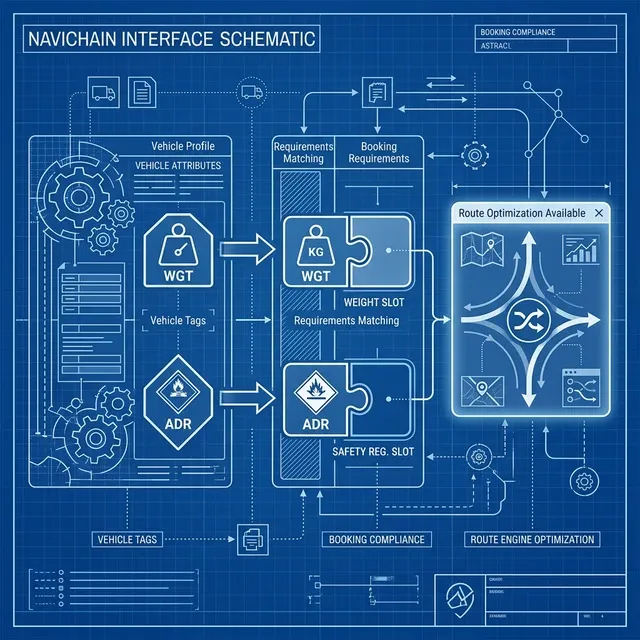
This is not a simple add-on map tool or a generic consumer navigation app. It is a fundamental enhancement of how Navichain understands your assets and performs dynamic changes in live runs. Dispatchers can now assign very specific properties to their vehicles – such as maximum gross weight, axle load, total height, fuel type, and ADR certifications. Crucially, they can mirror the exact requirements of incoming transport bookings.
When a booking requires tailgate lift and ADR Class 3 compliance, the system ensures that it can only be assigned to a matching vehicle. The intelligent engine acts as the ultimate matchmaker, effectively combining stops and calculating flawless routes on the fly, completely removing the burden of manual restriction control from the dispatcher's shoulders.
4. Technical Breakdown: How Intelligence Meets the Road
The core of this function is an elegant, structured data exchange between your operational inputs and our routing algorithm, designed specifically for dispatchers making dynamic changes to current runs.
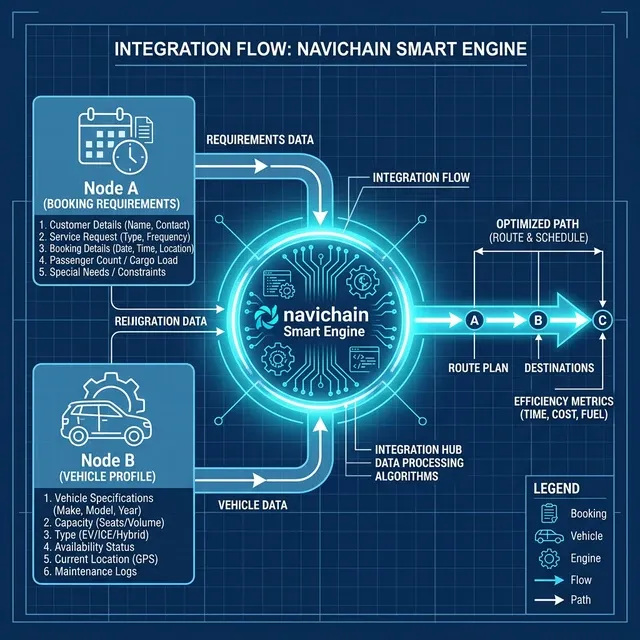
Step 1: Fleet & Booking Profiling In Navichain settings, you build digital twins of your fleet and attach specific parameters (e.g., 40t, Euro 6, ADR-certified). Conversely, when a customer places an order, the specific requirements for that load are registered in the booking (e.g., requires tailgate lift, ADR Class 3).
Step 2: Dynamic Assignment via Run Details The engine's true power is revealed when changing an active trip. From the main run network, a dispatcher opens the Edit Run details page. To accept a late order, they click Select Bookings, which opens a complete list of available, unassigned jobs.
Step 3: The Algorithmic Matching & Intelligent Merging When the dispatcher selects a new booking to add to the run, the Navichain engine immediately cross-references the new booking's requirements with the assigned vehicle's capacity. It queries the HERE routing network with these combined restrictions (weight, ADR, etc.).
Crucially, if the system detects an optimization opportunity – for example, if the pickup for the new booking is at the exact same address as an existing stop on the run – a Route Optimization Available window immediately pops up.
- The dispatcher clicks Merge.
- The system intelligently combines these tasks. The driver is directed to the address only once, instructed to handle both bookings simultaneously. This drastically reduces driving distance, eliminates redundant location visits, and keeps the route sequence perfectly clean.
The final calculated path is then locked, automatically avoiding low bridges, bypassing ADR-restricted tunnels, and preventing non-compliant vehicles from entering environmental zones.
5. The Data Argument: Fuel, Fines, and Margins
The commercial impact of Context-Aware Routing is immediate and measurable. In an industry where net margins are under constant pressure from high fuel costs and cutthroat competition, the return on investment for optimized routing is profound.
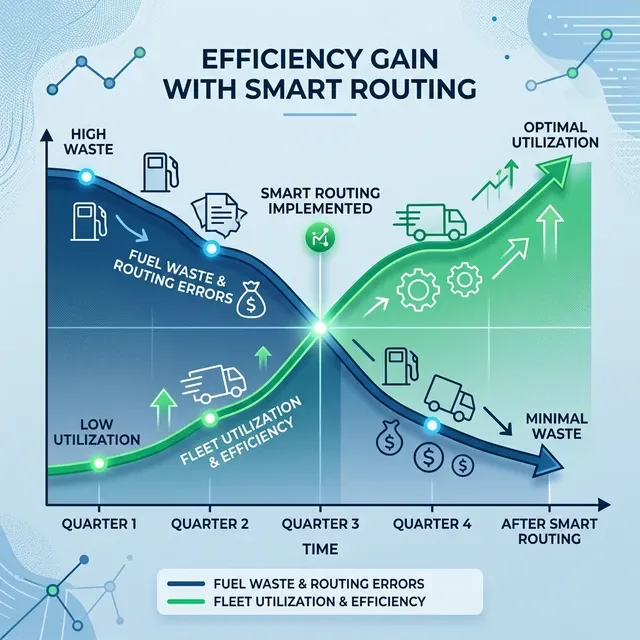
Elimination of Compliance Fines European fines for ADR route violations or weight limit breaches can be catastrophic, often wiping out the profit from hundreds of successful runs. Automated restriction matching reduces routine compliance errors to nearly zero, protecting your margins and driver licenses from unnecessary exposure.
Fuel Economy and Reduced Emissions By calculating routes based on actual dimensions and utilizing the Merge function for stops at the same location, unnecessary detours and redundant driving are eliminated. Fleets see a direct and significant reduction in fuel consumption per run, which translates directly to the bottom line while reducing the company's carbon footprint.
Dispatcher Speed and Reduced Stress Transport planners save hours previously spent manually checking route feasibility against truck specifications or manually restructuring complex stops. They can dynamically add late bookings to existing runs with total algorithmic certainty, allowing them to handle more vehicles with less stress and significantly higher accuracy.
6. The Navichain Difference: Sovereign Intelligence
Why use Navichain's routing over standalone consumer navigation applications? The answer lies in our unwavering commitment to Strategic Trust and data sovereignty.
Standalone routing tools often require you to export your customer schedules, pricing logic, and highly sensitive vehicle movements to third-party platforms. This exposes your business to fragmented data silos and potential vulnerabilities linked to the US Cloud Act, where your operational intelligence can be accessed by foreign entities.
By embedding the HERE routing engine, customized for enterprises, directly into Navichain's own hosting environment, your data never leaves the security of your sovereign European environment. It is a unified ecosystem, fully GDPR-compliant, and entirely under your control. You get the world's best routing intelligence without sacrificing ownership of your critical business data.

7. The Enabler for the SME Ecosystem: Conclusion
For European logistics SMEs, competing with multinational transport operators requires significant technological leverage. Context-Aware Smart Routing provides exactly that competitive edge.
It enables smaller teams to execute complex, heavily regulated transport tasks with the precision of a massive corporate transport department. By eliminating friction from route planning, automating intelligent merging of stops, and ensuring total compliance on every trip, you protect your margins, shield your drivers from dangerous situations, and accelerate your cash flow. You no longer guess the best route; you design it for absolute, uncompromising profitability.
References
- European Agreement concerning the International Carriage of Dangerous Goods by Road (ADR).
- HERE Routing API specifications & features for commercial vehicles.
Ready to optimize your supply chain?
Get full access to all white papers and experience our open AI models operated entirely in a self-hosted, sovereign infrastructure for maximum data integrity and local execution engine.
No credit card required • Navichain Sovereign Cloud Data Sovereignty