Drivers don't quit because their pay is too low. They quit because everyday life is too hard.
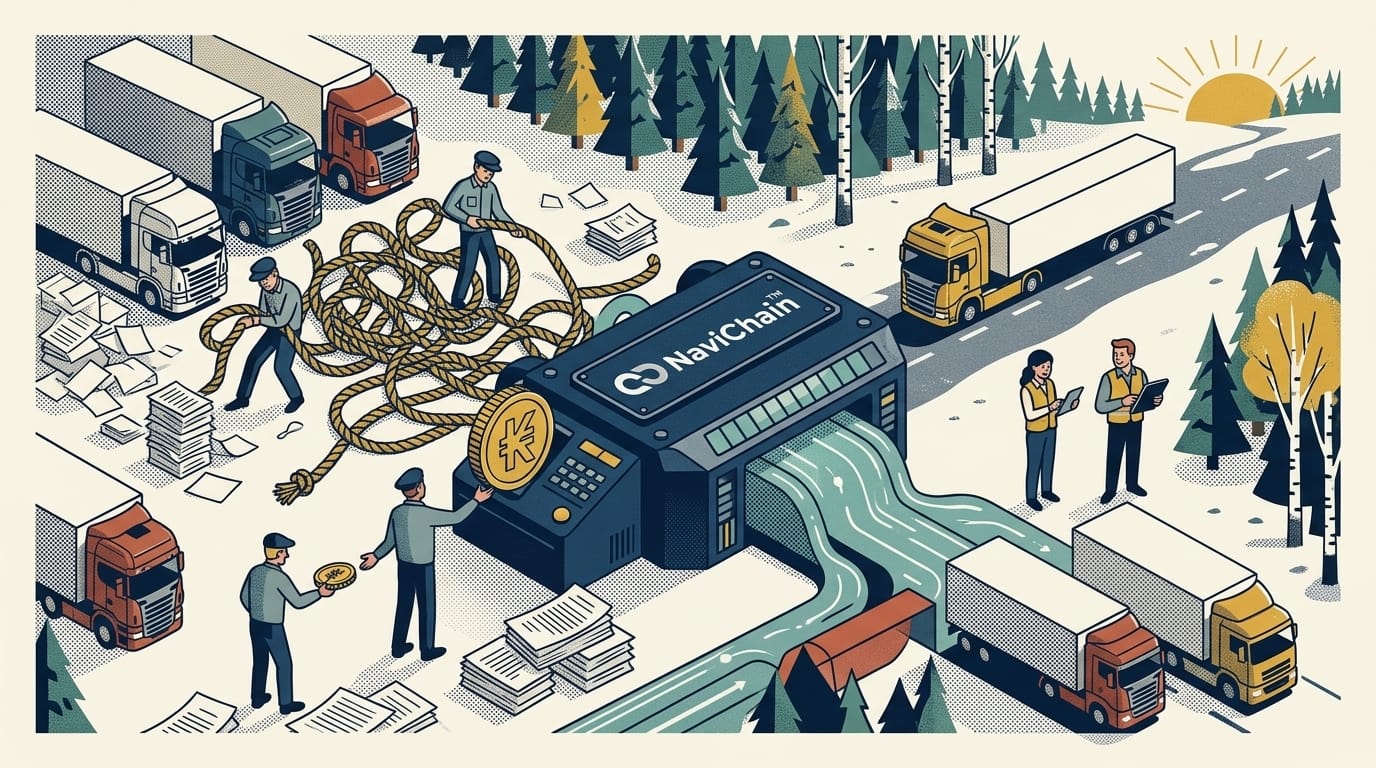
Your Best Recruitment Bonus
is a better system.
Europe is short of 200,000 truck drivers. The short answer is to raise wages. The real answer is to find out why they quit – and it's almost never about the money. It's about a day full of unnecessary friction. Navichain removes it.
Ask the transport manager at any medium-sized haulage company about their biggest challenge and the answer is almost always the same: we can't find drivers, and those we have quit too soon. The answer to that problem has long seemed obvious – pay more. And it works, short-term, to attract a new driver to sign the contract. But it doesn't solve the underlying problem. For every driver who quits and points to wages as the reason, there are at least three who quit for another reason, one they may not even put into words: a day full of unnecessary friction. Unclear instructions. Incorrect addresses. An app that crashes when you need it most. A feeling of working against the system rather than with it. That's what drives turnover in the industry – and that's exactly what Navichain is built to eliminate.
The Crisis No Wage Increase Solves
Source: IRU (International Road Transport Union) and industry analyses. The Navichain blog argues that wages are a secondary reason for turnover – the primary reason is operational friction.
The crucial insight, highlighted by Navichain's blog with research, is that drivers don't primarily quit because they've found a better-paying job. They quit because they're tired. Tired of receiving unclear instructions. Tired of calling the office because the address in the app doesn't match. Tired of handling paperwork alongside driving. Tired of being the last link in an information chain that ends with them without ever starting with them.
Wages are what bring a driver to the job on the first day. The system is what determines if they stay a year later.
The Seven Faces of Operational Friction
Seven frustrations that stack up every workday
- ✗Unclear assignments. The driver doesn't know exactly what needs to be loaded, in what order, with what special requirements. He calls the office. The office calls the warehouse. The answer takes time.
- ✗Incorrect or unclear addresses. The delivery address in the instructions doesn't match reality. There's no way to report it in a structured way and link it to the right order.
- ✗Paper-based waybills. The driver handles physical documents alongside driving. Documents get lost, disappear in the cabin, and cause invoicing disputes three weeks later.
- ✗Lack of receipt. Nothing confirms that the driver did the right thing. He doesn't know if the deviation he reported got through. He doesn't know if the waiting time was registered.
- ✗Multiple parallel apps. Order status in one app. Time reporting in another. Navigation in a third. Communication with the office via SMS. It's app fatigue manifested in a truck cabin.
- ✗Feeling of invisibility. The driver reports deviations and waiting times but never sees what happens with the information. It disappears into a black hole, and the feeling is that no one is listening.
- ✗Repeated administrative work. The same information is entered in three places. The delivery receipt is scanned, emailed, and manually entered at the office. The driver is part of a system that doesn't respect his time.
How a Day Looks – With and Without Navichain
The Cost of Losing a Driver – The One You Don't Account For
This means that if a haulage company with ten vehicles loses three drivers per year – a not uncommon figure – it costs 195,000–300,000 kronor in pure replacement costs, on top of the indirect consequences for quality and customer satisfaction. A subscription to Navichain for the entire fleet costs a fraction of a single turnover.
The Navichain App: The Driver's Best Work Tool
Everything the driver needs – goods, address, instructions, contact persons – is gathered in a single interface. No phone calls. No papers to handle.
Direct navigation to the correct address from the app. ETA is updated automatically and sent to the recipient and office without the driver doing anything.
The recipient signs on the phone. Paper handling is completely eliminated. The delivery receipt is in the system 30 seconds after the signature.
Deviation in the condition of the goods? Take a photo in the app. It is automatically linked to the right order and available to the office in real-time.
A button press starts and stops the waiting time measurement. The driver knows the information has been received and that the waiting time is actually billed.
The app works without mobile data. Everything synchronizes automatically when the connection is restored. No information is lost in dead zones.
The System as a Recruitment Tool – An Argument Rarely Used
The Navichain blog highlights a point that is underutilized in recruitment contexts: the TMS you run is part of your employer brand. A driver looking for a job and during the interview learns that the company uses a modern, seamless system – an app that provides clear assignments, digital signing, and no paper – takes the impression home.
In an industry with 200,000 vacant positions, the haulage company that offers the best everyday experience wins, not necessarily the highest wage. And a good system is a concrete, demonstrable proof that everyday life is better with you.
Give your drivers a tool they want to use. For free.
Navichain is free up to two users and about fifty bookings per month. The mobile app Navichain 365 for iOS and Android is included without extra cost – download it, run an assignment, and experience what a friction-free driver day actually means. No credit card. No commitment.
- Create a free account at navichain.se – takes less than two minutes
- Download Navichain 365 on iOS or Android – give your nearest driver access
- Run a real assignment: complete order information in the app, navigation to the address, digital signature at delivery
- Let the driver rate the experience themselves – and compare with how it was last week
- Calculate what halving turnover is worth for your business – and decide
Free up to 2 users · ~50 bookings/month · 199 kr/user/month for full functionality · Navichain 365 app always included · iOS & Android · Offline mode · Sign on glass · All data on Swedish servers · No commitment
Drivers don't quit because wages are too low. They quit because everyday life is too hard.
This is a distinction that deserves to be taken seriously. Every krona spent on recruitment bonuses and wage increases in a haulage company with high turnover is a short-term solution to a structural problem. The structural problem is that the driver's workday is unnecessarily hard – full of friction that a better system eliminates in a morning. Navichain is that system. And it costs 199 kronor per user per month. It's less than a tenth of what it costs to replace a driver who quit because his work tools didn't work.
Read More on Navichain
- Why Navichain is the Right Choice for Your Business
- Digital Transformation in the Freight Industry: What Does It Mean?
- Visual Route Planning with Drag-and-Drop: Plan with Your Eyes!
- EU 15,000 for a Single Trip Too Much? Automatic Cabotage Monitoring with Navichain
- Google Maps Doesn't Know the Bridge is 3.6 Meters - Navichain x HERE Maps Truck Navigation