Beyond the invoice: The real cost of operational friction and lost
🇬🇧 Read this article in English
Introduction: The Bottleneck That Drains Cash Flow
For most small and medium-sized enterprises (SMEs) in Scandinavian logistics, customer invoicing is a source of constant administrative problems. It is a time-consuming process, filled with manual checks, reconciliation against transport documents, and adjustments for fuel surcharges, waiting times, and other variables. Industry studies show that this administration can take up to 20% of the time for a small haulage company owner or traffic manager. But this immediate time cost, however frustrating it may be, hides a much larger, more strategic problem.
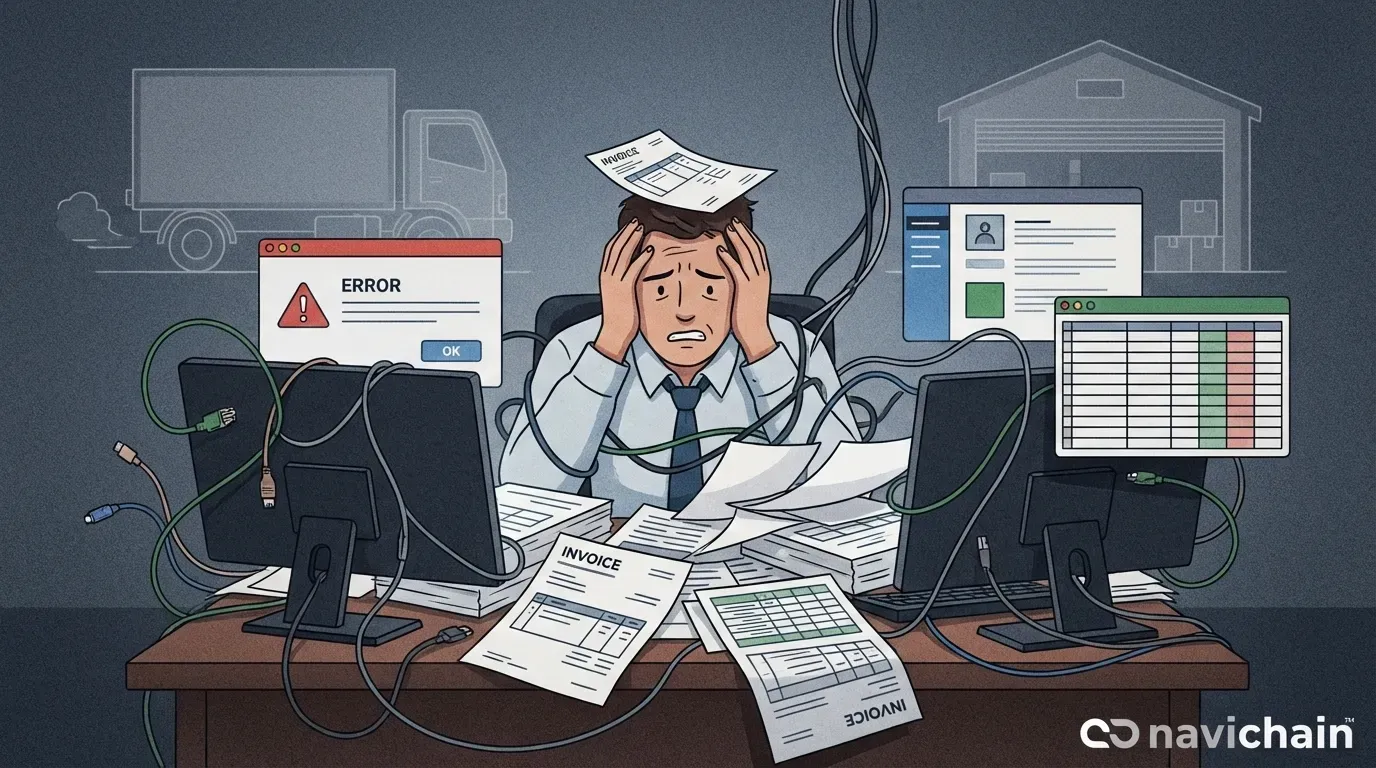
A visual representation of the frustration and economic challenges that inefficient invoicing can cause for transport companies.
The real cost of inefficient invoicing is not the lost working hours, but the drained cash flow and the loss of strategic control. *Illustration of a company struggling with inefficient invoicing, leading to financial problems.
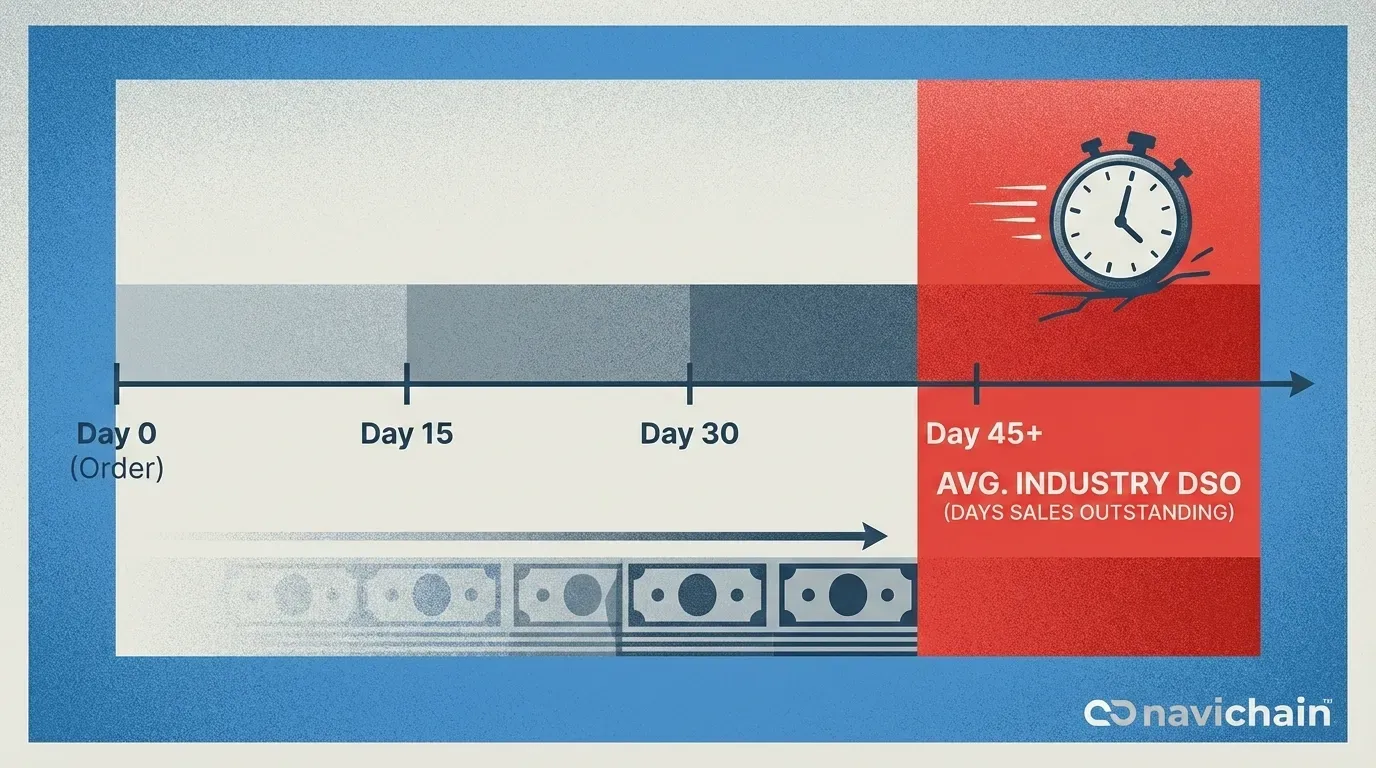
When the process from a completed job to a sent invoice (the "Order-to-Cash" or O2C cycle) is slow and filled with friction, your average customer receivables (Days Sales Outstanding, DSO) are extended. Within the European transport sector, an average DSO often lies between 40 and 60 days. Every day an invoice is delayed due to administrative bottlenecks is a day your working capital is tied up with the customer instead of working in your company. This white paper argues that inefficient invoicing is not an administrative problem to be handled, but a strategic failure signaling that your company's core processes are disconnected. We will analyze how data silos are the real root cause and present a framework for building a friction-free O2C model that not only frees up time but also cash flow and – most importantly – business-critical insight.
Deconstruction of the Problem: Friction, Errors, and Lost Insight
Why is logistics invoicing so notoriously complex? Unlike selling a standardized product, a logistics service is a complex collection of events, variables, and agreements. The final invoice must correctly reflect:
- Transport Data: Miles driven, zones, number of stops.
- Warehouse Data: Picked and packed units, storage time.
- Contract Data: Specific customer prices, discounts.
- Variable Surcharges: Fuel surcharges, congestion charges, waiting times, tolls.
- Proof of Delivery (POD): Signed delivery confirmations. For most SMEs, these data are in completely separate systems. The traffic manager works in a Transport Management System (TMS).
Warehouse staff use a Warehouse Management System (WMS) or handheld scanners. Orders and customer agreements are in a separate Order Management System (OMS) or even Excel. Finally, invoicing is done in a standalone accounting system.
Root Cause: The Digital Disconnect
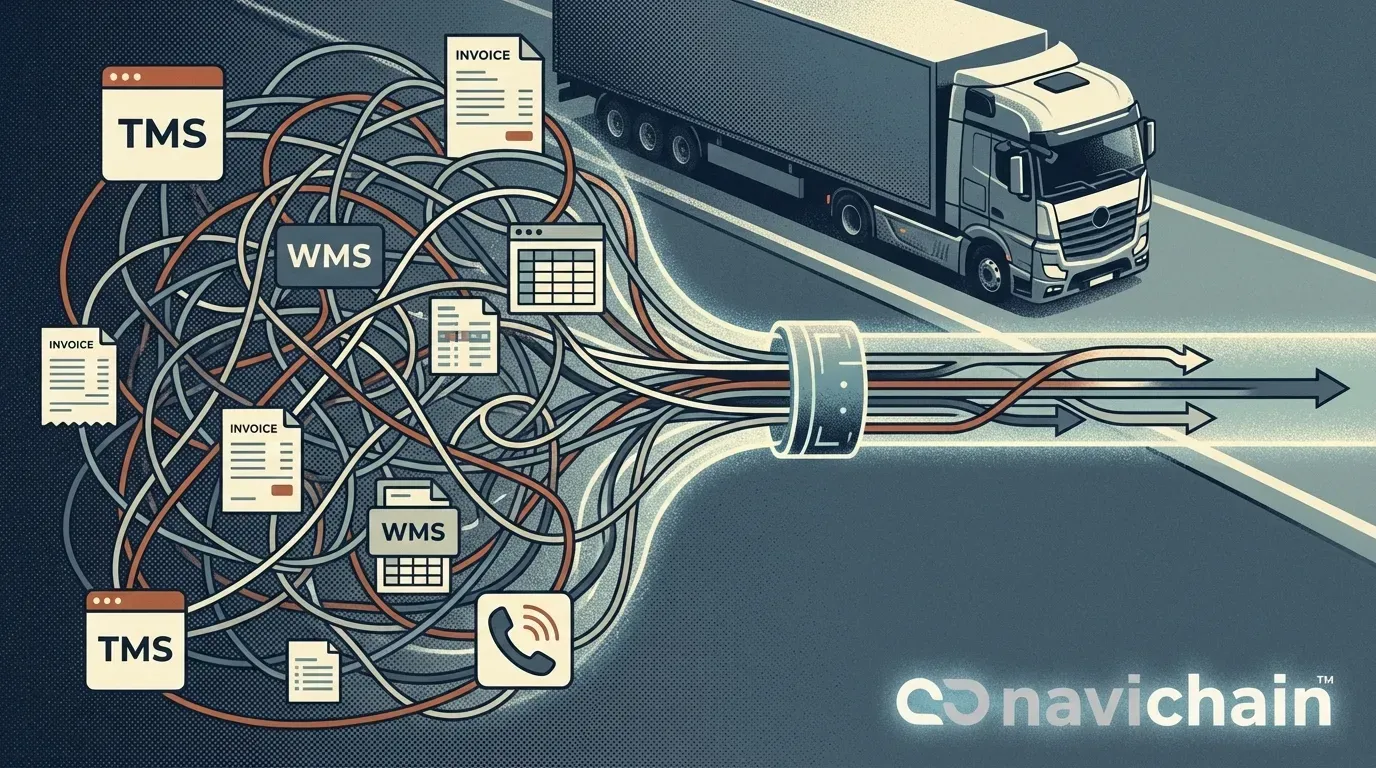
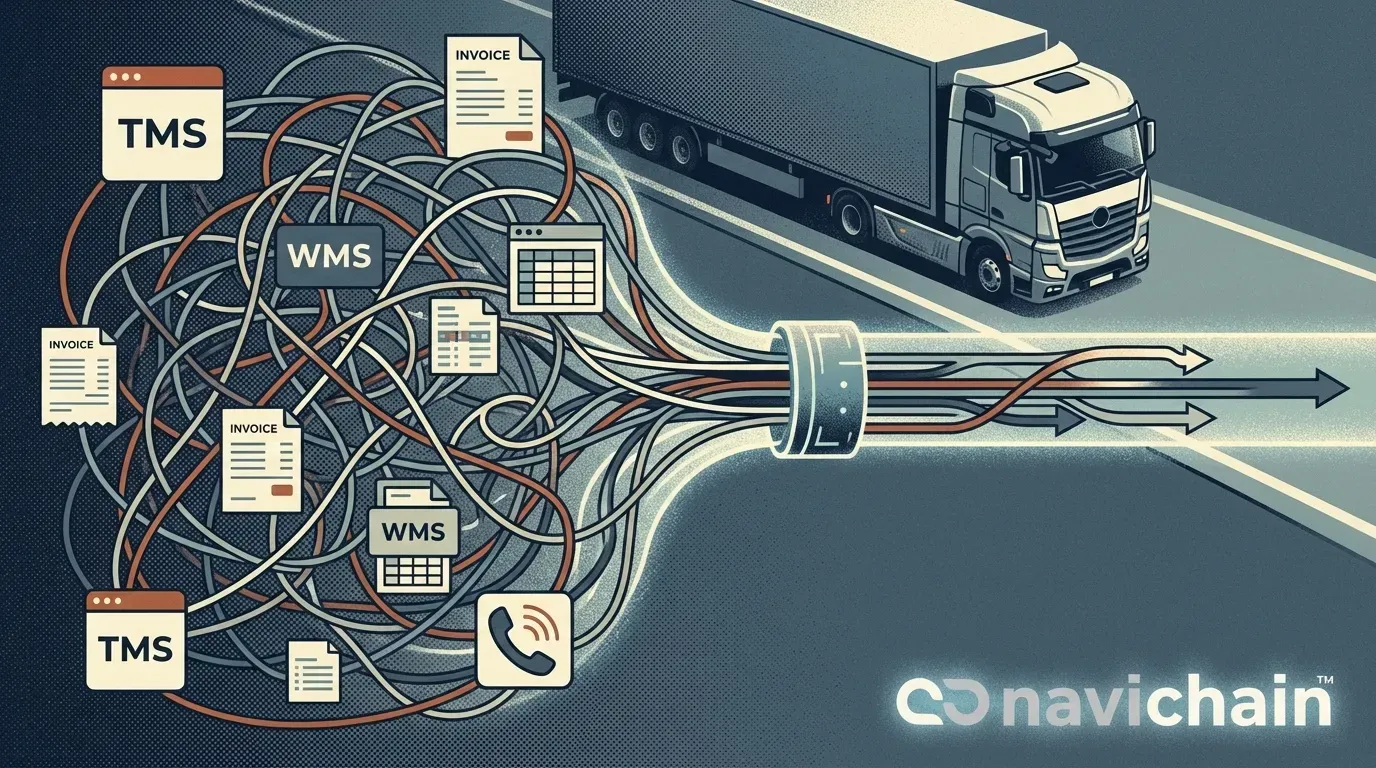
The problem arises in the "digital disconnect" between these systems. An administrator must manually collect data from TMS (e.g., driver logs and surcharges) and POD, match this against order data, and then input everything into the accounting system to create the invoice.
This manual "copy-paste" work is not only time-consuming; it is an extremely error-prone process.
Figure 1: Why is logistics invoicing so notoriously complex?
- Operational Friction: Every manual handover is a bottleneck. A missing POD or an unclear note about waiting time stops the entire process, requiring the administrator to chase information from drivers or traffic managers.
- Invoicing Errors and Disputes: An incorrect entry – wrong price, a missed surcharge – inevitably leads to an incorrect invoice. This results in customer disputes, time-consuming investigations, and the issuance of credit notes. Every credit note is a double loss: the administrative cost of correction and the delayed payment.
- Lost Strategic Insight: This is the most dangerous consequence. When your data is fragmented, it is almost impossible to answer the most important question of all: Which customers and which routes are actually profitable? You may know what you invoiced a customer, but without a unified data model, you do not know your actual cost to serve that customer (including all administration, waiting times, and fuel). You are flying blind, and the time-consuming invoicing process is the warning light you have ignored.
The Way Forward: The Friction-Free Order-to-Cash Model
Solving this problem is not about hiring more administrators or buying "faster" invoicing programs.
The diagram illustrates how operational friction and manual processes contribute to complexity and costs in logistics invoicing.
It is about eliminating the underlying friction by redesigning your information flow. The goal is to move from a fragmented landscape to a single, unbroken chain from order to payment. This model is built on three fundamental steps.
Fig 2: To successfully implement the friction-free Order-to-Cash model, it is not enough to just connect existing systems.
Step 1: Establish a Single Source of Operational Truth
You cannot automate chaos. The first step is to consolidate your core data. Instead of having TMS, WMS, order management, and invoicing as separate islands, they must function as parts of a unified operating system. In this framework, an order is registered once.
Illustration of a consolidated data source that is enriched throughout the order's lifecycle.
This single order entry then becomes the central entity that is enriched with data throughout its lifecycle.
- The traffic manager adds transport data (route, vehicle) to the order.
- The warehouse worker adds picking data (pallets, weight) to the order.
- The driver attaches a digital POD to the order. When all data is in the same system, the need for manual reconciliation is eliminated. The information is already validated and complete.
Step 2: Automate Validation and Pricing
Once you have a single source of truth, you can start automating. The next step is to build your business logic directly into the system. This means creating automated rules based on your customer agreements.
- Automated Pricing: The system should automatically calculate the price based on order data. If a customer's agreement states "Price X per km + Y% fuel surcharge + Z SEK for waiting time over 15 min," the system should be able to pull these data from the order (which has been fed by TMS and driver app) and generate a correct invoicing basis without human involvement.
- Automated Validation: The system can flag exceptions instead of requiring manual review of everything. For example: "Automatically approve for invoicing all orders where POD matches the order. Flag only orders where weight or pallet count deviates." This shifts your team from being data entry personnel to exception handlers, dramatically increasing efficiency.
Step 3: From Transactional Efficiency to Strategic Insight
This is the transformative step. When all your operational data – from order creation to transport cost to invoice – is in a unified system, you have suddenly created something invaluable: a data model of your profitability. The time previously spent on manual administration can now be spent on strategic analysis. You can immediately answer questions such as: * What is our exact profit margin per customer, per route, or per vehicle?
- Which customers cause the most administrative work and invoicing errors?
- Where do the waiting times we fail to invoice for occur? At this stage, invoicing ceases to be an administrative cost center and becomes instead the end product of an efficient process and a source of strategic insight. You can make data-driven decisions about pricing, customer relationships, and operational optimization.
From Diagnosis to Design: The Blueprint for a Resilient Logistics Operational System
To successfully implement the friction-free Order-to-Cash model, it is not enough to just connect existing systems.
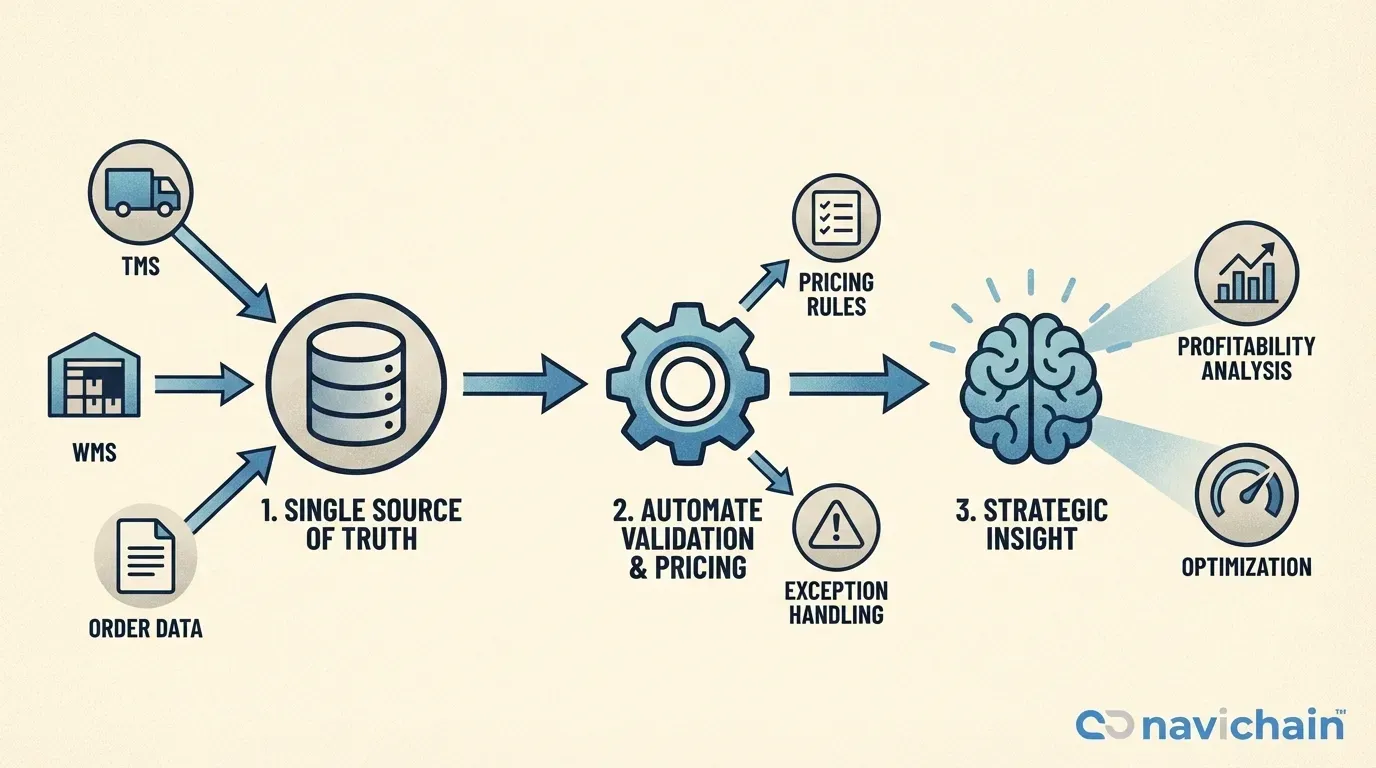
Schematic overview of how a friction-free Order-to-Cash model integrates various logistics functions into a unified operational structure.
European SMEs in logistics, especially in Scandinavia, operate under unique pressures of high costs, intense competition, and strict regulatory requirements (such as GDPR).
Building a truly resilient and efficient business requires that your technical foundation is built on three core principles.
Principle 1: A Unified Operational Structure
Stop thinking in terms of separate "modules" (TMS, WMS, Invoicing). The platform of the future is a single, unified operational structure – a central nervous system for your business. Data must flow frictionlessly from the moment an order is created to the moment it is delivered, invoiced, and paid. This unified architecture is the absolute prerequisite for eliminating data silos, reducing manual work, and enabling the automation described in step 2 of the framework.
Principle 2: Secure Data Architecture and Control
For European and Swedish SMEs, data control is not a bonus; it is a strategic necessity. Relying on platforms whose infrastructure is spread globally, especially outside the EU, involves significant and often underestimated risk. The complexity of international data transfers and GDPR compliance is an administrative and legal burden. A resilient architecture requires that your operational data – your most sensitive asset – is stored and processed within your own jurisdiction (e.g., within Sweden/EU). This is best achieved through a secure, self-hosted infrastructure that gives you full control and sovereignty over your own information. It dramatically simplifies GDPR compliance and isolates you from geopolitical data insecurity.
Principle 3: Embedded Analytical Intelligence
Data is only valuable if you can act on it. In a landscape of unified data (Principle 1) that is fully secure and under your control (Principle 2), a unique opportunity arises.
The next principle is to have a layer of embedded, proprietary intelligence (Integrated AI) that can work with your secure data. This is not about generic AI tools. It is about a secure, specialized AI that can analyze your unique operational patterns to identify profit leakage, optimize routes based on real data, and predict cash flow challenges. This intelligence must function within your secure environment, so your trade secrets never leave your control.
References/Sources
- IRU (International Road Transport Union). (2023). Global Driver Shortage Report 2023. (Used to highlight the extreme operational cost pressures on the sector). https://www.iru.org/resources/iru-library/global-driver-shortage-report-2023
- Ti Insight (Transport Intelligence). (2024). European Road Freight Transport 2024. (Used for market context, cost pressures, and digitalization needs in Europe). https://ti-insight.com/report/european-road-freight-transport-2024/
- McKinsey & Company. (2022). McKinsey on Payments: The future of order-to-cash. (Used to support the strategic benefits of optimizing the O2C cycle). https://www.mckinsey.com/industries/financial-services/our-insights/mckinsey-on-payments-the-future-of-order-to-cash
- Transportnet. (2023). Digitalization the Key for Haulage Companies. (Swedish source, used for local context on the need for digitalization to handle administration and profitability). https://www.transportnet.se/article/view/1041130/digitalisering_nyckeln_for_akerierna
Enabling the Blueprint: Navichain SaaS Unified Logistics Platform
The strategic blueprint described in this white paper – built on a unified structure, secure data control, and embedded intelligence – may seem complex to achieve. Navichain SaaS was designed from the ground up to embody these exact three principles for SME logistics companies.
Fig 5: Navichain SaaS was designed from the ground up to embody these exact three principles for SME logistics companies.
- Unified Operational Structure (Principle 1): Navichain is not a collection of modules; it is a single, unified logistics operating system. We break down silos by seamlessly integrating Transportation Management (TMS), Warehouse Management (WMS), Order Management, and Billing Management into one platform. When an order is completed in TMS, the invoicing basis is immediately and automatically ready, based on a single source of truth.
- Secure Data Architecture and Control (Principle 2): This is our most important differentiator. The entire Navichain platform is hosted on our own secure, self-hosted infrastructure in Sweden. For our customers, this means maximum data security and control. By keeping all data strictly within Swedish/EU jurisdiction, we ensure simple and robust GDPR compliance, freeing our customers from the risks of international data transfers.
- Embedded Analytical Intelligence (Principle 3): Because your data is both unified and secure, our integrated AI can work directly with your operational data within our secure Swedish infrastructure. This allows you to perform deep, secure analysis to unlock unique efficiency – from analyzing customer profitability to optimizing routes – without your sensitive business data ever leaving your control. Our mission is to democratize logistics technology and give SMEs the powerful, integrated tools they need not just to survive, but to thrive.
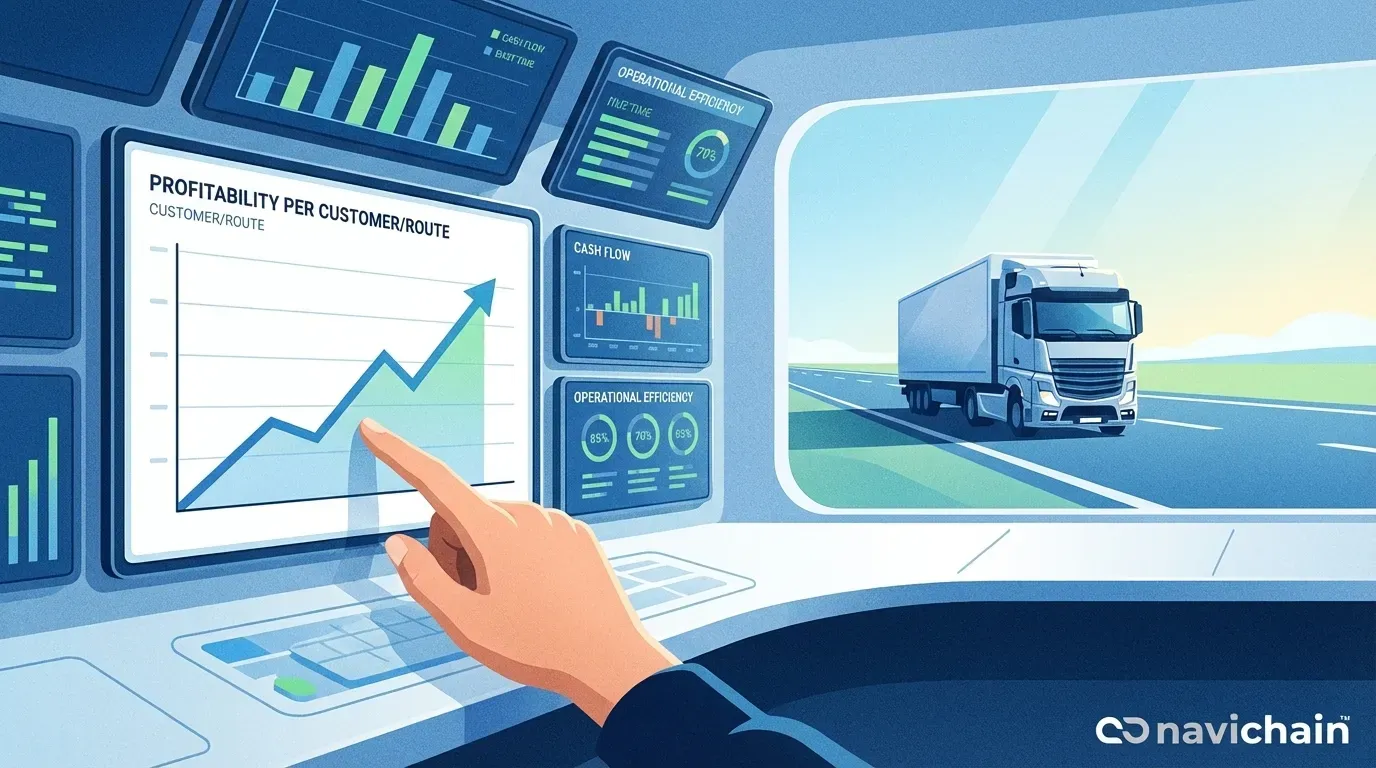
Navichain enables unity, security, and intelligence in logistics operations, providing SMEs with powerful tools to optimize their business.
We handle the technical complexity so you can focus on what you do best: moving your business forward.
Illustration of a company experiencing improved cash flow and strategic control thanks to efficient invoicing.
The Navichain platform visualized, illustrating its role in providing companies with increased control and insight into their logistics data. The secure, Sweden-based infrastructure enables data-driven optimization and improved cash flow.

The Navichain platform visualized, illustrating its secure and data-driven solution for logistics management. The Sweden-based infrastructure enables oversight and control of business data.