Stop Paying for Parked Trucks: Agile SaaS Pricing and EU Data Sovereignty
Cross-language link: Läs på svenska
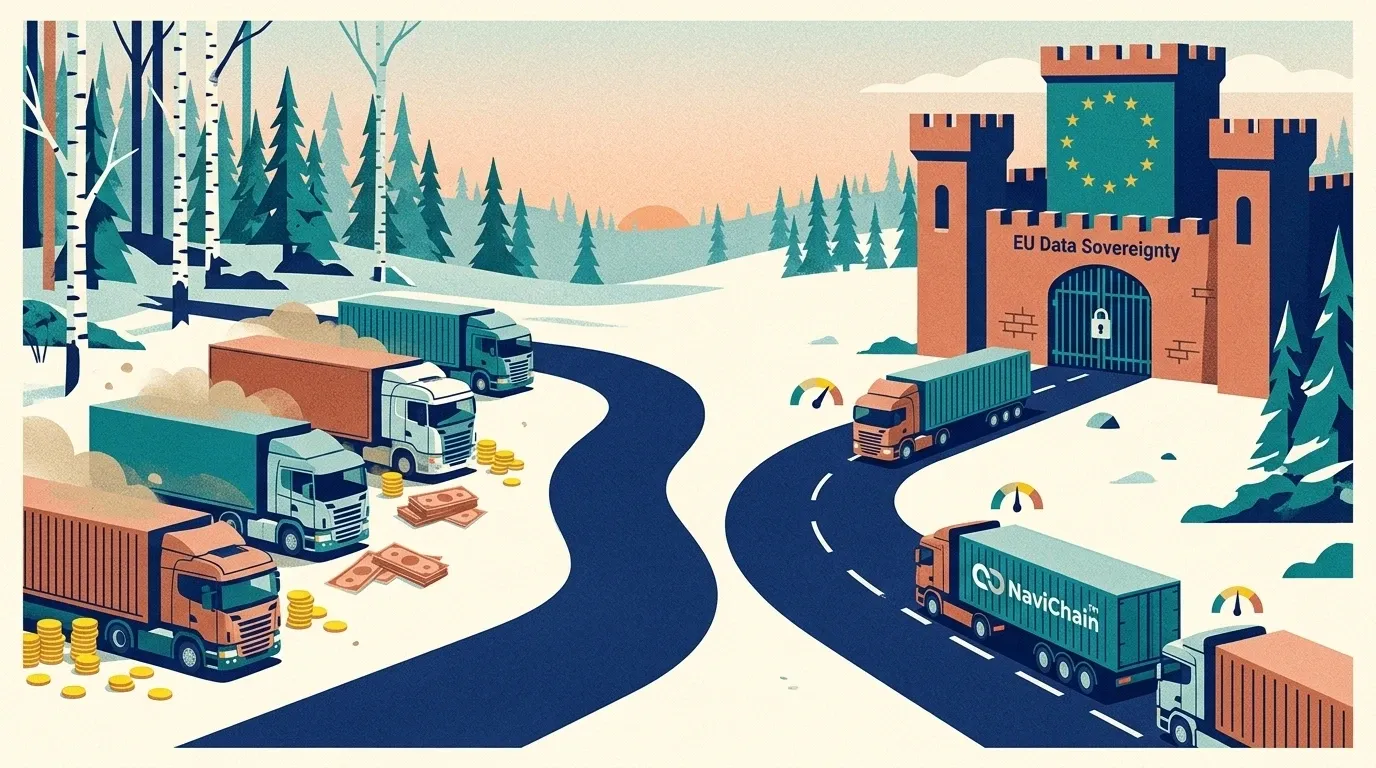
European logistics SMEs are constantly pressured by tight margins and complex compliance laws. Yet, legacy transport software forces companies into rigid annual contracts, draining capital for unused licences when trucks sit idle. Navichain breaks this cycle. We offer a true 24-hour rolling subscription—meaning you only pay for exactly what you use. Combined with our guarantee of 100% EU-hosted Sovereign AI infrastructure to bypass Cloud Act vulnerabilities, Navichain delivers unmatched cost control and GDPR compliance.
Key Takeaways / Executive Summary
- Evade Financial Lock-In: A rolling 24-hour pricing threshold ensures a logistics business only ever pays for immediate user capacity—rendering unused software licenses obsolete.
- Abolish CapEx Drain: Scale fluidly during high volume seasons without locking your future liquidity into punishing multi-year agreements spanning beyond peak needs.
- The European Data Shield: Reject tools that expose your proprietary supply chain paths to the extra-territorial US Cloud Act; keep your core operational metrics legally sealed under strict EU hosting infrastructures.
- Adopt Immediate Agility: Trial the ecosystem entirely risk-free with a non-expiring Free Starter Tier restricted to 2 active operational users.
Why is Idle Capacity Creating a Hidden Tax on Your Resources?
In the asset-heavy world of European logistics, demand is inherently cyclical. Trucks require maintenance, drivers take statutory leave, and seasonal volumes fluctuate wildly. When a vehicle sits idle in the depot, it generates zero revenue. Yet, the traditional enterprise software industry operates in a parallel universe where your overheads remain entirely static, regardless of your operational reality.

Legacy transport management software routinely forces SMEs into rigid, expensive annual licensing agreements. This 'vendor lock-in' acts as a severe financial anchor. You are compelled to forecast your maximum possible software capacity for the year and pay for it upfront. The result? You bleed capital paying for "shelf-ware"—digital licences that sit unused for days, weeks, or months at a time.
Furthermore, European SMEs face an increasingly hostile regulatory landscape. Deploying a US-backed software platform often exposes your sensitive customer and transport data to the extra-territorial reach of the US Cloud Act, creating a direct conflict with European GDPR mandates. For the modern CEO or COO, traditional SaaS presents two unacceptable risks: capital inefficiency and compliance vulnerability.
How Does the Shift to Software as a Utility Affect Growth?
To achieve genuine Operational Excellence, leadership teams must completely rethink how digital infrastructure is provisioned. We must stop viewing logistics software as a bloated, fixed Operational Expenditure (OpEx) or Capital Expenditure (CapEx), and begin treating it as a dynamic, consumable utility.
What is Software as a Utility (Utility Computing)? This refers to the provisioning and billing of IT services on a strictly metered, pay-per-use basis, similar to traditional utilities like electricity and water, directly aligning tech costs to variable consumption.
Consider the physical assets in your fleet. You do not pay a flat annual rate for diesel regardless of how many kilometres you drive; you pay at the pump for the exact volume of fuel consumed to execute a specific route. Enterprise software must adopt this exact same economic logic.
By transitioning from inflexible annual commitments to a hyper-agile, usage-based model, transport managers and business leaders can instantly align their overhead costs directly with their active revenue generation. This conceptual shift transforms software from a financial burden into an agile lever, ensuring that your costs scale back automatically the moment your trucks stop moving.
How Does the Navichain 24-Hour Rolling Subscription Eradicate Friction?
Navichain was built to break the legacy vendor lock-in. We have engineered a unified operating system designed explicitly for the financial and regulatory realities of the European SME. Today, we are introducing a paradigm shift in software procurement: The Navichain 24-Hour Rolling Subscription, fortified by absolute EU Data Sovereignty.
We have entirely eliminated the annual contract. Instead, Navichain operates on a strictly rolling 24-hour basis. You are only billed for the exact users who actively engage with the system on any given day. At the end of the month, your invoice is a perfect reflection of your actual operational output.
How Does Fluid Scalability Actually Work on the Backend?
Delivering this level of financial agility requires a sophisticated, transparent backend architecture. The mechanics of this feature are completely invisible to the end-user and require zero administrative overhead, but the financial impact is profound.

- Dynamic Telemetry: The Navichain platform continuously monitors active user sessions without requiring manual audits. When a dispatcher assigns a booking or a driver logs a Proof of Delivery (POD), that specific 24-hour block is activated.
- Automated Reconciliation: At midnight (CET), the system takes a daily snapshot. If a registered user did not log in during that 24-hour window, they are simply omitted from the daily billing ledger.
- Frictionless Scalability: During peak seasons, you can provision new accounts instantly. The moment the season ends and those temporary users log out, the billing ceases. There are no penalty clauses and no complex contract downgrades to negotiate.

Simultaneously, the technical foundation of Navichain guarantees uncompromising security. All data flows are routed exclusively through our self-hosted, sovereign infrastructure. From the moment a transport booking is entered to the final generation of a legal CMR document, the data remains strictly within the borders of the European Union.
In What Ways Can We Reclaim Working Capital via the Data Argument?
When we transition from abstract strategic concepts to hard fiscal data, the return on investment (ROI) of agile billing becomes undeniable.

Internal modelling and industry analyses across mid-sized European transport firms reveal a stark reality: a significant percentage of paid software licences in traditional enterprise contracts go completely unused annually. This waste is generated by a combination of natural driver turnover, statutory holidays, weekend downtime, sickness, and inevitable seasonal volume lulls.
By adopting Navichain's rolling 24-hour model, this financial bleed is instantly and permanently neutralised. If a regional logistics provider traditionally spends a fixed amount annually on a legacy Transport Management System (TMS), recovering capital from unused days provides immediate, tangible liquidity. This is capital that can be directly reallocated towards critical strategic initiatives: fleet decarbonisation, aggressive driver retention programmes, or expanding into new European corridors.
Why is Strategic Trust and the European Shield Crucial for Expansion?
Agile pricing is our uncompromising commitment to your profitability; our self-hosted infrastructure is our uncompromising commitment to your security. This dual mandate is the essence of what we call 'Strategic Trust'.
While competing platforms may attempt to offer superficially flexible pricing tiers, they remain fundamentally compromised by their underlying technical architecture. The vast majority of legacy logistics platforms rely heavily on foreign hyperscalers. This reliance creates an inescapable legal vulnerability under the US Cloud Act, which grants foreign law enforcement the authority to subpoena data stored on these servers, regardless of where those servers are physically located.
For a European logistics company transporting high-value goods or managing proprietary supply chain data, this is an unacceptable risk. Navichain refuses to compromise on this front. We guarantee that your company's proprietary data is hosted 100% on sovereign European servers utilizing Sovereign AI principles. We act as a digital fortress, allowing your compliance officers and board of directors to operate with absolute peace of mind.
How Do We Empower the Operational SME Ecosystem?
True Operational Excellence means deploying the best technology; Strategic Trust means deploying it without compromising your bottom line or your legal standing.

Navichain is designed to be the definitive operating system for asset-heavy SMEs who refuse to be constrained by outdated vendor tactics. We believe in our model so implicitly that we do not require you to take a blind financial leap.
To allow management teams to evaluate this ecosystem at their own pace, Navichain currently offers a fully functional Starter tier, completely free of charge for up to 2 users. This provides your management team the perfect, risk-free environment to map out workflows, run live transports, and experience the agility of the platform without spending a single Euro.
Stop subsidising legacy software vendors. Protect your margins. Secure your data. Reclaim your agility with Navichain today.
Sources and Recommended Deep Dives
- European Commission (2025): General Data Protection Regulation (GDPR) and Supply Chain Compliance.
- International Chamber of Commerce (2024): The Impact of the US Cloud Act on European Data Sovereignty.
About the Author
Manusha (Integration & Automation Specialist)
Eliminating operational silos and unifying analog haulage logic into powerful software architectures. Emphasising Sovereign AI logic, Manusha protects independent transportation margins through automated digitalization. Learn more at navichain.se.